By:Kaylyn Hlavaty
Beginning on October 15th, Muslims around the world gathered at mosques for dawn prayers to celebrate one of Islam’s most sacred holidays, Eid al -Adha. The holiday marks the end of the hajj, the pilgrimage made by Muslims during to the Mecca in Saudi Arabia.
Beginning on October 15th, Muslims around the world gathered at mosques for dawn prayers to celebrate one of Islam’s most sacred holidays, Eid al -Adha. The holiday marks the end of the hajj, the pilgrimage made by Muslims during to the Mecca in Saudi Arabia.
The Eid al -Adha,
the feast of sacrifice, commemorates the willingness of the prophet Ibrahim to sacrifice
his first-born son Ishmael as an act of submission and dedication to Allah’s
request and his son’s willingness to be sacrificed. In the Quran, as Ibrahim is
about to sacrifice his son, he hears a voice from heaven that stops him and
allows him to sacrifice a sheep instead.
Every year
during Eid al -Adha, Muslims slaughter sheep, camels and cows to symbolize the sacrifice
Ibrahim was willing to make for God. At dawn, men, women and children go the
mosque to pray. Following prayer, families go to the cemetery to honor the
loved ones lost.
 |
| Inside the Al-Amin mosque. photo taken by Kaylyn Hlavaty |
As a journalist
and foreigner, I wanted to witness the traditions and hear the meanings of this
holiday. Around 7 a.m., I made my way to the Mohammad Al-Amin mosque in
downtown Beirut. I wanted to begin my observance of this holiday with the first
tradition of the day: going to the mosque. After I took my shoes off and I covered
from head to toe, I went upstairs to the women’s praying area.
The women were sitting in groups, some with children waiting for the morning prayer to start and others already praying. Not knowing where to sit, I slowly made my way over to a group of women talking. I introduced myself and I started to ask them questions about what Eid means to them. Since none of the women spoke English, we used our facial expressions and body language to communicate. Since we couldn’t understand each other when we spoke, we used facial expression and handshakes to show understanding and respect.
The women were sitting in groups, some with children waiting for the morning prayer to start and others already praying. Not knowing where to sit, I slowly made my way over to a group of women talking. I introduced myself and I started to ask them questions about what Eid means to them. Since none of the women spoke English, we used our facial expressions and body language to communicate. Since we couldn’t understand each other when we spoke, we used facial expression and handshakes to show understanding and respect.
 |
The burial of the late Abdalah Hasbalah |
Eid is very
special holiday for her and her family, like it is for many Muslims because
it’s a time to spend with family and a day to be joyous. Once we got to the cemetery, she
explained to me that her father had died four months ago.
“It’s still very hard for me and my family. We are all very close and when you lose someone so close to a holiday that means a lot to us, it’s even more difficult,” said Amal.
 |
| Children selling flowers outside the cemetery |
As I walked inside
the burial grounds, I was told to put my camera away, so out of respect I did.
On the way her father’s resting place, there were many other families paying
their respect to the deceased. I was standing with the family watching Amal and
her sister read verses from the Qur’an. Once everyone started to cry, I started
to get emotional as well. I thought to myself, here I am with a family I have
only known for about thirty minutes and they were generous enough to invite me
to the cemetery during a intimate occasion. Also, they furthered the invitation
to spend an entire day with them. I felt honored to be in that moment and
witness this special moment. It’s not every day a journalist or an outsider for
that matter can experience Eid the way I did.
They invited me for Nescafe and as the avid coffee drinker I am, I immediately accepted the invitation. While Amal was preparing the coffee, her son Ahmad Bakri took me to see the slaughtering of the sheep. I was happy I could see the slaughter just down the street from their house. I was prepared to see quite a bit of blood because I come from a family of hunters so I’m used to this sort of process. According to tradition, the sheep were slaughtered in the front of the mosque. Women, children and men stood to witness the slaughter. There were three sheep already dead when I arrived, which left one sheep to follow the rest.
 |
| The slaughter in front of the mosque. Photo taken by Kaylyn Hlavaty |
Once I saw the slaughter of the final sheep, we headed to Ahmad’s house in Kornish al Mazraa where his sister, Nada, his father Farook, his brother Emel and his mother Amal all live. From the moment I walked in, I was given such warm hospitality. Once we drank coffee, I wanted to see more of the traditions that were taking place, especially the outreach to the poor. Ahmad took me to Ibad Al Rahman. It resembles a charitable center with an attached mosque. Throughout the year, this center provides prayer classes, medical and food assistance and on Eid, meat donations to the community and the poor. Throughout the holiday, there is approximately 3,600 sheep butchered and donated to the center.
 |
| Children witnessing the slaughter. Photo taken by Kaylyn Hlavaty |
A man carrying
several bags filled with lamb meat walked out of the donation center. I stopped
him to ask how Eid is important to him and if he could explain any special
traditions he had. His name was Mohamed Mogharbl. He came to the center because
a relative of his family donated a lamb to the center and he was picking some
up for his family, uncle and the rest he was going to give to the poor.
“I had to get a
card from the officials at the center so I could get permission to pick up the
meat. On the card it says the price of the sheep, the kind of sheep such as in
size and fat ratio and the name of the sheep dealer,” said Mogharbi.
When I asked him
how the center knows who is considered poor and ones who are there to pick up
the meat, he said there was a separate line for the poor people and the card
allows anyone to pick up the meat. On average, to donate a sheep, it costs
around $300 USD. As a general rule, the sheep has to be older than five months
and it should be in good health.
 |
| The butchers passing out the meat inside the center Photo taken by Kaylyn Hlavaty. |
Since part of
Eid is about giving to the less fortunate, Muslims make it a goal to donate
either money to someone they know or give the extra meat from the lamb to the
poor. When Mogharbi was a child, his father would give money to an older lady
down the street as part of celebration before Ramandan ending. Mogharibi
continues the tradition by giving money to the lady’s daughter.
“It’s very
important in our religion that we give when we can, especially during Ramadan
and during Eid because it’s these good deeds that we will be rewarded for,”
Mogharibi said.
In just my short
time walking around the neighborhood with Ahmad, I could feel the energy of
happiness and giving in the air. Children playing with snap rocks; aromatic
scents occupying the air and sightings of families walking the streets were
traits of holiday atmosphere.
 |
| People waiting in line for sheep meat. Photo taken by Kaylyn Hlavaty |
Once we arrived
back at Ahmad’s house, we had delicious dinner of rizz with lahmeh. It’s made
with rice, cashews and beef. There wasn’t a time that I wasn’t offered coffee
and tea and the frequent attention given to me. By the time dinner was done and
one of Amal’s sister left, it was already 4 p.m. I decided it was my time to head
back to Ashrafieh, which is only a ten-minute drive without the Beirut traffic.
As I left the house, I felt like I knew them for much longer than the eight
hours we spent together.
I was fortunate
to run into Amal at the mosque and for her to welcome a complete stranger into
her home and invite me to experience her holiday traditions. From the moment we
met, there was a language barrier, but it didn’t stop us from showing our true
expressions towards each other, which was respect and acceptance. Despite what
some may believe about the views Christians have towards Muslims and vice
versa, my experience today proved again that no matter the religion, beliefs or
social background, we can all find understanding and acceptance amongst one
another. Some say actions speak louder than words, and today they spoke loud with
kindness and generosity.
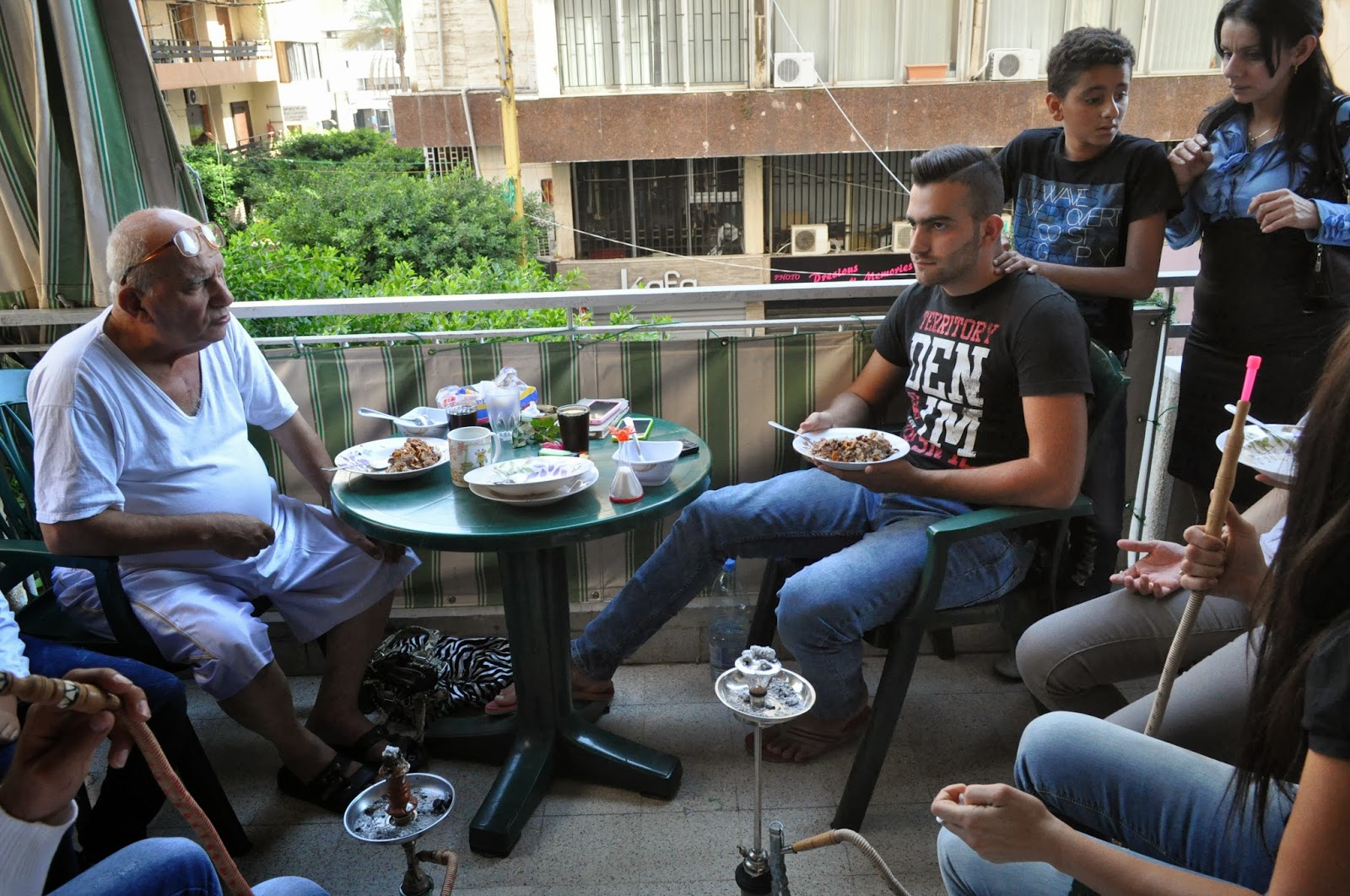 |
| Left: Farook Bakri and Emel Bakri at their home in Kornish al Mazraa Photo taken by Kaylyn Hlavaty |
No comments:
Post a Comment