By Nisha Garud
The full first week of the Study of the U.S. Institute(SUSI)
2014 on Journalism and Media saw an exchange of ideas among 18 scholars from 18
countries. As part of the online International Mass Media Class, scholars from
Lebanon, Kyrgyzstan, Hong Kong and Malawi gave lectures on the political and
media structures and journalism practices in their home countries.
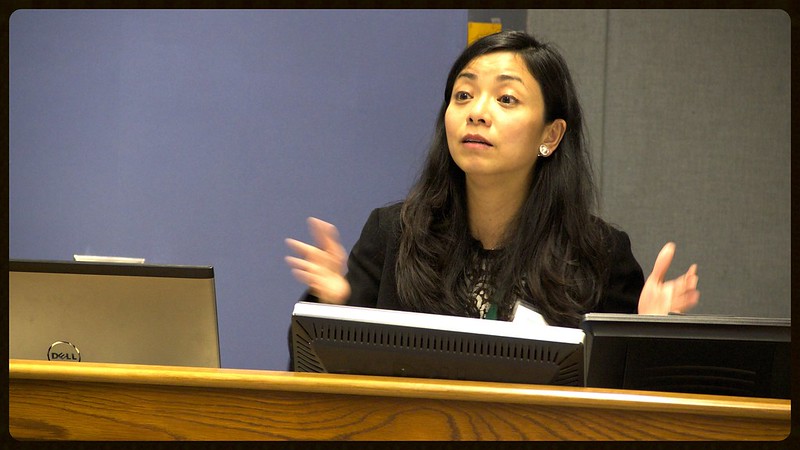 |
| Bonnie Chiu from Hong Kong |
Ellard Manjawira, a scholar from Malawi, explained how there
were two groups of untrained but experienced, and young but trained journalists
in his country because no journalism training was allowed in Malawi from 1964
to 1994. For a period of 30 years, there was only one newspaper for the whole
country. Today, newspapers are the major news media in Malawi and they are
largely private and independent. Comparing with other media, newspapers have
the widest reach in Malawi, he said. He said that online and social media were
growing but the access to technology was still limited to elites and in urban
areas.
The scholar from Lebanon, Mirna Abou Zeid, told the audience that administrative power is divided between three main sects in her country, which influences the media system and ownership. The president is always a Christian Maronite, the Prime Minister is always a Sunni Muslim and the speaker of the Parliament is a Shia Muslim, she said. While enlightening on the media in Lebanon, Mirna explained that there is a limit of 25 on newspaper licenses, out of which 11 licenses have to be given to Arabic newspapers. Political parties are not allowed to own media but it is still covertly controlled by the politicians. Newspapers engage in self-censorship, however, there is no distinction between facts and opinions.
Talking about the influence of Russia on the media in her country, Kyrgyzstani scholar, Nargiza Ryskulova, said that there are innumerable Russian channels which have helped form a pro-Russian opinion. Kyrgyzstan press is not free and is divided into two major languages: Russian and Kyrgyz. The media are in a transitional state in the country and Nargiza hopes that with new technology, it will soon move towards being liberal.
No comments:
Post a Comment