By Nisha Garud
Study of the U.S. Institute (SUSI) on Journalism and Media
2014 scholars Brenda Bukowa from Zambia and Merja Drake from Finland brought
the online International Mass Media class to a successful completion with
lectures on their countries media and political structures and journalistic
practices. The lectures were held at Copeland Hall on the Ohio University
campus in Athens on July 14, 2014.
 |
| Brenda Bukowa during the online International Mass Media Class in Copeland Hall. |
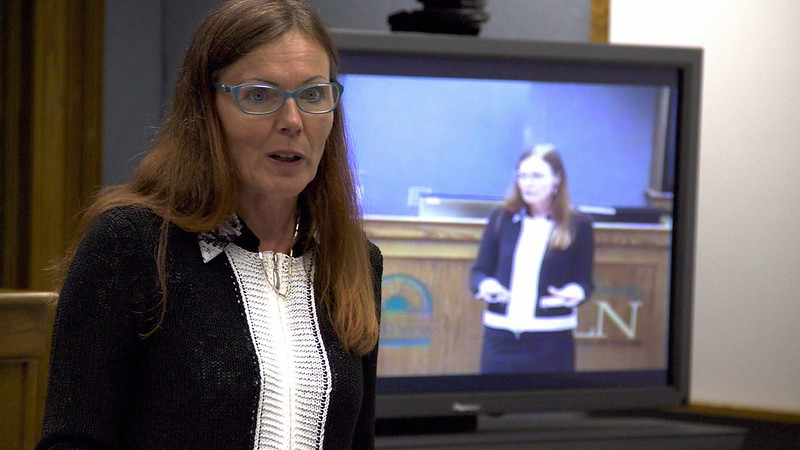 |
| Merja Drake speaks during the online International Mass Media class in Copeland Hall. |
Brenda said that her nations president determines media
policies, which keep changing every five years with a new president in power.
The media do not need licenses to start their business. New newspapers and TV
channels crop up every day and disappear without any notices. Some newspapers
are weekly but are published only monthly. Hundreds of newspapers are published
during the elections and die immediately. The media are not expected to
criticize the president, who gives no account of his whereabouts to the
citizens.
She explained that factors like political influence, censorship,
lack of finances and technology, low wages, lack of good journalism education
were killing the media in Zambia. She believes that a new constitution that
guarantees freedom of information, establishes Public Information Commission,
and defines its functions and provides for the right of access to information
will guarantee freedom the press.
Merja presented a small video about Finland to show the
audience its geographic beauty. Finland, which ranks first on the World Press
Freedom Index, is a bilingual country with a population of five million people.
Merja explained that the secret behind the countrys top ranking is that media
are not biased towards any political or social organization. The news reports
neatly present both the sides of the story, which at times, make the reports
look bland. If an individual is criticized in a news report, then he has the
right to replay i.e. to present his side of the story.
She added that every document is a public and very few
documents are classified as government secrets. All data are available on the
internet for the people. She informed the SUSI scholars and the online students
that the Finnish government had digitally archived every single paper right
from the beginning and they were welcome to access and archive for research.
No comments:
Post a Comment