Showing posts with label Extremism. Show all posts

Friday, October 26, 2012

Neo-Nazis in Germany

By: Chu Wu  
Produced & edited by: Molly Nocheck

When you see a man hidden behind a white mask, you may wish him to be the Phantom of the Opera. However, the reality is that he may be a Neo-Nazi in Germany.

On May 1 this year, hundreds of people marched at night, armed with torches, and hidden in black clothing and white masks in Bauzen, Germany. This group organized the event through text message and called themselves “Die Unsterblichen” (“The Immortals”). The organizers later uploaded the video onto YouTube, delivering the message: “Your short life, make it immortal.” The flash mob reminds people of the torch marching back to the days of Hitler and the Third Reich when the Nazis saluted their leader in this way.

Germany’s loss in WWII did not end Nazism as people may hope. Instead, Neo-Nazis carries on and is becoming a growing national problem in the spotlight.
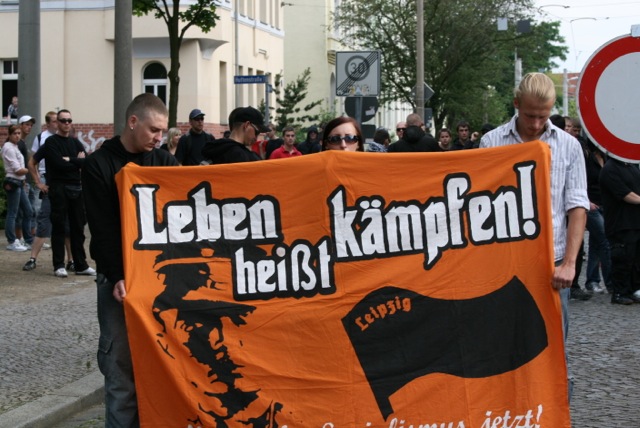
Courtesy of Klara Naumann. Academic Fair Use.
According to the statistics from Robert Grimm, a researcher at Manchester Metropolitan University of the MYPLACE project, as of 2011, there are 22,400 right-wing extremists in Germany among which 9,800 are violent or potentially violent. These people and the parties carry out political movements, demonstrations and hate crimes.

Police in Germany failed to prevent and investigate a series of murders by the National Socialist Underground, a far-right terror group. After the incident, the federal government of Germany promised to strengthen the fight with far-right extremism and enhance the democratic society. However, it’s tough. The problem is complex. Anti-Semitism, xenophobia, and opposing multiculturalism are the basic characteristics of the extreme-right parties.

Timm Kohler is the program manager in a Berlin-based organization dealing with human rights issues. He says the main focus of the extreme-right and the Neo-Nazi topics are placed on the east states, which used to be German Democratic Republic before the fall of the Berlin Wall.

He explains that when the states suffer from a poor economy and high unemployment rate, people tend to believe it is foreigners who take away the job opportunities. The activists, with this idea in mind, insulted and conducted crimes on foreigners, believing that they will attempt to hold possession of the Germans.

Mr. Fuerst is the political-economic specialist in the US Consulate of Leipzig, Saxony, “It’s just because there are few foreigners here, local people have no chance to know and meet foreigners. Thus, they become more afraid of them.”

Ethnic groups are exposed to such dangers. Angela Rainone is an international student from Italy in Leipzig University. Her ex-boyfriend was once beaten by Germans on the street because he is black.

“My experience in Germany, for most part, is very good, but I remember once an old man responsible for fixing infrastructure in my apartment refused to help me because I am a foreigner.”

“They (the Neo-Nazis) don’t like anything that’s different,” says Crister S. Garrett, an American professor in Leipzig University. Asians, Africans, and Jews are easily identified as non-German, leading them to be greater targets.

Matthias Quent in University of Jena studies right-wing extremism for his research. The statistics make him worried about the future of the country. “Up to 20 percent of the German people are hostile to foreigners, in some areas even more than 50 percent,” he says the group focused enmity and the attitude of right-wing extremists are widespread.

Though he agrees that Neo-Nazi parties are not taking over the national government, it is definitely embossing political and social life in some areas.

Courtesy of Klara Naumann. Academic Fair Use.
Die Nationaldemokratische Partei Deutschlands, known as NPD, is the most famous and biggest extreme-right wing party in Germany. The number of registered members is 6,600 in 2010 and 6,300 in 2011. NPD strongly opposes multiculturalism. They believe what they have been committed to is trying to keep Germany as an autonomous country by its own people.

Felix Korsch and Andrea Kloss are students at Leipzig University and have been working on research for this topic. They mention a publication by NPD to publicize itself strategically. “They are producing some kind of ‘newspapers’ that look like this would be regular press and would have been made by journalists. But in fact, that’s camouflage that has nothing to do with journalism,” Felix examines printed Neo-Nazi media.

By using different strategies, NPD actually attracts the young generation. Timm says most of the voters for NPD are between the ages 25-35. Matthias also found that the party has achieved in some villages to well over 20 percent of the votes. These facts worried people like Matthias and Felix a lot. Nevertheless, it’s not drawing the majority’s attention to the aggressive Neo-Nazism. They believe it has to do with the German history and lack of media coverage.

Mr. Lux from NPD in Berlin has agreed to an email interview, but has not since replied. Felix explained that he has continuously failed to complete an interview with the Neo-Nazis due to their refusal to answer.

The efforts of the federal government trying to ban NPD are reported by media in recent years, but it still remains in debates. Matthias says: “The government act ambivalent.” He believes there are some good ideas and projects.

However, some top officials like the conservative Family Minister Kristina Schröder are deteriorating the movements because they feel discredited. With an increasing number of right-wing extremists crime in Germany reaching 8,000 in the first half of this year, the authorities are concealing the political motives in a lot of cases.

As an existing problem in Germany, the extreme-right ideologies and the Neo-Nazis will stay in dispute because of the complexity of legislation, freedom of speech and historical roots.

Friday, March 16, 2012

Battling bullets with blackboards, Pakistan’s tribal youth struggle against extremism


By Sagar Atre
Copy edited and produced by Laura Straub

Jan Muhammad was born in the tribal province of Balochistan, a region devastated by decades of war, unemployment and extremism. But at 22, Jan Muhammad is a speaker at global youth forums for peace. Jan was part of a training workshop organized by the College of Youth Action and Development (CYAAD) to prevent youth from joining extremist groups.

CYAAD founder Raziq Fahim speaks to women in a village.


Lack of education
“The problem is the extreme lack of educational facilities and opportunities to earn a decent living,” said Muhammad. We have no real avenues for professional jobs. Extremist groups provide an income, and with no other option, youngsters often turn to violence. We have had violence here for decades now. Exploiting such sensitive situations is simple. I am lucky to have had the option of choosing a different path. Most of my friends don’t, and I want to change that.”

From the last few decades, residents of Balochistan, the federally administered tribal areas (FATA) and Khyber-Pakhtunkhuwa, all bordering Pakistan’s northern fringe, have seen conflicts in quick succession; the Soviet invasion, Islamic insurrections, tribal conflicts, and now, American drone strikes. Conflicts have destroyed basic infrastructure, farms and also factories and other workplaces.

The borders with Afghanistan are porous and the conflict there has a severe impact in these regions. Most people sustain themselves through small-time farming and odd jobs but shortages of water, food and opportunities to better oneself make these provinces a harsh place to live. Many generations of villagers are embittered, and become easy prey for religious indoctrination, and in turn, violent extremism. CYAAD aims to work against this problem.

Dissuading youth from extremism
Jan Muhammad conducts a workshop for tribal youth.
Raziq Fahim, founder of CYAAD, says, “These youth are alienated. They do not have opportunities or the economic and intellectual resources to create opportunities. This vacuum is exploited by extremists, who promise money and martyrdom. Youth here see loved ones die violently and have forever lived in poverty. We try to mitigate the bitterness arising out of this. We work to turn them away from violence and involve them in community building.” CYAAD runs training programs where youth learn about civic rights, community building, conflict resolution and peace. Six hundred youth have attended these workshops so far, and many have found work in the development sector.

Dr Muhammad Taqi, a columnist on Pakistan based in Florida, says, “Persuading a religiously indoctrinated, poor and angry young man towards extremism, which gets him a monthly salary is not difficult. Disillusionment with the government and anger towards the western world, combined with economic problems and helplessness are a perfect mix of what extremists are looking for. Right now, they are helped mainly by the voluntary organizations working there.”

The government is accused of ignoring the problem and failing to act. Officials at the education and social welfare ministries were not reachable for comment.

Computer training for tribal youth.
Sadiq Khan, senior faculty member at the Institute of Development studies and practices, (IDSP), is a trainer for IDSP workshops. Sadiq believes, “Our aim is to pull these youth back from religious fundamentalism. Our programs focus on giving youth a basic sense of some important areas: religion, local politics and the individual’s role in developing the community. We also work with women in communities; women are better anchors to a family. However, physical violence and hardships are stronger reminders of reality than our modules. Their devastated infrastructure and economic poverty must go for our trainings to become more effective. We can help them by equipping them with skills and knowledge, but the responsibility of providing them opportunities of earning and working must come from other agencies.”

Extremism begins young
Extremist recruitment begins from a very young age. Boys aged nine have been recruited by the Taliban and they have fought in tribal skirmishes alongside the Balochistan Liberation Army, a secessionist organization demanding a separate Balochistan. Dilawar Khan, a CYAAD fellow and faculty, says, “I was automatically a possible recruit when I lived in a rural region called Pishin. I knew who they were and how they recruited my compatriots. But my parents instilled in me a strong dislike of violence. Many of my friends were embittered by their losses. If anything, youth in those regions need to be cared for. We talk to them as friends. Showing them a different, more optimistic and peaceful side of life changes them and makes them more hopeful about the future. These youth need not be told the value of peace; they know it better than anyone.”
A peace rally for tribal areas.


The Baacha Khan Trust Education Foundation (BKTEF) is an organization which has established schools and developed curricula which mix academic learning with teaching various skills. Dr Khadim Hussain, Managing Director of the BKTEF, says, “We work simultaneously on school and college levels. Our school curricula focus on cultural skills, critical thinking, analytical skills, and other facets of education which enable the child to learn better. We also try to inculcate courses which emphasize peace and a better, more detached understanding of religion. For youth, we conduct dialogues and workshops. Talking to them about religion and its role in life and society is critical. We are working with the government to realize the need of economic investment and aid to these regions, and by doing so create a sustainable model which will empower the coming generations of the tribal areas not just psychologically, but also economically and professionally. We want tribal areas without poverty and violence. Their reputation as fertile recruitment grounds of extremism must end.”

Jan, Dilawar, and many other youth in the tribal areas now work with development agencies to help their compatriots build a better future. Youth are involved in rebuilding homes, running schools, improving the basic facilities in the tribal areas, and even involving more youth into these activities. Foreign agencies like UN Habitat are slowly adding more youth to their local cadre.

When last contacted, Jan was on his way to Egypt, to talk to youth there about resolving conflict. Change in the tribal areas is slowly coming, but violence, extremism and their aftereffects are a continual threat looming over these efforts of rebuilding Pakistan’s most desperate, barren lands and the morale of their people.

Sunday, March 13, 2011

CITIZEN COALITION UNITED AGAINST EXTREMISM IN PAKISTAN

Written By:Thomas J. Morrisey

Edited By: Dave Talmage

As Pakistan continues to suffer from the violent actions of religious extremists, a coalition of students, lawyers, trade unions, and many others has stepped forward, dedicated to countering them by trying to wake up a populace they view as simultaneously fearful and apathetic.

Taking a stand

This January, several small political parties, non-government organizations united to form Citizens for Democracy, with the common goal of trying to fight extremism through popular protest.

Ali Kazmi is a psychology student at Beaconhouse National University in Lahore, very close to Pakistan’s border with India. Kazmi has been attending meetings of Citizens for Democracy.

“Even though things are really bad, it’s also important to know that work is being done to improve Pakistan,” Kazmi said.

Kazmi said that the group has started to fight the powerful extremists through such actions as filing legal complaints against clerics who make violent threats and pressuring news channels that give airtime to extremist hosts. “It’s a one point agenda – to separate church from state,” Kazmi said.

Citizens for Democracy is stymied by a population that commonly views secularism as advocating the repression or elimination of Islam, a viewpoint Kazmi said he did not agree with.

He blamed the Pakistani educational system for portraying politics as a black-and-white dichotomy, with the only choices being an atheist state that abolishes religion and political Islam.

“Nonpolitical Islam and a secular government could very easily coexist,” he said, pointing to the historical example of Sufism, a mystical tradition of worship within Islam, and its opposition to tyrants without making any claims on political power itself.

Kazmi said that the group is still small, but said that its existence alone has resulted in increased news coverage for secular political movements. He said that this was an important step forward, as he saw much of the media as being cowed and unwilling to challenge powerful mullahs directly.

Apathy and external enemies steal focus of many in Pakistan

Kazmi said that groups like Citizens for Democracy’s worst enemy is one that is far more widespread than extremists – apathy.

“The people have lots of ideas, but they’re all ideas that have been fed to them,” he said. Trying to get people to begin thinking critically is one of the most difficult challenges his group faces.

He was especially critical of Pakistan’s middle class, a group that he described by paraphrasing a famous line from John Lennon’s Working Class Hero. “They’re doped with religion and sex and TV,” Kazmi said.

Kazmi said that the coalition’s other great challenge is dealing with many Pakistanis’ focus on perceived external enemies. Many Pakistanis are focused on the United States as an enemy, due to its ongoing incursions into Pakistan’s border regions. Kazmi said that these attacks are counter-productive and stir up more support for extremism.

In fact, Kazmi said that even when extremists strike within Pakistan, many people are convinced that the attacks are actually “false flag” operations carried out by foreign intelligence agencies like the US Central Intelligence Agency and the Israeli Mossad.

Kaiser Khan, a tour guide operator, mountain climber and hunter based in Islamabad, agreed that one of the greatest challenges to stability in Pakistan was dealing with the negative fallout from US intervention.“Ever since the US has entered Afghanistan, we have suffered from this negative campaign,” Khan said. “We’ve lost more people, civilians, soldiers, and more collateral damage.”

Lacking central government

Both Kazmi and Khan expressed little faith in the central government’s ability to improve the situation or seriously combat terror.“The central government has always appeased the mullahs. It is very inept and impotent,” Kazmi said.

Khan voiced his agreement on government’s ineptitude, pointing out that the central government hasn’t even been able to consistently get informative material printed up and posted for distribution at his country’s embassies.

In its most recent effort to focus attention on the need for secularism in Pakistan, Citizens for Democracy held a vigil outside of the Lahore Press Club in memory of Shahbaz Bhatti, an opponent of Pakistan’s anti-blasphemy laws who was assassinated on March 2, 2011. Bhatti was the federal Minister for Minorities and a member of Pakistan’s Christian minority.