Showing posts with label Iran. Show all posts

Wednesday, December 5, 2012

Pollution in Iran's Caspian Sea

By: Chelsa Lewis-Bevel
Produced & edited by Molly Nocheck

The wonders of the Caspian Sea have ancient origins. 1.8 million years ago, early hominids roamed the coastlines, and sought refuge next to this great body of water, which supplied them their every need. Today the people of the Caspian region still rely heavily on the resources provided by the Sea. But, this safe haven is in danger. An estimated 140 million tons of pollutants are poured into the sea every year.

Iran borders the southern part of the Caspian Sea. Of the five littoral states, it hosts the largest Caspian Sea coastline in relation to country size. The deepest area of the sea sits in the southern region, belonging to Iranian territory. Iran’s large coastline, and water depths up to 3,200ft, provides the country with opportunities to expand its coast based industries, and its oil industry. But, these expansions come with a price. Saeed Arjmand, a student studying environmental engineering at the University of Tehran, thinks pollution in the sea can get out of control if it’s not checked soon.

Photo Credit: presstv.ir. Academic Fair Use.
“In terms of pollution, the Caspian Sea is in critical condition,” he says.

Arjmand cites three ways Iran contributes to pollution in the sea; Sewage, agricultural waste, and its oil industry. Parvin Nassir, a member of the Iranian Society of Environmentalists, agrees.

“It’s a mixture of a bunch of different factors, different types of pollutants, coming from all across the coast, makes for a messy situation. It’s hard to pinpoint who’s to blame,” she says.

Scientists at the Caspian Research Station, in Noushahr, Iran, give some insight on how Iran is contributing to the pollution. Iranian sewage is a recent concern, as it produces bacterial pollution, which threatens the sea’s marine life. The country’s agricultural industry dumps waste such as fertilizers and pesticides as well as detergents into the sea. The main pollution sources of the Caspian Sea are the daily, extractions of crude oil and the transportation of the oil by the country’s oil industry.

Photo Credit: presstv.ir. Academic Fair Use.
“The traffic of large oil tankers dumps 122,350 tons of oil pollutants into the sea each year, alone”, says Nassir.

Iran’s contribution seems heavy, in this context, but the country’s pollution only accounts for 5% of all pollution in the Caspian Sea, according to the Iranian National Institute of Oceanography (INIO). Iran has a small share from polluting point of view, but it gets an extensive part of the pollution created by the other littoral states because of the sea currents in the Caspian Sea. The pollution in the Caspian Sea seems to be taking a toll of Iran the most.

Delbar Selim lives in Sari, a city in Iran’s Mazandaran Province, about 20 miles from the Caspian Sea shore. Citizens like Selim, who live by the shore fear for the Sea’s future.

“Some people, say 10 years from now, it will be too dangerous to even swim in the sea, I can’t even imagine that,” says Selim.

Coastal inhabitants have a bond with the seashore, according to Selim. And every year, they watch it getting worse. But the pollution is jeopardizing more that, the coastal culture. The pollution of the sea is causing the country some major economic losses, which include declining fishing revenues, changes in fishing expenditure, decreased aquaculture developments and property devaluation. The area is losing much of its attractiveness to tourists, who bring in a lot of revenue for coastal businesses. The country is also facing health issues. According to recent health statistics, diseases such as typhoid, dysentery and tuberculosis are 15 times more prevalent in coastal areas than in the remaining part of the country.

However, the country could be seeing better days, when it comes to pollution in the Caspian Sea. During the 15th meeting of the Association of Universities of Caspian Sea States, the Iranian National Institute for Oceanography was appointed as the center monitoring pollution in the Caspian Sea. This may give the country an opportunity to really assess the problem of pollution and come up with solutions that will benefit all littoral states.

The Institute has many plans for waste minimization; the most important is finding the problem. A report from the institute explains how they will address the growing issue. “The first plan is to identify the point sources of pollution in the Caspian seaboard. This includes the pollution from all industries, commercial places and cities around the Caspian Sea”.

Friday, October 26, 2012

Restrictions on Educational Fields for Women in Iran

By: Chelsa Lewis-Bevel
Produced & edited by: Molly Nocheck

In late June, 1.6 million of Iran’s high school graduates sat down to take the nationwide college entrance exam; the Concours. As August approached, nervous graduates waited in anticipation for the exam results. Scores were announced, disappointing some and elating others. But none were expecting the news that several universities across the country would be instituting “single-gender courses”; this effectively banning women.

Of the 2012 accepted applicants, nearly two thirds were female. This news came as a shock. Iran was one of the first Middle Eastern countries to allow women to attend college, and has seen progress in equal rights for women. 36 of the nation’s universities announced that 77 undergraduate courses, in both the liberal arts and sciences would be unavailable to women. With no additional statements from the 36 institutions or any remarks from the Iranian government, citizens are left contemplating how and why something like this could happen.

Some citizens believe this is an act to combat the reported low birthrate in Iran, others fear the country may want to bring back a more traditional Islamic state. Shirin Ebadi, a popular human rights advocate, believes the real agenda is to reduce the number of female students, weakening the Iranian feminist movement.

Mohammad Jalali, a recent graduate of University of Tehran believes this decision comes mainly from the government, not the individual institutions.

“This is not fair,” he said. “Women should have the same opportunities as men”. He believes the banning stems from the low job opportunities in Iran, and the push to get more men in the workforce.


Dr. Jalal Jalali, a professor at Guilan University, condemns the ban. “I don’t understand why they did it, it should be removed.” Guilan is not among the 36 universities imposing the restrictions, but still there is little room for discussion and debate about the ban, at the university. “It is not easy to talk to [the students] about the ban and political issues are not easy [to talk about]”, said Jalali. Yet it is difficult to silence the collegiate youth completely.

Nima Radi, a senior, civil engineering major at University Azad Lahijan, believes the ban may hurt the effected educational fields, “Some courses can be done better by women, like English translation, they are hurting courses that can be better done by women”.

If mums the word across college campuses and the government and universities imposing the ban are keeping tight lipped, the citizens have very little to go on when constructing their views on the situation. Factors concerning the course restrictions may extend beyond a simple social injustice, and coverage of the ban may be misleading according to country officials, who believe the media is blowing the situation out of proportion.

Out of the 350 plus universities in Iran, only 36 are imposing restrictions. Each university follows its own admission policies and applicants can apply to the same banned fields at other universities. Women who have already started study in the banned fields are allowed to continue, at universities imposing the ban. Some of the restricted courses are only limiting the amount of women taking the course, not all women. These facts go unreported in the media.

Science and higher education minister, Kamran Daneshjoo, dismisses the controversy, saying that 90% of degrees remain open to both sexes and that single-gender courses are needed to create "balance." Iran has the highest ratio of women to men in college throughout the world. How does this notion of creating balance play into the restrictions? Someone looking at the ban from a human rights perspective will see fault there, but is that the only scope through which this issue needs to be looked upon?

Mohsen Radi, a civil engineering PhD student, believes that many are not looking at the situation as a whole. Although he does not agree with the ban itself, he can understand the motives, and why country officials fear the growth of women in college.

“The restrictions are only in areas where there is a large imbalance between men and women”. An imbalance that he feels is detrimental to the country. Right now 65 percent of all college students are women, and that percentage is slowly rising every year. This growing imbalance could potentially affect the Iranian society. “Sometimes you have to think of the good of the country, before individual needs. It’s not about putting women down, it’s about balance”, said Radi.  


“The growth of female students, they couldn’t control it”, said Majid Radi, manager at an engineering consulting firm in Tehran. He works closely with women daily, and does not think gender matters in terms of work ethic. He believes there’s a political and economic aspect to the issue that people are ignoring in favor of social ideals. “More men are needed in the workforce, it is better for our country”, he said. Not necessarily the men, but the balance of gender is better for the country. Radi is against the ban, citing it as a superficial solution to a problem that is deeply rooted and will take time and better planning to resolve.

The issues concerning the ban are complex, and the government and imposing institutions’ silence, only adds to the confusion. Two months after the announcement, citizens still have minimal information, and no sign as to when the ban will be lifted. Their only option is to wait, like so many students did back in august, for results that may have huge implications for their country.

Sunday, June 21, 2009

A Protester Speaks Out From Tehran

By Taylor Mirfendereski

The following is the transcript from my June 20 (June 21 in Iran) interview with a young Iranian protester in Tehran, Iran. She has taken a big risk to speak with me. To protect her safety, I will refer to her as Parisa.

I first communicated with her by phone, but because many phones in Iran are tapped, she preferred to communicate through the Internet. I have corrected the grammar and English of her responses for clarity, but have not altered the content.

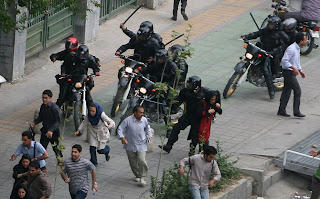
Photos in this entry are courtesy of The Boston Globe.

TAYLOR: Have you gone to any protests?

PARISA: Yes, I go to all of them!

TAYLOR: What are your reactions to the protests and riots?

PARISA: I participate in all of them because I am sure that there is a big [election] fraud. In fact, the reason for the increase in voter participation was that [the Iranian citizens] see the lies that Ahmadinejad tells for themselves. Everyone said, “It doesn’t matter who will be president. We will vote to not let Ahmadinejad get elected [again].” This election was the first time that we ever had this large of a voter turnout (40 million).

Until now, I believed that these protests were good because it shows our population. Imagine, they say Mousavi won about two million votes in Tehran and on June 15, our biggest rally, there were three million of us who attended. For example, everyone in my family voted for Mousavi, but I was the only of us who attended the rally. Therefore, you should multiply the population.

Another reason that I was in favor of rallies was because the government’s threats of arrest, violence, and even killing people, no longer has an effect on the will of people.

Imagine, on June 15—from morning until the last minutes of the rally– every 15 minutes in all news, they said, “There is no permission for a rally. If you go, we will behave violently. There will be serious sanction against people who attend this rally.” Many of my friends were really frightened by this because the day before, the Basij (militia) started their violent actions. We saw their brutality, but we went.

Interestingly, they asked taxis and busses to not take people to Enghelab Square (where the rally took place), but we went and we showed them how many of us there were and how brave we are. It had a very good effect.

TAYLOR: If you look outside of your window, what do you see? Are there people on the streets protesting?

PARISA: In fact, no! Only at 10:00 pm. At this time, everyone chants “Allah Akhbar” (God is great). But it’s really stupid because after two days of saying “Allah Akhbar,” they [the government] said that the Iranians chant “Allah Akhbar” for Ahmadinejad. After that day, we changed our chants to “Allah Akhbar” and “Ya Hossein, Mir Hossein” to show that we are protesters of Ahmadinejad. (NOTE: Mir Hossein, as said in the chant, refers to Ahmadinejad’s opposition leader.)

TAYLOR: Can you leave your house? Is it safe?

PARISA: In the morning, yes, we can go and it is safe. During the first days after the election, it was even unsafe in the morning. People were gathered close to their homes and offices and the police hit every body. An interesting issue that I want you to pay attention to is that in the middle of election day—before it was finished—they [the government] said, “Tomorrow, any gatherings are forbidden!” I wonder how they knew that people would gather the day after the election? At that time, the election wasn’t even finished. We were still voting! So, it shows that there is definite election fraud because they were sure that after they announced the winner there would be protests.

TAYLOR: Are you scared? Why or why not?

PARISA: When I saw the basij, I was so scared that I couldn’t breathe! Imagine, there were 30 motorcycles, two people on each, without uniform—like normal people, with batons. They had beards and their faces were very aggressive. You know, I am a lawyer. I know the dangers of letting normal people interfere with governmental issue. The problem is that they don’t work for money like all the other police. The basij work for their beliefs. So they think they will go to heaven by killing those who protest against Khameneyi (Supreme Leader of Iran). After Khameneyi spoke during Friday prayer, I got so scared. But I don’t have any fear of being killed.


TAYLOR: Have your friends gone to any protests?

PARISA: Many of my friends went, but some didn’t go because they were scared.

TAYLOR: Has anyone you know been injured or killed? Please explain what happened to them.

PARISA: One of my family members had his head broken. He was hit by a baton.

TAYLOR: How has the atmosphere in Iran changed from before the election to now? What is the atmosphere like now? Are people more open to speaking out against the government?

PARISA: It is very amazing because all of the people have become more brave. You see many artists, soccer players, and lawyers protesting in so many ways. When I was at the rallies, I noticed that people were kinder than before—they help each other and I feel there is a big change. We don’t have any leader in our rallies, but everyone respects the rule of being silent. For Iranians, who usually don’t obey the rules, it is very interesting. I think that the capacity of bearing injustice and watching the lies of government is full. That is the reason that we have all become brave.

TAYLOR: Did you expect it to change like this? Are you surprised?

PARISA: One week before the election, there were signs of something strange. You know, we had televised debates between the candidates, and in all of them we saw that Ahmadinejad said too many lies. He accused the candidates of so many crimes. The day after, the formal institutes who were responsible for the information that Ahmadinejad said, sent a formal letter to TV channels and said that Ahmadinejad tell lies. The TV stations didn’t read their mail and said that they would read it after the election (although they still haven’t read it) and so we see there is a power who wants to show Ahmadinejad as a good person and show the opposition as liar. The day that all of this happened, I thought, “If this power wants to ignore people’s vote because of the lies that Ahmadinejad told in front of 70 million people who have brains and can think, there will be tension in society.” However, I didn’t know that Mousavi was this brave.

TAYLOR: Who is protesting? What are the demographics?

PARISA: It’s very interesting. All ages—even very old people and religious people. You can see all kinds of people. If you have access to the video of Friday prayer, compare the people who were there with the pictures of the protesters. There is a big difference. But I have to say that most of the protestors are young and most of them are educated.

TAYLOR: Can you drive your cars on the streets or are they blocked with people?

PARISA: Rallies are at a specific time and place so cars cannot move just at that time and that place.

TAYLOR: How have people organized their protests if cell phones are shut down?

PARISA: They use their landline phones. Some people who can pass filters use their Internet and email to find out. Our mobile phones sometimes work and sometimes don’t work. But when we go to rallies, they are completely shut down. The SMS (text message) system has been off since the day of the election. All of Mousavi’s websites are blocked. He has tried to make other sites, but the speed of our Internet is very slow. During the rallies, people share the next day’s schedule with each other. Imagine, without having tools for communication, the Iranian people are this strong! So if we had communication access, then we could be much more!

TAYLOR: Can you access information? How? Which information can you access?

PARISA: With difficulty. Our TV has only government-owned and operated channels. It has become the god of lies. It makes us crazy and recently, I haven’t watched it because it makes me crazy. We have to try so hard to find true information and so there are not too many people who have the time or tools to find it. So I have to say no. We don’t have access.

TAYLOR: Can you still go to work this week? Why or why not?

PARISA: I could! But I didn’t. I was so tired of rallies and not sleeping. I didn’t sleep because I have been trying to find information on Internet.

TAYLOR: What outcome will come from this situation? What do you foresee for Iran's future?

PARISA: This election marked the start of change. I don’t know when there will be change, but I am sure the start day is today.

TAYLOR: What is the overall energy in Tehran right now— fear, excitement, hope, etc.?

PARISA: It goes up and down. The first day, we were so upset. We didn’t see any hope. After the June 15 rally, we got happy, but again after Khameneyi spoke at Friday prayer, we became so sad and scared.

TAYLOR: Is this another revolution? Do you believe that a revolution is needed?

PARISA: No. We just want to have another election with a supervisor who is not in favor of anybody who is running. But after Khameneyi’s speech in Friday prayer, I don’t know what will happen.

TAYLOR: Who did you vote for in the election? Who do you think won? Do you think they will do the election over? Why or why not?

PARISA: I voted for Mousavi. I thought he would win and I am sure he is the real winner. Their [the government’s] behavior shows that they will not have another election because they want Ahmadinejad to be the president, even with the price of killing their people.

TAYLOR: Describe the most memorable thing that you have seen since the protests and riots began on election day?

PARISA: The amount of people who came to the rally on June 15 (3 million). Although, the best thing was that they said they would attack us.

Yesterday, June 20, the amount of basij and police and their brutality was the worst thing I’ve seen. I cried the whole time. They hit everyone. Old, young, girls, boys. They didn’t let us gather. You know, when the population is spread, we are vulnerable. Yesterday they tried to spread people. They used everything. I heard the sound of guns. They were very scary. There were too many basij. I think they came from all over the country.

TAYLOR: How is the older generation reacting to everything? Upset, excited, scared?

PARISA: They are active in protesting and they think like the younger generation.

TAYLOR: Have you met anyone who is upset with the situation?

PARISA: Every one is upset!

TAYLOR: Why is it safer to communicate online than on the phone?

PARISA: The government controls the phones and records the conversations. They try to say America and England are leading the protesters. For example, last night in Iran, the Iranian news stations said that there is evidence that proves England had influence in this situation. Their evidence was the voice of a woman who was talking on the phone and asked her friend to burn the cars, banks, and say death to Khameneyi.

TAYLOR: Has the city of Tehran shut down? Are the malls and restaurants open?

PARISA: In the morning, they are open. But during the evenings, the places close to the rallies are closed.

Thursday, June 18, 2009

Voices from Iran during Iran Election Fallout

By Taylor Mirfendereski


Following Iran's presidential election last Friday, where Iran's state media declared that incumbent Mahmoud Ahmadinejad had won the election with 66 percent of the votes and that his main challenger, Mir-Hossein Mousavi, had won just 31 percent of the votes, protests and riots broke out all over the country.

Iran has seen no protests of this magnitude since the Islamic Revolution of 1979. I spoke to two people in Iran's capital, Tehran, about what they have observed in the city since the presidential election. The interviews were conducted on June 16, about four days since the fallout began.


More interviews from Iran to come.

Wednesday, February 25, 2009

Homosexuals not recognized in Iran, sex change operations legal


In September 0f 2007 during his visit to New York, Iranian President Mahmoud Ahmadinejad responded to a question from a Columbia University student about the execution of homosexuals in Iran by proclaiming that Iranian homosexuals simply do not exist.

In Iran, we don’t have homosexuals like in your country,” he told the questioner. “In Iran, we do not have this phenomenon. I don’t know who’s told you that we have it.
Several people have ridiculed President Ahmadinejad for his strong remarks, noting the absurdity of the idea that homosexuals exist everywhere in the world but Iran. Evidently, the confusion around his statement stems from the fact that Iranian homosexuals do not have legal rights. In Iran, homosexuals are subjected to punishment or execution. The Islamic penal code has a specific section about the punishments for homosexual “crimes.”
The Penal Code defines sodomy as “sexual intercourse with a male.” Article 110 states that the punishment for sodomy is death; it is the judge’s responsibility to decide how to carry out the killing. In the articles that follow, it clarifies that a mature man of sound mind who partakes in sodomy is subject to killing, where as an immature person will endure 74 lashes for the action.

Following the chapter about sodomy, the Penal Code discusses lesbianism. It defines lesbianism as the “homosexuality of women by genitals.” Article 129 states that the punishment for lesbianism is 100 lashes for each party. Another article adds that if the act of lesbianism is repeated three times and punishment is enforced each time, then the death sentence will be issued the fourth time.

In 2005, two teenage boys were publicly hung in Mash’had, Iran for the “crime” of homosexuality. According to a report from the Iranian Student News Association, the boys were interrogated and severely beaten in a prison for 14 months. They eventually admitted to having sex with each other and were killed.

To avoid torture and execution like the Mash’had boys, homosexuals in Iran are forced to keep their sexual identities in the closet.

“It’s not peaceful for [homosexuals in Iran]. They are living in a hard situation and their lives are at risk. They face legal and social problems but some have found out how to live an underground life,” Arsham Parsi, a homosexual Iranian said.

Jinos Sharifrazi, an attorney in Tehran, Iran, says that although partaking in homosexual acts is a crime in Iran, people commonly ignore the law. “Having a boyfriend or girlfriend in Iran is a crime, but most people still have them. Going to a party and drinking is a crime, but tons of people do it. Likewise, it is a crime to have sex with the same sex, but some do it anyway,” she said.

Parsi, from Shiraz, Iran says he knew he was gay when he was about nine years old and had sex with his male cousin. “I didn’t know what was wrong with me. I thought maybe I was sick, and probably had to go to the doctor, but I didn’t know which one to go to,” he said.

In an attempt to feel “normal.” Parsi tried to compensate for his differences through the Islamic religion.

“I prayed more to become a good person, a normal person. Most people prayed five times a day and I would pray ten. Other people fasted for two months and I would fast for four,” Parsi said.

At the age of 18, he fully realized his sexual orientation after receiving access to the Internet and conducting research about homosexuality. Two years later, in 2001, two of Parsi’s closest gay friends committed suicide because of the challenges they faced living in Iran as homosexuals.

“After my friends died, I didn’t have anyone to talk to about it and I didn’t have any websites, references or organizations to go to. It was so awful for me. I decided to do something for the next generation of people who were born gay,” Parsi said.

He founded the Iranian Queer Railroad, an online interest group for the homosexual, bisexual transsexual populations. He operated the website, made phone calls, conducted interviews and wrote letters under a false name. One day in 2005, Parsi received a voicemail and several emails from the Iranian government, who had become aware of his activity after tracing his Internet Protocol address and phone calls. He knew he had to leave immediately before being arrested or killed. On March 4, 2004, he fled from Iran to Turkey.

Some gay Iranians, like Parsi, make the decision to openly advocate for their homosexual rights. Other homosexuals who reside in Iran choose to go about their lives, hiding their sexual identities from the public. Another portion of Iranian homosexuals prefer to have sex changes.

Sex changes have been legal in Iran ever since Ayatollah Ruhollah Khomeini, the spiritual leader of the 1979 Islamic revolution, passed a religious decree, known as a fatwa, about 25 years ago and authorized the operations to “diagnosed transsexuals.”

Iranians who wish to go through the operation must contact Iran’s Ministry of Health. They are required to meet with a panel of psychologists whose primary job is to determine whether the person is a homosexual or transsexual. Once a person is deemed to be a “true” transsexual, they can proceed with the operation.
Parsi, still the director of the IRQR and now based in Canada, explained that Iranian homosexuals who seek sex change operations may attempt to find a way to make their psychologists diagnose them as transsexual.
“I have received about 45 reports of operations in Iran where the people [who seek or have had a sex change] are not really transgender. They are gay and only want to change their sexuality for a little bit of freedom,” he said.

Bahram Mirdjalali, one of Iran’s few gender reassignment surgeons, disagrees with Parsi. “[The high number of sex changes in Iran] has nothing to do with politics, religion or any other external factors. These people are not homosexual. They are just people who are basically trapped in the wrong body,” he said through an interpreter.

He added that he believes the people who undergo sex changes have a phobia against their own gender. “If they are technically male, they are not attracted to men. But once they have an operation and become a female, they become attracted to men,” Mirdjalali said.

Mirdjalali has performed more than 600 operations over the last 12 years. He said that in a European country like France, where he was trained, he would have carried out fewer than 80 transsexual operations over the same period. Aside from Thailand, Iran carries out more sex change operations than any other country.

Mirdjalali assisted with an Iranian study about the roots of the high number of those with gender identity disorders in Iran. The study concluded that women living near the war zone during the Iran-Iraq War with three to four month gestations had a higher rate of incidents of children being born with gender identity disorders than the average population.

He said that the entire sex change process is physically painful and emotionally draining for the patient, adding that it is crucial for the patient to have the support of his or her family and close friends. “I see people going through this very tough operation and difficult post operational procedures, but once I see them smiling, it gives me such great satisfaction,” Mirdjalali said.

The Iranian government used to make note of a person’s sex change on their birth certificate, but because of Mirdjalali’s efforts to change the policy, there is now no documented trace of the operation. The person’s new gender replaces the old on the birth certificate, making it easier for transsexuals to peacefully reemerge into society.

But even though sex changes receive legal recognition in Iran, this doesn’t always equate to social and political acceptance.

“[Transsexuals are not accepted in Iran. Everyone gossips about them. People—especially old people and traditional people—think that transsexuals are bad people or criminals,” Sharifrazi said.

Bijan, a resident in Tehran, who wished not to disclose his full name, has never seen a transsexual in Iran. He doesn’t deny their presence in the country, but instead thinks that the transsexual community avoids the public whenever possible to avoid humiliation from the generally unwelcoming Iranian crowd.

“It’s very unacceptable to be [transsexual] here. A lot of people keep hidden until they can leave the country. My friend’s son wanted a sex change, but waited until he left Iran to receive one. His father was always trying to keep him away from other people because he knew the others would make fun of him for his differences,” Bijan said.

Mirdjalali also notices a lack of tolerance towards those with gender identity disorders. “Traditional families are having a hard time accepting this concept that we are operating on their kids. I often have to talk longer hours with the father or mother of the patient. A lot of parents and family members do not want to recognize that these individuals are in need of help and have gender issues,” he said.

Parsi tries to encourage Iranian homosexuals to stop resorting to sex change operations as a means to be free. “[Gay and lesbians] who are going through this process are victims of ignorance. They usually don’t have any knowledge about their rights,” he said. “Suicide rates are very high after operations and many live in a pre-suicide type of depression.”

Through his organization, Parsi offers advice to Iranian homosexuals who consider going through the surgery. He asks them to share their particular situations and talks to them about their motive for wanting a sex change.

“[From the mind of a gay man considering a sex change,] the only way he thinks he can sleep with a man is to become a woman,” Parsi said. “But these people are not transgender. They are homosexuals. Society forces them to change their sex.”

Parsi, Mirdjalali and others may disagree about the reasons for such a high number of transsexuals in Iran, but it’s impossible to deny the existence of a homosexual population in a country of approximately 70 million people.