By: Rachel
Sayers
Produced and edited by: Olivia Harlow
On
the evening of August 18, 1996, along the dim back streets of Buenos Aires, a
young woman was seen stepping into the passenger’s side door of a police
vehicle. For months police repeatedly threatened her, discriminating against
her for her unyielding desire to choose a gender different than that which she
was born. Later that night she was found lying on the street, bleeding
profusely from two gun shot wounds to the penis. She died soon after.
At
the time of her death, Mocha Celis was 34-years-old and illiterate. Blatanat
discrimination in the education system forced her from schooling, and soon
after she took the only job available to her: prostitution. Although legal in Argentina, prostitution often
accompanies a lifestyle encumbered by violence, disease, and police harassment.
Despite
this, it is a trade that has historically drawn in much of the transgendered
population, with some estimates as high as 99 percent, a rate put forth by the Asociación Travestis Transexuales Transgeneros de
Argentina (ATTTA).
“People thought I did it because I wanted to, not because I had
to,” explained Virginia Silveira, a transgendered woman who spent several years
as a prostitute on the streets of Buenos Aires. “They saw me as a criminal, but
I did not consider it my job. It was
simply the only way to survive. It was part of the environment. All my friends
and every single trans person I knew were prostitutes. They had no other option
because no one would have them for any other job.”
“The transgender community used to be excluded from society,”
ATTTA director Marcela Romero explained. “They were excluded from health
services, education, and work, leaving them very few choices. It was a chronic
problem.” The problem was finally addressed in 2010 when a 33-27 vote made
Argentina the first Latin American country to legalize same-sex marriage, and
again in May 2012, when a unanimous vote in Congress passed one of the most
liberal gender identity laws in the world.
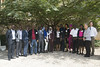
 |
| © 'Mocha Celis' Popular Baccalaureate |
Under the Gender Identity Law,
co-written by Romero, all persons are granted the right to recognize their own
gender identity, without need for genital reassignment surgery, hormone
therapy, or a psychiatrist diagnosis. People are guaranteed a right to be
treated according to their chosen gender, including identification on official
documents by name and sex, as well assurance that such information will remain
confidential. Furthermore, the law also guarantees all persons access to surgical
interventions and hormonal treatments if they so choose.
It is an emphatic step for a country that is, in many ways,
still emerging from the atrocities performed by former dictator Jorge Rafael
Videla, who has admitted to “disappearing” several thousand people he saw as
opponents to his authoritarian ideals. Human rights groups estimate that during
his reign from 1976-1981, more than 30,000 people were kidnapped and murdered,
or simply vanished, including several hundred transgender activists.
The residual attitude from such brutalities can pervade all
aspects of a transgendered person’s life, but perhaps it is most impactful in
education. A study published in 2006 by a local human rights organization found
more than 64 percent of transgender individuals had not completed primary
school and another 20 percent had not graduated from secondary school.
“It wasn’t my classmates who discriminated
against me, it was the institution itself,” explained Silveira, who dropped out
of primary school in a neighboring province before moving to Buenos Aires.
“They refused to call me by my real name or let me use the bathroom I wanted
to. They wanted me to match my appearance to my biology. They wanted me to act
like a boy and dress like a boy, things I wasn’t comfortable with. They made me
quit.”
After spending years prostituting herself in the Argentine
capital, Silveira came across an article on a trans activist’s Facebook page
about opening the world’s first school specifically—but not especially—for
transgender, transsexual, and transvestites. She enrolled a few months later.
‘Mocha Celis’ Popular Baccalaureate
opened in Buenos Aires in March 2012, just months before the Gender Identity Law
would be signed into effect. As a secondary school, it offers an accelerated
three-year program for students over the age of 16 to receive their high school
diploma.
“We could not live in a country where gender identity stood as an obstacle to the access of a basic right like education, so we hatched an idea that eventually became ‘Mocha Celis’,” said founder Francisco Quiñones. “It was extremely difficult to convince the government of the necessity of a space like this, but eventually we prevailed.”
The school opened its doors as a non-profit with just 25 students, among them Silveira, her long brown hair and impressive stature an unnoticed juxtaposition among the mostly trans inaugural class. Since then the school has grown to include more than 100 students, with the student population becoming an eclectic mix of trans and non-trans, young and old.
“Our school focuses on inclusivity, not exclusivity,” said Vida Morant, co-director of ‘Mocha Celis’. “All are welcome. We guarantee a space free from discrimination, sexism, and institutionalized violence against any group. We want to set an example of what should happen at other schools.”
‘Mocha Celis’ will graduate its first class this year and expectations are high. “I’m going to be a lawyer,” said Silveria, her matter-of-fact tone leaving no room for doubt. “I want trans people, not just in Argentina, but around the world, to know that their rights are not gifts from the government. That [their rights] are basic entitlements, and that they are owed to them.”
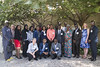
 |
| © 'Mocha Celis' Popular Baccalaureate |