Tuesday, July 21, 2009

IIIJ FACILITATES E. SCHNIER’S REPORTING ENTERPRISE IN SOUTH AFRICA

By IIJ News Reporter


One of our graduate students who received the John Wilhelm Foreign Correspondence Scholarship through the Institute for International Journalism (IIJ) has secured a major international reporting enterprise in Johannesburg, South Africa. Ellen Schnier, MA’ 2009 will intern for three months at the South African Broadcasting Corporation (SABC News – Television). SABC is the largest broadcast news corporation in Africa. She leaves for South Africa in September 2009.

"The scholarship funds given to Ellen are sufficient to cover her return air fare to South Africa, costs for ground transportation to go to work while in Johannesburg, and lodging for the three months," said Professor Yusuf Kalyango, Director of the Institute. Ellen joins an exclusive fraternity of more than 200 journalism majors who have received international journalism scholarships through the IIJ to intern in more than 30 countries around the world. Other recipients of this year’s international scholarships include Michael Barajas who will travel to Jerusalem in Israel to intern with the Associated Press and Stine Eckert who will intern with the Aljazeera network in Washington, D.C.

While in South Africa, Ellen hopes to learn about the international news environment in one of the largest news markets in the world. It will be a combination of an advanced, well-developed news organization in an industrialized city in the midst of Sub-Saharan Africa. The internship will give her an opportunity to experience South African life and culture. She hopes to investigate issues of poverty, race relations 15 years after the end of the apartheid, and health challenges the nation faces. “Hopefully, I will be able to travel to other African nations either with SABC or Channel Africa which is owned by SABC, to explore the culture and important issues in neighboring countries.

Ellen worked as a reporter and anchor on the Athens MidDay news, where she gathered news, wrote, and edited news packages for the television newscast. During an internship at WLWT, the NBC affiliate in Cincinnati, Ohio, she had the opportunity to conduct interviews, including one with the governor of Ohio. She competed on a nationally televised reality music competition, Clash of the Choirs, and her winning choir won $250,000 for Cincinnati Children’s Hospital. After the group was named Ambassadors of the Year in Cincinnati, she became a correspondent for WLWT Cincinnati’s local choir competition and produced profiles on several choirs for the evening news.

As for her graduate studies at Ohio University, Ellen has focused on African media and culture. Her thesis examined the U.S. network television coverage of events in Africa from 1977 to 2008. She also investigated and filed a special report for the IIJ’s Globetrotter Newsletter about Uganda’s successful campaign to reduce the infection rate of HIV/AIDS. A second special report investigated the Uganda Supreme Court’s decision to reinstate the use of the death penalty in Uganda.

Thursday, July 16, 2009

My orna and me -- Walking around as a woman in Dhaka, Bangladesh

by Stine Eckert, Pulitzer Student Fellow

Stine Eckert traveled to Bangladesh as a Pulitzer Center Student. Learn more and see all her reporting: http://www.pulitzercenter.org/showproject.cfm?id=120


Whereas Western dress shirts and dress pants are the socially most acceptable outfit for Bangladeshi men, women predominantly still dress traditionally in Dhaka, Bangladesh. A note on experiencing clothing for women.


Every time I leave my room I have to wrap myself up, with a scarf called an orna.

My orna more or less lives on both of my shoulders and forms a “u” or “v”-shape in front of my breast to cover up my female shape. The ends of my orna dangle loosely on both sides of my back, reaching down to my hips or knees, depending on the length.

My orna has become my permanent companion in Bangladesh ever since a Bangladeshi girl showed me how to wear it properly. Well, at least I try. Without it, I have come to feel something is missing. This doesn’t mean we have a purely peaceful coexistence. No, my orna can be quite a nuisance and when I return to my room, I usually fling it on the sofa immediately. That’s in private.

In public, the orna (sometime also spelled urna) is part of the most prevalent outfit for women in Bangladesh, the so-called three-piece. It starts with baggy pants that taper down at the ankle of the foot and building a balloon shape around the woman’s thighs. They are matched by a long or short blouse and crowned by the orna.

For elements number one and two I stick to wearing jeans or loose linen pants I brought from home, matched by more or less bulky short-sleeve shirts, which seem to be accepted. Since element number three was missing, I was encouraged by several visitors to Bangladesh and Bangladeshis themselves, male and female, to fill the lack of element number three by draping some fabric around my upper body.

Embracing this new style of clothing, in the impossible attempt to blend into rest of female society, I donned a yellow-orange scarf, given to me by an Indian friend. I felt a bit like wearing the uniform of an alien species in Star Trek, a uniform I am constantly fighting with.

Every couple of minutes I need to reign in my orna to make sure it doesn’t travel down one of my shoulders. It also tries to move either to close to my neck softly strangling me when the dusty winds rush through the channel-like streets or droops to low uncovering the desired parts. Its fabric has an incessant desire to bond with the rough bark of trees, discover the pots of street vendors, flirt with the hood of cars that come dangerously close in the constantly thick traffic, or whisper to the concrete of the street.

Once a gusty wind blew the orna up into my face; girls driving by got a good laugh out of me. Imagine running an obstacle course while wearing a blanket in front of you.

I alternate between three ornas, a yellow-orange, a green, and a turquoise-brown one. One is like a short thin net, the other one like a thick blanket big enough to cover me for a nap, and the third feels like a long soft alga. All of them like to use my arms as slides, all of them are eager to make acquaintances with palm leaves along the road, all of them form alliances with my purse to keep me captive while I rummage for a handkerchief and try to keep breathing.

I have been trying to improve our relationship by observing how Bangladeshi women tame their ornas. They wear them elegantly with the color always matching the rest of their three-piece. Their ornas sit confidently on their shoulders, never misbehaving. If so, a tiny tuck shows them who’s the boss. Their ornas don’t seem to bother them. On the contrary, they employ it frequently to cover their heads against the hot-glowing sun. At least half the women don’t wear headscarves and the orna can be pulled over their heads quickly if needed such as when the muezzin calls for prayer and covering one’s head shows respect for the song-like reminder. But even then not all women seek cover.

In short, Bangladeshi women live in peace with their ornas, and the rest of their baggy dress. Few women wear jeans or other Western-style clothing. A 15-year old girl I interviewed at Nari Jibon, a small project teaching practical skills to women, told me she would like to wear jeans but it’s not accepted. In her tailoring class she learns how to sew fatuas—a shorter loose blouse—and three-pieces. That’s also what most shops offer in addition to the better-known saree, a five-meter long fabric matched by a tiny blouse, which seems to be worn more often by older women.

Traditional outfits for men consist of shirts and lungis, a skirt-like piece of fabric that is knotted around the hips and usually reaches to the ankles. But unlike the traditional dress of women, the lungi is not so prevalent among men, who can afford a business outfit. Workers on the street, rickshaw pullers, construction workers, street vendors all wear lungis. Businessmen who want respect don’t, at least not in public. I’ve been told they wear them at home and when they go to bed since they’re really comfortable.

Some other men on the streets wear long-sleeve shirts, called panjabi, matched by loose pants, and a little cap, often in white or lighter colors. Asking a Bangladeshi what that means it seemed that these men practice their religion more. Wearing a cap is a requirement for prayer, wearing the whole outfit might indicate that this man has completed his hajj, a pilgrimage to Mecca, which every Muslim should do once in her/his life.

The crisp business suits, tightly tailor fitted for the working male, however, rule the world of men in public while women walk wrapped in a cloud of pretty colored ornas and sarees.
Awkwardly I stumble along, ready to scold and adjust my orna for its next attempt to mock me.

Photo: Nipu, Shadia, and Tasnuva wear matching ornas -- big, long scarves -- to match the rest of their three-piece outfit, the traditional outfit for women in Bangladesh apart from the saree.

Learn more and see all of Stine's reporting: http://www.pulitzercenter.org/showproject.cfm?id=120

The Other Side -- A Visist to Nari Jibon, a small women's aid project in Dhaka, Bangladesh

by Stine Eckert, Pulitzer Student Fellow

Stine Eckert traveled to Bangladesh as a Pulitzer Center Student. Learn more and see all her reporting: http://www.pulitzercenter.org/showproject.cfm?id=120

Girls and women learn sowing, English and how to use a computer at Nari Jibon Development Foundation - A visit to a struggling women’s project in Dhaka. Part 3

“I want to get at least two or three computers hooked up to the Internet again,” says Golam Rabbany Sujan. He started as a resource officer at Nari Jibon in its beginning in 2005, later became project director.

The Internet was crucial for the Nari Jibon cyber café that gave women the chance to blog and write about their lives. He had to shut it down in February 2009. “Women don’t like to go to the cyber cafés outside because there are boys which make them feel uncomfortable,” Sujan explains the value of the café. And the women could apply their English and computer skills, too. “The students here were very proud to publish about their own interests,” he says.

But the 14,000 Tk ($205) per month to pay for the local Internet network were too much, Sujan says. He tries to keep up the Nari Jibon blog by posting occasionally from an outside cyber café.

His last post of June 23, 2009 tells the story of 13-year-old Rozina Akthar, who comes to Nari Jibon five times a week as she doesn’t go to school. As Rozina is deaf it was hard to communicate with her when I visited but she showed me her sowing. Sujan’s description on the blog of how Rozina recently got harassed on the street gives an example of the so-called eve-teasing, verbal insults that many Bangladeshi women experience but can do little about.

Mr. Sujan explains that at the moment the whole organization runs on about 14,000 Tk ($200) alone to pay electricity, the phone bill, some of the teachers and Ruma. Mr. Sujan himself and the English teacher work currently without pay.

The chance for more money only comes when Mr. Sujan can obtain a certificate to receive international donations. Since February 2009 Nari Jibon is registered as a Social Welfare Trust, a local Non-Governmental Organization (NGO). But that is not enough, Nari Jibon needs to obtain the sought-after NGO Bureau status to secure international donations. Yet, just getting the local NGO status was a year-long project.

“It took 36 documents to sign and $1,000 in lawyer fees to get the current status of Nari Jibon,” says Nari Jibon Assistant Director Katie Zaman, a master student in sociology at the University of Wisconsin-Madison who works on her thesis about women’s work and domestic violence in Bangladesh.

All the documents are ready to apply for the NGO Bureau status, says Mr. Sujan, but ironically more money is needed to get the certificates to tap international funds. It will need at least another 10,000 Tk ($150) in bribes, he says. “The more money we can give, the speedier will be the process.”

Without its major donor and international money, Nari Jibon relies mostly on smaller donations as the fees by the students are not sufficient to cover all costs.

Former main donor and founder of Nari Jibon Dr. Kathryn B. Ward is tired and frustrated. She says she had to pull the plug at Nari Jibon in November 2008 after spending over $65,000 of her own money and more in research grants in the past four years to get the project established. She paid for computers, sewing equipment, and the office infrastructures; students always have paid a small fee to join classes and use the facilities. Some of them, however, expected Nari Jibon to come for free altogether.

Originally Dr. Ward had hoped that other NGOs would fund some of the redundant and less prepared staff and aides at Nari Jibon. As she works as a professor of sociology and women studies at Southern Illinois University, she says she cannot longer direct the project from overseas, nor afford the funding.

The “Mother of Nari Jibon,” as the caption of a photo in the Nari Jibon office affectionately calls her, had to let go of her project but her concern doesn’t end easily. Just recently she sent another $150, which came from her local food coop.

She says after repeatedly giving directions to and promises from the Nari Jibon in Dhaka, its staff needed to take more initiative on their funding, sustainability, and operations. “At the same time, Bangladesh authorities have made registration very difficult.” As a result, Nari Jibon has had difficulties in finding other donors without government registration, she says.

Frustration doesn’t stop with the money. Even though Nari Jibon lists the success stories of its students and the girls I met tell of their joy and pride to be able to have Nari Jibon to pursue their own interest, change in society comes slowly for women.

“The sex workers [who came to Nari Jibon] still have to go home at night and come back with bruises in the morning,” Dr. Ward says.

Currently, she says she needs a break from Nari Jibon and Bangladesh: ”You can have the best intentions and do good things but that doesn’t help with the system in the larger Bangladeshi society.”

Photos:

On the third floor of the apartment building in the area of Malibagh works the small organization Nari Jibon. Before they occupied several floors and can expand again when more money is available.


Dr. Kathryn B. Ward, professor of sociology and women studies at Southern Illinois University founded Nari Jibon. After giving more than $65,000 of her personal money, more in research grants, and time to establish the project she feels exhausted and frustrated.

Learn more and see all of Stine's reporting: http://www.pulitzercenter.org/showproject.cfm?id=120

Wednesday, July 15, 2009

Ruma -- A Visit to Nari Jibon, a small women's aid project in Dhaka, Bangladesh

by Stine Eckert, Pulitzer Student Fellow

Stine Eckert traveled to Bangladesh as a Pulitzer Center Student. Learn more and see all her reporting: http://www.pulitzercenter.org/showproject.cfm?id=120


Girls and women learn sewing, English, and how to use a computer at Nari Jibon Development Foundation -- A visit to a struggling women’s project in Dhaka. Part 2

As I talk with Nipu, Shadia, and Tasnuva, who learn English, sewing, and Microsoft Office at Nari Jibon, a quiet fragile women in a bright yellow sari drifts in and out of the doorframe of the computer room. Sixty-five-year old Ruma has been with Nari Jibon since the beginning of the project in March 2005. She helps the tailoring students, brings tea, and welcomes guests at Nari Jibon. She already greeted me as I only got half way up the stairs to the third floor where all classrooms and the office are located.

Ruma came to Dhaka 25 years ago, when she fled from her second husband in Khulna, a village in South West Bangladesh where he still works as a fisherman. As her first husband died she was forced to marry his younger brother, whom she didn’t like. In Dhaka she found work by ironing garments to support her two sons.
“Nari Jibon has changed my life positively,” she says. “If I had a chance like that earlier, I could have worked from home.” She lives vicariously by seeing the younger girls learning tailoring and English as she never went to school. Until four years ago she was illiterate.
“Now I can read and can’t be cheated on prices anymore,” she says. In the morning she reads Prothom Alo, one of the top Bangladeshi daily newspapers. Her next goal is to teach her grandson how to read and write and to better establish Nari Jibon. “I love the project.”
Nari Jibon pays her 1,000 Tk a month, a quarter than what it used to be before December 2008. Rent for her approximately 12 x 12 feet room in the neighborhood costs 1,800 Tk a month. “I have a small house,” she says as she leads me down the narrow passage to her homestead, which she shares with her 25-year-old son who works as a rickshaw puller, his wife Lovely, and three year old son Rapi. Lovely will start a job in the garment factory next month, sowing on buttons.
Outside her house, a row of stoves provides a shared kitchen. Ruma’s flame heats a pot with boiling egg curry. As we sit down on her bed she proudly shows her writing exercises while neighbor women and kids quickly gather at the door, spill into the room, and men peek through the window to eye Ruma’s strange visitor.

A neatly dressed girl in a red and white three-piece with sparkling earrings stands out. Fatima doesn’t know if she is 13 or 14 years but says she also works in a garment factory, motioning to a boy nearby she indicates that she helps produce men’s pants. Every day except Sunday she walks half an hour to start her eleven-hour shift in the factory. Usually she works eleven hours, she says, but today there was not much work and she walked back home by one o’ clock.

As I leave a little girl tries to take my hand, a young man poses to have his picture taken, and Ruma says she’s happy I visited her house.

Learn more and see all of Stine's reporting: http://www.pulitzercenter.org/showproject.cfm?id=120


Friday, July 10, 2009

My first week in Mysore

I arrived in Mysore 9 days ago and have already experienced Indian culture! The traffic is very disorganized, as horns sound all the time and there don't seem to be many enforced rules.The peopl of Mysore seem very friendly and the area seems safe. It's the monsoon season, so there are many rainfalls throughout the day. In Bangalore, horns started honking without a pause at 6 a.m. and people chatted loudly. Every morning, I hear a man singing "tomatoes, tomatoes, tomatoes,..." and some words in Kannada, the local language. Men walk through the neighborhoods every morning, selling fresh fruit and vegetables.


"There are two different Indias in India... one is the one you've seen and the other one is the rural part," Nanjappa, vice president of rural projects, said.I went into the village Begur yesterday and will study the culture of rural India for the next week. Rural India is home to over 70% of the population, according to the International Human Development And Upliftment Academy (IHDUA), the organization for which I intern. After my observations, I will work for two local newspapers. The IHDUA based in Mysore is a non-government organization established in 1991 by Oncologist Dr. B. S. Ajaikumar. The organization works on four main rural projects: rural literacy, women empowerment, economics, health and education, and awareness about health and hygiene. The IHDUA now works with 55 villages.Yesterday, there was a Self-Help Group (SHG) meeting in Begur. These meetings help a group of men or women to ameliorate their businesses and upgrade their skills. I first sat with a group of men who try to work together to strive for economic development. Because the majority of the rural population doesn't speak English, I could not understand most of the conversation. After the second meeting, which was among women, I went into a room with six girls who produced purses. The other women returned to their businesses, which include selling fruits, vegetables, flowers, chicken or sheep fur. Some of the girls knew some words of English and asked me for my name and my parent's name. Two girls used sign language to ask if I had eaten lunch, which in India means about the same as how I was doing.I rode on the back of a motorcycle the "Indian way" (girls sit sideways) and visited some local stands.

On thursday, the first stop was at a small kindergarden and school. The children seemed shy, because they sat quietly on the floor the entire time. The kindergarden was one room with one small desk and one chair. The walls were full of colorful pictures, so that the children could learn the words of different fruits, vegetables, animals, body parts and so on. Before I left, I wrote a few sentences in a guest book and saw that two other Americans have visited this place.
Unlike the kindergarden kids, the school children wore a uniform. I have noticed that most schools in this area require uniforms, often blue- or green-colored.
My driver then took me to see some rural projects of IHDUA. We stopped at several houses in about 8 villages and every person was very welcoming and friendly. Every single household offered me chai tea and some gave me snacks as well.
In one village, I saw a kitchen garden constructed by IHDUA. The purpose is to provide nutrition through vegetables and fruits to the habitants. I also sat in another SHG (Self-Help Group) women's meeting. The women seemed very interested in my culture as well and my driver translated their questions to me. They asked if I was married and if I wanted to stay at the village with them sometime.
The second project I visited a smokeless oven, provided by IHDUA. According to Nanjappa, women used to inhale smoke and get sick while cooking, so the organization constructed one where the smoke goes outside only.
In a different village, I observed the production of silk. There were large wooden wheels on the front porch with hundreds of silk worms weaving. One of the men told me that it takes three days for the worms to construct the material. I refused a chai, but got one anyway. It seems as if nobody takes "no" as an answer here regarding to food or drinks.
Although it was pouring this morning, it fortunately stopped once we got to Begur. I had a different driver today and the motorcyle seemed to be going a lot faster. Because the villages today were a little more distant from Begur, we visited fewer areas. The people at the first house were keeping different food items, such as mangoes and spicy pickles, in different-sized, blue containers. Provided by IHDUA, these items apparently ameliorate their business. At the next village, we visited a woman that was tailoring, such as the girls in Begur.
At the last stop, women were preparing nutritional supplements for malnourished children.

Career First, Marriage Later -- A Visit to Nari Jibon in Dhaka, Bangladesh

by Stine Eckert, Pulitzer Student Fellow

Stine Eckert traveled to Bangladesh as a Pulitzer Center Student. Learn more and see all her reporting: http://www.pulitzercenter.org/showproject.cfm?id=120

Girls and women learn sewing, English, and how to use a computer at Nari Jibon Development Foundation -- A visit to a struggling women’s project in Dhaka. Part 1

Rozina and Shompa stand up as if a teacher called on them when I enter the room. After settling that they can sit down they seem to be a bit more relaxed. Shompa has pinned a bright pink piece of cloth underneath the needle of the sewing machine in front of her. She has been learning to sow at Nari Jibon Development Foundation for a month now, working in the small room four times a week for two hours. After she first tailored a fatua, a short-sleeved lose shirt, she’s now on to sow a dress.

“Pink is my favorite color,” says the 20-year old political science bachelor student at National University. It will take her a day to make the whole three-piece, a typical traditional outfit for women in Bangladesh consisting of a dress, long loose pants, and a scarf wrapped around the shoulders. But it saves money and is good practice.

As Shompa, which means dream, becomes more skilled she will be able to tailor a three-piece in three hours, just like expert tailors. After her training is over two to three months, she can buy her own sewing machine and work at home. “I want to start my own tailoring business.“ Shompa says, a source for income at the side for her, even when she reaches her goal to become a teacher in political science.

Twenty-twos girls are currently in the tailoring class at Nari Jibon. As the organization struggles to find donors, according to Project Director Golam Rabbany Sujan, Nari Jibon, which means women’s life, had to raise the admission for the course.

Since December 2008 every girl pays 500 Tk or $7.50 to participate up from just 300 Tk ($4.50). In 2007 the girls only paid 100 Tk ($1.50). Fees were low as Nari Jibon started out to especially help poor, underprivileged women. But with a drop in donations it has opened up for everyone who can pay.

To pay her admission, 15-year old Nipu Akhtar works part time in an office, where she helps with accounting and binds books. With her monthly-earned 1,000 to 1,500 Tk ($15 to $20) she can almost pay for her three courses; her parents pay the rest.

Nipu not only learns tailoring but also English for 500 Tk ($7.50) each, and how to use Microsoft Office and create graphic designs, for another 1000 Tk ($15). With her new skills she wants to later open her own boutique to sell dresses.

She says if a woman is not educated, the family wants the daughter to marry to decrease family expenses. “I want independence,” Nipu says. “I will never marry. Only if a nice boy comes and then only after twenty years.”

Opposite to her sits Shadia Islam, 18 years, who already won a little independence by simply coming to Nari Jibon. She says her father was not willing to pay the fees. Besides, he didn’t like the idea she would be working outside her home, she says. But her mom supported Shadia: “My mom pursued my dad and changed his mind, she said to him ‘ Better do it, there’s no gain but no loss either.’” She has one more year in high school and wouldn’t mind marrying after a while, she says. “But I want my parents to find me a husband.”

Similarly Tasnuva Swarena, 22, doesn’t rule out marriage. But she also wants to have a job hoping that the computer class will help her to later find a government or bank position. She will graduate from Dhaka University with a Bachelor in anthropology in three months. But even when she finishes her master in another year, she says “there’s little chance I find a job in anthropology.”

Photo: "Pink is my favorite color," says 20-year old political science student Shompa who later wants to open up a tailoring business at home.

Learn more and see all of Stine's reporting: http://www.pulitzercenter.org/showproject.cfm?id=120

Sunday, June 21, 2009

A Protester Speaks Out From Tehran

By Taylor Mirfendereski

The following is the transcript from my June 20 (June 21 in Iran) interview with a young Iranian protester in Tehran, Iran. She has taken a big risk to speak with me. To protect her safety, I will refer to her as Parisa.

I first communicated with her by phone, but because many phones in Iran are tapped, she preferred to communicate through the Internet. I have corrected the grammar and English of her responses for clarity, but have not altered the content.

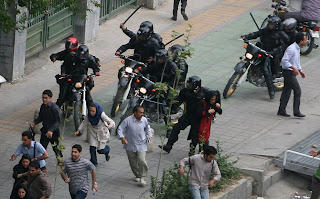
Photos in this entry are courtesy of The Boston Globe.

TAYLOR: Have you gone to any protests?

PARISA: Yes, I go to all of them!

TAYLOR: What are your reactions to the protests and riots?

PARISA: I participate in all of them because I am sure that there is a big [election] fraud. In fact, the reason for the increase in voter participation was that [the Iranian citizens] see the lies that Ahmadinejad tells for themselves. Everyone said, “It doesn’t matter who will be president. We will vote to not let Ahmadinejad get elected [again].” This election was the first time that we ever had this large of a voter turnout (40 million).

Until now, I believed that these protests were good because it shows our population. Imagine, they say Mousavi won about two million votes in Tehran and on June 15, our biggest rally, there were three million of us who attended. For example, everyone in my family voted for Mousavi, but I was the only of us who attended the rally. Therefore, you should multiply the population.

Another reason that I was in favor of rallies was because the government’s threats of arrest, violence, and even killing people, no longer has an effect on the will of people.

Imagine, on June 15—from morning until the last minutes of the rally– every 15 minutes in all news, they said, “There is no permission for a rally. If you go, we will behave violently. There will be serious sanction against people who attend this rally.” Many of my friends were really frightened by this because the day before, the Basij (militia) started their violent actions. We saw their brutality, but we went.

Interestingly, they asked taxis and busses to not take people to Enghelab Square (where the rally took place), but we went and we showed them how many of us there were and how brave we are. It had a very good effect.

TAYLOR: If you look outside of your window, what do you see? Are there people on the streets protesting?

PARISA: In fact, no! Only at 10:00 pm. At this time, everyone chants “Allah Akhbar” (God is great). But it’s really stupid because after two days of saying “Allah Akhbar,” they [the government] said that the Iranians chant “Allah Akhbar” for Ahmadinejad. After that day, we changed our chants to “Allah Akhbar” and “Ya Hossein, Mir Hossein” to show that we are protesters of Ahmadinejad. (NOTE: Mir Hossein, as said in the chant, refers to Ahmadinejad’s opposition leader.)

TAYLOR: Can you leave your house? Is it safe?

PARISA: In the morning, yes, we can go and it is safe. During the first days after the election, it was even unsafe in the morning. People were gathered close to their homes and offices and the police hit every body. An interesting issue that I want you to pay attention to is that in the middle of election day—before it was finished—they [the government] said, “Tomorrow, any gatherings are forbidden!” I wonder how they knew that people would gather the day after the election? At that time, the election wasn’t even finished. We were still voting! So, it shows that there is definite election fraud because they were sure that after they announced the winner there would be protests.

TAYLOR: Are you scared? Why or why not?

PARISA: When I saw the basij, I was so scared that I couldn’t breathe! Imagine, there were 30 motorcycles, two people on each, without uniform—like normal people, with batons. They had beards and their faces were very aggressive. You know, I am a lawyer. I know the dangers of letting normal people interfere with governmental issue. The problem is that they don’t work for money like all the other police. The basij work for their beliefs. So they think they will go to heaven by killing those who protest against Khameneyi (Supreme Leader of Iran). After Khameneyi spoke during Friday prayer, I got so scared. But I don’t have any fear of being killed.


TAYLOR: Have your friends gone to any protests?

PARISA: Many of my friends went, but some didn’t go because they were scared.

TAYLOR: Has anyone you know been injured or killed? Please explain what happened to them.

PARISA: One of my family members had his head broken. He was hit by a baton.

TAYLOR: How has the atmosphere in Iran changed from before the election to now? What is the atmosphere like now? Are people more open to speaking out against the government?

PARISA: It is very amazing because all of the people have become more brave. You see many artists, soccer players, and lawyers protesting in so many ways. When I was at the rallies, I noticed that people were kinder than before—they help each other and I feel there is a big change. We don’t have any leader in our rallies, but everyone respects the rule of being silent. For Iranians, who usually don’t obey the rules, it is very interesting. I think that the capacity of bearing injustice and watching the lies of government is full. That is the reason that we have all become brave.

TAYLOR: Did you expect it to change like this? Are you surprised?

PARISA: One week before the election, there were signs of something strange. You know, we had televised debates between the candidates, and in all of them we saw that Ahmadinejad said too many lies. He accused the candidates of so many crimes. The day after, the formal institutes who were responsible for the information that Ahmadinejad said, sent a formal letter to TV channels and said that Ahmadinejad tell lies. The TV stations didn’t read their mail and said that they would read it after the election (although they still haven’t read it) and so we see there is a power who wants to show Ahmadinejad as a good person and show the opposition as liar. The day that all of this happened, I thought, “If this power wants to ignore people’s vote because of the lies that Ahmadinejad told in front of 70 million people who have brains and can think, there will be tension in society.” However, I didn’t know that Mousavi was this brave.

TAYLOR: Who is protesting? What are the demographics?

PARISA: It’s very interesting. All ages—even very old people and religious people. You can see all kinds of people. If you have access to the video of Friday prayer, compare the people who were there with the pictures of the protesters. There is a big difference. But I have to say that most of the protestors are young and most of them are educated.

TAYLOR: Can you drive your cars on the streets or are they blocked with people?

PARISA: Rallies are at a specific time and place so cars cannot move just at that time and that place.

TAYLOR: How have people organized their protests if cell phones are shut down?

PARISA: They use their landline phones. Some people who can pass filters use their Internet and email to find out. Our mobile phones sometimes work and sometimes don’t work. But when we go to rallies, they are completely shut down. The SMS (text message) system has been off since the day of the election. All of Mousavi’s websites are blocked. He has tried to make other sites, but the speed of our Internet is very slow. During the rallies, people share the next day’s schedule with each other. Imagine, without having tools for communication, the Iranian people are this strong! So if we had communication access, then we could be much more!

TAYLOR: Can you access information? How? Which information can you access?

PARISA: With difficulty. Our TV has only government-owned and operated channels. It has become the god of lies. It makes us crazy and recently, I haven’t watched it because it makes me crazy. We have to try so hard to find true information and so there are not too many people who have the time or tools to find it. So I have to say no. We don’t have access.

TAYLOR: Can you still go to work this week? Why or why not?

PARISA: I could! But I didn’t. I was so tired of rallies and not sleeping. I didn’t sleep because I have been trying to find information on Internet.

TAYLOR: What outcome will come from this situation? What do you foresee for Iran's future?

PARISA: This election marked the start of change. I don’t know when there will be change, but I am sure the start day is today.

TAYLOR: What is the overall energy in Tehran right now— fear, excitement, hope, etc.?

PARISA: It goes up and down. The first day, we were so upset. We didn’t see any hope. After the June 15 rally, we got happy, but again after Khameneyi spoke at Friday prayer, we became so sad and scared.

TAYLOR: Is this another revolution? Do you believe that a revolution is needed?

PARISA: No. We just want to have another election with a supervisor who is not in favor of anybody who is running. But after Khameneyi’s speech in Friday prayer, I don’t know what will happen.

TAYLOR: Who did you vote for in the election? Who do you think won? Do you think they will do the election over? Why or why not?

PARISA: I voted for Mousavi. I thought he would win and I am sure he is the real winner. Their [the government’s] behavior shows that they will not have another election because they want Ahmadinejad to be the president, even with the price of killing their people.

TAYLOR: Describe the most memorable thing that you have seen since the protests and riots began on election day?

PARISA: The amount of people who came to the rally on June 15 (3 million). Although, the best thing was that they said they would attack us.

Yesterday, June 20, the amount of basij and police and their brutality was the worst thing I’ve seen. I cried the whole time. They hit everyone. Old, young, girls, boys. They didn’t let us gather. You know, when the population is spread, we are vulnerable. Yesterday they tried to spread people. They used everything. I heard the sound of guns. They were very scary. There were too many basij. I think they came from all over the country.

TAYLOR: How is the older generation reacting to everything? Upset, excited, scared?

PARISA: They are active in protesting and they think like the younger generation.

TAYLOR: Have you met anyone who is upset with the situation?

PARISA: Every one is upset!

TAYLOR: Why is it safer to communicate online than on the phone?

PARISA: The government controls the phones and records the conversations. They try to say America and England are leading the protesters. For example, last night in Iran, the Iranian news stations said that there is evidence that proves England had influence in this situation. Their evidence was the voice of a woman who was talking on the phone and asked her friend to burn the cars, banks, and say death to Khameneyi.

TAYLOR: Has the city of Tehran shut down? Are the malls and restaurants open?

PARISA: In the morning, they are open. But during the evenings, the places close to the rallies are closed.

Thursday, June 18, 2009

Voices from Iran during Iran Election Fallout

By Taylor Mirfendereski


Following Iran's presidential election last Friday, where Iran's state media declared that incumbent Mahmoud Ahmadinejad had won the election with 66 percent of the votes and that his main challenger, Mir-Hossein Mousavi, had won just 31 percent of the votes, protests and riots broke out all over the country.

Iran has seen no protests of this magnitude since the Islamic Revolution of 1979. I spoke to two people in Iran's capital, Tehran, about what they have observed in the city since the presidential election. The interviews were conducted on June 16, about four days since the fallout began.


More interviews from Iran to come.

Monday, June 15, 2009

What it means to be homeless…


In COLUMBUS.

By Taylor Mirfendereski

Have you ever ridden your bicycle on a park’s bike path? It’s probable that one or more people are living in a makeshift shelter or tent inside the woods along side the bike path.

Have you driven over a bridge? There could be someone living underneath.

Notice empty beer bottles, bags, or shopping carts in an area? It’s likely that homeless people panhandle in the area.

Results from Ohio’s 2008 Point and Time Count show that over 12,000 Ohioans were homeless during a single 24 period. Many of these people reside in shelters—places like the YMCA, Open Shelter or ministries. Others are unsheltered. Due to their sometimes-remote locations, they’re often unnoticed by the average person.

In hopes of gaining a better understanding of the conditions that thousands of Ohioans live in and to learn about how they ended up in their situation, I spent three days interacting with the homeless in the area.

Since some homeless individuals are mentally unstable, substance abusers, or live in unsafe areas of town, I did not go on my journey alone. I was accompanied by Maryhaven Engagement Center’s Brian Hall. Brian is an outreach coordinator for the homeless. He locates those living on the land and interacts to help them find better living alternatives.

Day One:

We first drove through an abandoned parking lot towards woods behind a building. Brian and I went to assess the situation before bringing my video camera, as we did not want to frighten or intimidate anyone.

We lifted up branches and created our own path to get through the woods. We finally found the homeless person’s shack. It was a one-room shelter that appeared to be made of plywood. Empty beer cans and trash surrounded the structure and a knife was stabbed into the ground.

Brian had been there before and knew the person who lived there by name. No one was outside when he got there, so Brian yelled, “This is Brian Hall with Outreach. Anyone home?” An angry man came outside and screamed, “GO AWAY! GO AWAY!” Brian asked the man if he needed any blankets or food. The man slammed his door shut. We left.

This was my first indication that some homeless people do not want the help from others and that some people are more assertive or angry than others. After leaving this location, Brian explained to me that the man’s reaction was not unusual.

"What is most disturbing for me is to see people decide they don’t want the help at that particular time. But we’re not satisfied with that. We continue to engage people. That’s our job,” Brian said.

Our next stop was in a similar location as the last. A person lived in a patch of trees behind a building in a one-room shelter. His “yard” was a lot cleaner than the first person’s.

This man’s name was Jim Mills. The shelter, which he said he built himself, was made out of wood, siding, tarp and a screen material. He used to have a neighbor, who lived in a similar shack, but the person doesn’t live there anymore. Jim said that he built his shack on private property and is not supposed to be there.

Jim was very quiet, but a nice and friendly guy. He used to live in another campsite and also lived in the YMCA for six months. He gets his food from church groups and food pantries. He has no stable income, but finds temporary work when he can.

“Oh, I can do all kinds of things. Concrete, dry wall, siding,” Jim said.

He was kind enough to give me a short tour of his home. Watch the video below to meet Jim and see the tour of his shack.

We left Jim’s home and drove towards Confluence Park in downtown Columbus. Once we were near the park, Brian drove his car onto a bike path. This was surprising.

I asked him where he was going and if he was authorized to drive on the bike path. He explained that many homeless people live inside of the trees along the bike path. Because of the nature of his job, the police allow him to drive in locations that the average person cannot.

We stopped in the middle of the bike path and walked through the woods. A person’s tent was next to a river. I asked the man who lived there if I could talk to him about his life and how he ended up in his current situation. He was very apprehensive to speak to me. He agreed to talk if I did not show him of video or disclose his full name. His first name is Aaron.

Perhaps what was most fascinating about Aaron was his life before becoming homeless. He went to college at The Ohio State University and graduated with a bachelor’s degree in accounting. He held several reputable jobs, was married, and owned a home. He said that he lost his job, had no back up plan and consequently lost his house and everything else he owned. Now he lives by himself in a tent.


He told me that one of the greatest challenges that he faces is the weather.

“When it’s lightening out here, you really shouldn’t be out here with all these tall objects around here...but there’s not much you can do,” Aaron said.

Day Two:

We started off the day walking through another wooded area to get to Israel Dominick’s tent.

Watch this video to see the path we took to reach Israel’s location. NOTE: the playback speed of this video has been increased.


Israel has lived in the same location for three years.

The area is very quiet and peaceful. His tent is covered with a clear tarp and sticks. He explained that wild animals—especially raccoons are a big problem for him.

Israel said that he has no income and has never had a job. He said that he shovels driveways in the winter for free. He hopes to get out of his current situation, so Brian talked to him about finding an apartment.

After leaving Israel’s, we spotted some panhandlers sitting next to a building in Columbus. About five people gathered in the area, only one was female. From my observation, most were drunk. I spoke to the oldest man in the crowd. His name was Kenneth Page. Kenneth has been homeless for seven years. He used to have a job, a home and was married, but lost everything after he went to prison for assault. He has no shelter to sleep under.

He doesn’t want a job, because he makes 50 to 60 dollars a day holding a sign. He calls this flying. He says that he gets drunk every day and has no plans to get out of his current situation.

Day Three:

Across from a library in Reynoldsburg, Ohio in a patch of trees behind a Carpet Cleaning Company business, a homeless man lives in a tent. This was one of the most industrial and functional setups that I saw while exploring different living situations.

The individual had built cabinets on trees, used tree branches as a place to hang clothes hangers, and probably had more cleaning supplies than I have in my own home. The man was not there when Brian and I arrived, but Brian had interacted with him many times before. Apparently, the man is very reclusive and spends each day at the library where he reads. He has no plans to move into an apartment.

View the slideshow below to see pictures of his campsite.


The next place we visited was the most fascinating. We stopped the car on a bridge off the freeway and got out of the car. We ventured underneath the bridge, which was located next to a golf course.

My jaw dropped as soon as I stepped underneath the bridge. Each structural column underneath appeared to have a different residence inside. There were four or five cubbyholes that had mattresses, blankets, dirty clothes, and trash inside each one. There was a very intense odor of urine and feces.

I was kind of frightened at first, because from the angle that we were standing, we could not tell if anyone was there. Brian yelled, “Is anyone here?” and no one responded. Because we couldn’t see anyone, we walked further underneath. I wanted to capture footage of the situation, so I went down the slope—next to the river.

I looked up from below and noticed a man sitting in a chair in one of the cubbyholes. He sat still and said nothing—just stared at me. I tapped Brian’s shoulder, as he had not yet noticed the man. My heart pounded, while waiting to see how the man would react to our presence. Brian walked towards him and began to engage in conversation.

The man, who did not disclose his identity, agreed to talk to me. He lives under the bridge with about four or five others. He has two children and is struggling to pay child support. He is an ex-convict and therefore cannot secure a job. He gets everything that he needs—including food—from dumpsters. He said he keeps up with the outside world using his small handheld radio, but often cannot afford batteries. He bathes in the muddy river or goes up to a nearby laundry mat to use their sink.

The conditions under the bridge were terrible. In another cubbyhole, someone was using a old seat from a car as a couch. View a slideshow of pictures below.


Following our experience underneath the bridge, we drove to another wooded area next to railroad tracks. We followed holes in the ground--which served as steps--up a mound. We were then greeted by Mike. Mike is a homeless man who lives in a one-room shack on property owned by the state of Ohio. Immediately after our arrival and after he understood that he would be on camera, he got out his "Pledge" dusting spray and began cleaning the coffee table inside his shelter.

His shelter is made of wood, fences, tarp, and other materials. He built it himself and even painted the wood blue. Here's a picture below.


Compared to the living conditions underneath the bridge, Mike's home and yard were immaculate. Behind the shelter were lawn chairs and a make-shift grill. In front of the shelter, a large American flag blew in the wind. He had a bed and night stand inside. A picture of a model hung on his wall.

Mike said that he is unemployed, but formally built residential homes and mansions for others. He has no source of income, but isn't looking for a job either. He said that he's content in his current situation. He was very talkative and friendly. He even asked Brian and I to come back sometime for a meal and soft drink--welcoming us as if we were lifelong friends! I asked him if he ever gets lonely. He said the birds are his company.

In MEXICO.

In Columbus, the living conditions of the homeless that I met were vast. Some lived on the streets, others in makeshift shelters, and some in tents. Some of these conditions were better than others. Yet, all of these people were still considered homeless.

In other parts of the world—like Mexico—entire families live in comparable shelters to those that I saw in Columbus. The difference is—these people aren’t considered homeless, they’re considered poor.

I spoke to Jason Barger about the different standard of living in Mexico. Barger has spent much time building homes for the poor in Tijuana, Mexico and also started a project to assist the unsheltered homeless in Columbus.

“What you find [in Mexico] are people crowded together in these shantytowns. Nine, ten people living in a rotted, leaned to, self-made wooden structure in the dirt that may only be 8 feet by 8 feet or 10 feet by 10 feet,” Barger said.

Amor Ministries, a non-profit Christian ministry based in California, mobilizes volunteers to build new homes for many in this situation. Amor has built nearly 16,000 homes since 1980. Each house is 22 by 11 feet. But Barger said that even the new homes built by Amor might not be considered homes in the United States.

“Within our North American brains, if you were to see a picture of the houses we build, you may have that first reaction—that’s not a house, it looks more like a garage. But really when you put that next to what they used to have, we’re giving them a space that’s twice as big—or even three times as big as what they used to have,” he said.

Katie Haar, communications coordinator at Amor Ministries, explained that the families in Mexico who receive a new home must own their land.

“We don’t consider them homeless. They have a shelter and they have a place that they can call their own, but their housing is far from adequate. The places are usually made out of scraps that they are able to collect or things that have been given to them—old garage doors, tires stacked up, all sorts of things—even tents with tarps,” she said.

Haar’s description of the housing arrangements for the poor in Mexico seem nearly identical to that of Jim, Israel and others that I interacted with in Columbus. Haar acknowledged that the situation in Tijuana is comparable to the “homeless” situation in the Untied States and attributes the different standard of living to the “American dream.”

“Everyone wants to have a house and a car and a white picket fence. Less than that is put on a ranking scale. We sometimes have the mentality that ‘Oh, that’ll do for the people in Mexico because it’s Mexico or South Africa or any developing country.’ It’s like things aren’t acceptable for America, but its okay for a country that’s developing,” Haar said.

Samuel Gonzalez, who works at an orphanage in Tijuana, said that he considers “homeless” people to be those in Mexico who sleep on the streets, steal food and steal copper to make money. He agreed with Barger and Haar about the status of those who live in man-made shelters or tents.

“Here [in Mexico] they’re just considered poor. You see a lot of good people, you know. A lot of people haven’t had a break. They have children, they have kids, and mom and dad are there. It’s usually a complete family—that’s why we don’t consider them homeless.”

View pictures before and after the homes were built. (Photos courtesy of Amor Ministries)


Tuesday, June 9, 2009

Stine Eckert Epitomizes the Institute’s Mission

By Yusuf Kalyango, Jr.

One of our graduate students actively involved in the activities of the Institute for International Journalism (IIJ), Ms. Stine Eckert, has received the inaugural international reporting fellowship from the Pulitzer Center on Crisis Reporting. Stine will travel to Bangladesh this summer to investigate food security issues or the rights of women rights in that country. Stine joins five other journalism students from other universities across the country to investigate international crisis issues in Bangladesh, India, Kenya, Honduras, Ecuador, and Denmark.

Stine’s interest in global issues and her unerring desire to confront international crises as a correspondent is an exemplar of the mission of the IIJ, which is to promote the mediation and resolution of conflicts through a well intentioned global “media agenda”. One of the reasons she was selected was because of a story she reported in our Foreign Correspondence course about the struggles of women in that country.

Stine came to the E. W. Scripps School of Journalism as an exchange undergraduate student from Leipzig University, Germany. The exchange is part of a special arrangement between the two journalism schools at Ohio University and Leipzig University. The IIJ has played a central role in that exchange of journalism students and faculty visits.

As a reporting fellow for the Pulitzer Center, Stine will have an opportunity to spend several weeks in Bangladesh investigating food security challenges and the rights of women in that developing nation. Expenses for that international assignment are provided by the Pulitzer Center on Crisis Reporting. She will also receive a cash award of up to $2,000 from the Pulitzer Center.

Stine was one of the IIJ director's brightest and most engaged students in the foreign correspondence class. She was also the editor-in-chief of the first volume of The Globetrotter international newsletter, published by the IIJ. Stine also contributes international stories to the IIJ’s online edition of the International Special Reports project. In April 2009, Stine was announced as one of three recipients of our competitive John R. Wilhelm Foreign Correspondence Internship scholarship, which is a separate international reporting opportunity administered annually by the IIJ. Stine will spend another three months reporting for Aljazeera international television from Washington, D.C. to complete her IIJ Foreign Correspondence scholarship. She plans to undertake this latter project when she returns from Bangladesh.

The Scripps College of Communication at Ohio University is a member of the Pulitzer Center’s Campus Consortium. The IIJ is the primary coordinator of the Campus Consortium between the Pulitzer Center and the Scripps College of Communication. The E. W. Scripps School of Journalism with the support from other departments in the Scripps College of Communication contributes $10,000 to the Campus Consortium of the Pulitzer Center on Crisis Reporting. The role of the IIJ in that partnership is to fulfill the Pulitzer Center’s educational outreach programs by fostering the debate on global crisis issues through OU campus visits by international journalists fresh from the field; and to enable student interaction and engagement in international issues reporting.