![]() |
| Rows of sellers wait by their goods. Photo by Loren Nolan |
![]() |
| Ineffective sewage systems produce trails of garbage and mud like this one that runs through the market. Photo by Loren Nolan |
Foreign Correspondence Class - Global Contributors
![]() |
| Rows of sellers wait by their goods. Photo by Loren Nolan |
![]() |
| Ineffective sewage systems produce trails of garbage and mud like this one that runs through the market. Photo by Loren Nolan |
After a week in Africa, I’ve begun to just scratch the surface of its generosity. As an intern with Chikumbuso, I have come to see the role that religion plays in the lives of the widows, orphans and leaders of such an organization, as well as the impact of Christianity on the lives of those residing in Lusaka, Zambia. Simply driving around the city will make this apparent, as pictures of Jesus Christ are presented proudly on the back of public transit and words of praise are painted pristinely on buildings.
A Warm Welcome
As soon as I walked through the gates of the compound (or rather, was driven) I saw that underneath Chikumbuso was the word “remembrance.” The compound is a place to remember the gift of hope and to remember those who have passed.
Religious Glue
One of the single moms that lives on the Ckumbuso Property is named Elida. What I found most striking is that she is my age, 20 years old, and yet she has already been through so much. She spoke about deaths in her family due to HIV so casually, yet she told me that she prays every night before sleep and is thankful that she is able to wake up each morning.
Elida and I chatted about music, boys, hair, family and nail polish; typical 20 year old subjects. Even though we may live on opposite sides of the world and have lifestyles that may be completely opposite, Elida and I were still people and able to relate on the most basic, and even mundane, subjects.
A Christian Nation
As one of guest lecturers Leonard Chitni explained, under the late President Frederick Chiluba Zambia was officially declared a “Christian Nation.” Because of this, prominent leaders are expected to act in the Christian ideal, but this of course does not always happen. Chitni reasoned that leaps and bounds could be taken in government if only Zambian leaders were to practice basic Christian principles. The country enjoys a variety of sectors of religion, including Hinduism and Islam, and practices great religious tolerance, even with this label.
Compared to the U.S., though we enjoy great religious tolerance and diversity, there was much controversy over the “Christian Nation” label that was present at one time. Though the majority of the population is in fact of the Christian faith, this label simply was not acceptable.
The children of Chikumbuso are the most disciplined, respectful, generous and giving I’ve ever met. They do not talk out of turn or argue with one another, always say thank you and are exceptionally clean, constantly sweeping the classrooms and the compound. When I first met Wilkinson, the founder, and told her that I loved it there, she responded, “Chikumbuso does that; it has a way of getting into your heart.” She was more than right.
Brooke Bunce is one of 18 students from Ohio University, studying abroad in Zambia over winter intercession about media, society, and governance, through the Institute for International Journalism.
She is a sophomore magazine journalism major with a specialization in women and gender studies.
There are emotions that people experience when they travel to a new country: Anxiety, fear, excitement, anticipation, and more. As I stepped out of the United States for the first time, I experienced many of those emotions. However, I never imagined the lessons that I would learn about the emotional toll HIV/Aids takes on a community of children halfway around the world.
As a student, I have learned about the statistics of HIV/Aids in other countries and know the symptoms of those infected. As a student in Zambia, I am beginning to understand the emotions that are felt when you make a connection with someone, or a community of people, infected with the disease.The Problem

Tackling the affect of HIV/Aids
Through extensive counseling services and funding the expenses for the HIV/Aids medication, Gertrude, the director that lives at the school and Linda, the founder of the Chikumbuso project, have created a safe haven for children that feel as though their life does not have meaning or much of a future.
Important Lessons
The smiles at the project are contagious. There is something about a child’s smile that pierces straight through me. During my time here, I have learned the important lesson that these children were taught at a much younger age; there is meaning to life no matter how short it may be. There is a beauty in life that cannot be seen no matter what circumstances you are presented. There is always a reason to smile, even when it may not be easy.

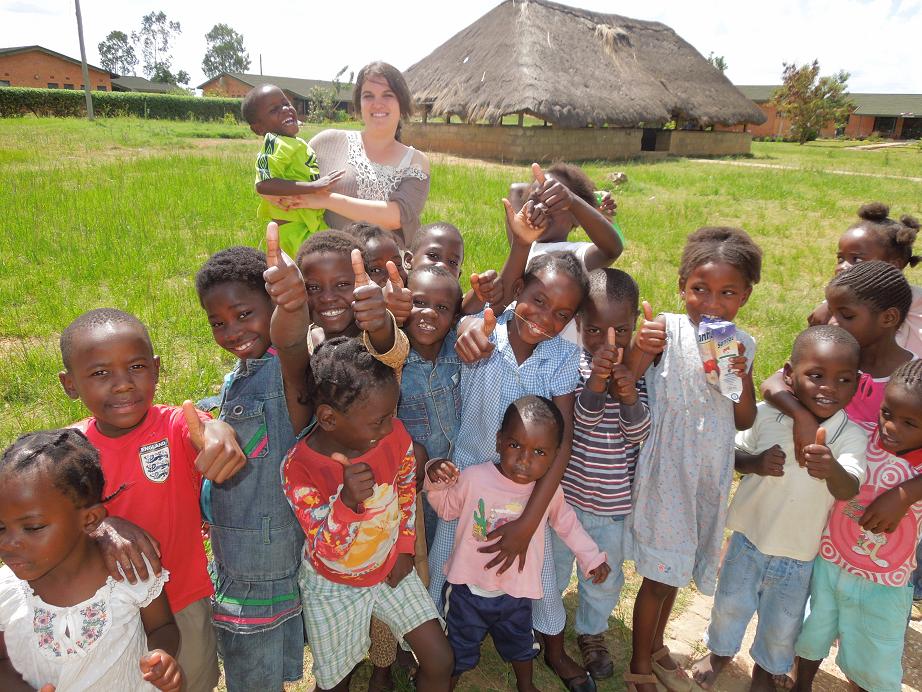
The children of the Chikumbuso project outside the art room.
Driving down the long dirt road, our driver constantly dodging pedestrians, we finally found an area to park our bus at the Soweto market in Lusaka. The brief glimpses I gathered as we drove towards our spot were merely a preview of the experience we were about to dive head first into. The amount of people flowing in different directions made our travel to our parking space quite a challenge.
Smile and PowerthroughHowever, one thing that I noticed about the Zambian culture is that despite their destitute living conditions, the people are very exuberant. It is difficult to see a child selling fruit while covered in mud and flies, yet a bright white smile flashing through. At the Soweto market and in my other interactions with Zambians, it truly amazes me how overly helpful and pleasant the people are. I cannot imagine living in many the conditions that I saw, so seeing how happy and pleasant the people of the country are while enduring their struggles made me really realize how trivial many of my everyday “problems” are back home. At the market it wasn’t uncommon to see people in used and tattered clothes, but it was just as common to see those people laughing and having a good time as well.
By Alisha Estabrook, in Lusaka
Currently, Ohio University students studying abroad in Zambia since Nov. 26 have so far noticed some differences between the way people here run media, society and government versus the United States.
It is important to keep in mind that while these observations are comparing two nations, they are vastly different nations, on opposite hemispheres. Zambia is seven hours ahead of United States Eastern Standard Time on Daylight Savings. It took traveling across the Atlantic Ocean and crossing the Prime Meridian and Equator to skip forward in time. As someone who comes from a small town in the United States, I should point out that even big cities in the U.S. are strange territory for me.
This is Zambia in my opinion and its differences:
Transportation
In the first leg of our journey, I noticed quite a few differences in how people utilize transportation here in terms of personal vehicles, buses and walking.
I have noticed that most vehicles have large license plates. They are taller than the ones found in the U.S., unless the plate is on a truck, then it is thin and long. For identification, the plates have three letters followed by a second line of four numbers.
Many people use buses to get around. They have short fronts that enable them to keep up with the congested traffic. They cram as many pedestrians into the bus as possible. People are packed in like sardines. The bus will even have people lying across people to squeeze in more bodies.
Bus stops are all over Lusaka, the capital of Zambia. They have pull-off areas connected to the road to pick people up. Many buses can occupy one pull-off area, making buses stick out into oncoming traffic. This is the cause of quite a bit of honking, but not the only honking. It seems that horns are constantly sounding, so much that we do not know why people honk half of the time.
Traffic never seems to slow down, unless there’s a jam. Merging on to a road seems dangerous, as it is not uncommon for cars behind you to not slow down. Certain times during the day, like when people travel to work, are busier than other times. Here, a traffic jam is part of the daily routine.
Main roads are paved, but side roads aren’t necessarily. Most vehicles are capable of off-roading. It has surprised me what the University of Zambia bus, our designated transportation for this trip, can make it though. I’m not sure if a typical bus driver from the U.S. would attempt half the things our driver has accomplished.
It took a few days before we saw a stoplight, and even longer before we came across a stop sign. Instead, Lusaka has many roundabouts. The stoplights and stop signs seem to be saved for the middle of the city, or less busy areas. But even then, you have to beware of traffic disregarding the signal.
Many road signs don’t have words on them. The outline and color of a yield sign is enough to get the message across. Street signs are limited. Usually bigger roads have names pointed out. The roundabouts are more likely to have the street names before the intersection, but in the case of smaller roads, I usually can’t find a street sign.
I have also noticed many speed bumps all over Lusaka as a way to help slow down traffic.
Not once have I seen any sort of handicapped parking space. I’m not sure if this is attributed to the fact that Zambians don’t live as long as people in the U.S. or not. I haven’t seen any elderly people out and about either, so there doesn’t seem to be a real need for them.
On Foot
People can be seen walking at any time of day. Pathways cut across the country or through fences. Footbridges are available so people can cross above busy streets. Sidewalks are generally found on busy streets either beside the road, separated by bumper strips or grass.
Young children travel on the backs of mothers wrapped in cloth that is tied in front of the woman’s chest.
They aren’t really crosswalks like the U.S. utilizes, and there is no concept of “jaywalking” (even though many people in the U.S. disregard that law too). People cross in front of traffic all the time, even when vehicles are traveling towards them. Vehicles drive alongside people, most of the time in really close proximity. I’m surprised people aren’t hit more often. Many people also stand in the middle of the road, attempting to sell newspapers or cell phone minutes to drivers and passengers. Lots of people also clean the sides of the roads as vehicles speed beside them.
Generally, most of these practices seem like a hazard to me. Coming from the U.S., I notice these things as differences from how the general public or I travel. Somehow, it works for Zambia.
Note these observations are only from Lusaka. I am looking forward to traveling outside of the capital to see how highways and other cities work with transportation.
Alisha Estabrook is one of 18 students from Ohio University, studying abroad in Zambia over winter intercession, about media, society, and governance, through the Institute for International Journalism
| A child smiles outside the door of a traditional healer |
| A child at the Kasisi Orphanage, just outside Lusaka |
By Brenda Evans in Lusaka, Zambia
| Lusaka, Zambia |
| Home in Kalingalinga |
When I thought about orphanages, I imagined small, crowded rooms full of children with three or four caretakers chasing after them. This thought was further initiated in my mind when I traveled to Vietnam two years ago and played with children for a few hours at an orphanage in Nha Trang, Vietnam. I assumed when I found out that I would be interning at SOS Children’s Villages in Zambia that I would be met with similar circumstances like Vietnam where there would be overcrowding and a small staff.
However, I knew that I wanted to push myself out of my limits and try to make a difference during my short time in Lusaka, so I decided to sign up to a intern at a non-profit organization even if the experience could potentially be emotionally taxing.
History of SOS Children's Villages

Built in a dangerous area where murders were commonplace, SOS Children’s Village was established in 1996; however the organization began in 1949 in Austria. The SOS Children’s Villlages operate just like real-world villages where there are homes and a school. Twelve children live together in a house operated by a mom. There are currently 531 SOS Children’s Villages in the world with many of the organizations concentrated in Africa. Once the child turns 15, he or she is then placed in a youth facility where the teenagers live together like a roommate where they are also given a stipend to be used for groceries or whatever others items that can be afforded within the budget.
Mothers are given weekly stipends to be used for groceries or whatever items they wish. Once the children are placed in the youth housing, they are also given a stipend to pay for their food. SOS Children’s Villages is a home for children regardless of their situations—some are orphaned, others may be given to the village for concerns of abusive families. Whatever the situation, children are never turned away.
My experience interning at the village
Spending a day at SOS Children’s Villages can give you such a feeling of reassurance that at times I even forget that the children are orphans, however I am always pulled back into reality. The children are so intrigued with my personal life that will ask my questions such as, “Do you have parents?” Forgetting for a brief second that some of them are orphans, I reply, “Yes, but my mother passed away five years ago.” As soon as I was finished with the sentence, I was bombarded with replies of agreement that some of the mothers of the orphans had died as well.
Unless someone asked if the child was an orphan, I strongly believe that it would be strongly difficult for an outsider to discern if the child was an orphan or not. The children at the village are strong willed, intelligent and kind. Chelsea Moulder, my fellow intern and student at Ohio University, played a game with the girls that focused on self-esteem. Before starting the game, we went around the room asking them what they wanted to be when they were older. Without hesitation, almost every girl replied with either nurse, doctor or teacher.
The children at SOS Childrens Villages are without a doubt the nicest children that I have ever met. I love having opportunities volunteering at a non-profit because it reminds me to always stay grateful for what I have in the United States. Before I left the United States, I had the preconceived notion that most countries operated just like in the United States. I now know after traveling in college that this is not true. As the Christmas season approaches, consider sponsoring a child from SOS Children's Villages in Zambia. Can’t wait to see what all else happens in Zambia!
Bethany Scott is one of 18 students from Ohio University, studying abroad in Zambia over winter intercession, about media, society, and governance, through the Institute for International Journalism.
The college search process is an almost ascertain part of many American students lives as they near the end of their secondary educations. University of California Santa Barbara, Indiana University, University of Tennessee, University of South Florida, Miami University, Ohio University. I visited five different states, thousands of miles apart, over the time-span of a few months, all in the search for a university that would be just the right “fit” for me. Four years and some odd months later, I still remember the college search processclearly. There was a lot of travel, a number of campus tours, meetings with department heads, and speaking to current students about their experiences. I was excited for what my future had in store, and not once did it cross my mind that I would do something after high school other than attend a university.
The purpose of the Young African Leaders Initiative (YALI) Connect Camps is to invest in the next generation of African leaders through intensive executive leadership training, networking, and skills building, which will prepare them to make social change in their communities. The core Ohio University team working jointly with The Collaboratory at the U.S. Department of States Bureau of Educational and Cultural Affairs has designed a program for the YALI participants called Connect Camps taking place in sub-Saharan Africa to pursue the following goals:
1) Give up to 160 young African leaders the opportunity to collaborate, learn, and network with U.S. and African resource experts and with each other during the eight YALI Connect Camps; to develop innovation strategies that build on their professional skills, engage in hands-on experience with low-bandwidth technologies, conduct community outreach, and build their capacity through mentoring, networking, and using strategic civic leadership for social change.
2) Use a stimulating canvas model of leadership to develop skills in entrepreneurship and creating social change by engaging in five-days of facilitated interactive sub-group workshops, and fostering mentorship relationships between the Mandela Washington Fellow alumni and their chosen mentees for the Camp.
3) Demonstrate some community-oriented enterprises using applied technology that supports innovation and collaboration in community development and entrepreneurship, civic leadership, and public management.
4) Develop leadership skills among delegates through mentoring relationships, between themselves, as well as with American and African facilitators.
5) Provide participants with opportunities for face-to-face networking and to facilitate a collaborative, innovative project or projects that further YALI goals.
Various U.S. Embassies in Africa have been instrumental in the selection and coordination of hosting the Connect Camps. The YALI Connect Camps are funded by a grant from the U.S. Department of States Bureau of Educational & Cultural Affairs and administered by the Institute for International Journalism (IIJ) at Ohio University.