By Lindsay Boyle
During the latter part of third week of the 2012 SUSI program, the scholars journeyed to Atlanta for two days full of media and cultural visits.
The SUSI summer institute — in which scholars from all over the world come to the E.W. Scripps School of Journalism at Ohio University to study journalism and media — is funded by an annual renewable grant from the U.S. Department of State’s Study of the U.S. Branch in the Office of Academic Exchange Programs.
Early on July 26, the scholars visited the headquarters of CNN. Once there, they split into two groups to tour multiple studios and newsrooms, including the domestic and international studios. During the tour, they learned more about how CNN’s media system works.

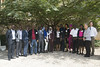
SUSI scholars pose outside of the CNN headquarters.
The scholars were also able to meet with Eli Flournoy, who is CNN Worldwide’s first director of International Newsource. Flournoy grew up in Athens, Ohio, and is an alumnus of
Athens High School. Additionally, his father is a professor in OU’s School of Media Arts and Studies.
Dr. Suren Deheryan, the SUSI scholar from Armenia, said that the CNN visit was very interesting. Because he comes from a small country with small media organizations, he felt he could apply what he learned at CNN to help improve Armenian media.
“As a journalist and as a lecturer of media, it is very important for me to be there and to see what CNN is in the U.S., how it works,” he said. “It gives us some ideas about how we can, for example, organize our editorials.”
Later that day, the scholars traveled to World of Coca-Cola, where they were able to learn about the history and marketing of Coca-Cola on an international level. They also tasted samples of Coca-Cola from around the world. According to some of the scholars, some versions of Coca-Cola taste very different than others — and not always in a good way.

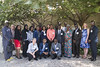
Dr. Aysha Abughazzi and Prof. Karlyga Myssayeva pose inside the World of Coca-Cola.
On July 27, the scholars began their day by stopping by The Carter Center, where they met with associates who talked about how the center operates around the world. The center works primarily to alleviate human suffering, resolve conflicts, expand freedom and improve health.
Next, the scholars visited the Jimmy Carter Library and Museum. There, they were given a presentation about presidential history in the United States, followed by a tour of the museum. The museum includes an exact replica of the Oval Office, as well as a permanent exhibit that documents significant events from former President Jimmy Carter’s life and career.
The scholars also spent time at the Martin Luther King Jr. National Historic Site, where they learned about the civil rights movement and the history Atlanta. The site includes King’s birth home, the church where he preached, his tomb, a monument, a rose garden and a visitor’s center.

Dr. Wilberforce Dzisah and Prof. Divine Bisong pose in front of the Dr. and Mrs. King's tomb.
Scholar Aazadi Burfat, from Pakistan, described the visit to the Martin Luther King Jr. National Historical Site as inspirational, but also described some of the material she saw as “touchy.”
“Segregation is the ugliest form of human pride and arrogance,” she said. “I never imagined that the United States, a very developed and modern society, had those deep social movements and struggles in its history against race, creed and color, like we have in developing societies.”
She said that, in Pakistan, people know and read a lot about Martin Luther King Jr. She likened him to a former Pakistani leader, Zulfiqar Ali Bhutto, who was renowned for his “distinct, revolutionary and brave” behavior.
“(Martin Luther King Jr.’s) idea of nonviolence is so fascinating and needed at this time that it must be promoted,” she said. “He will remain symbol of nonviolence, courage and never ending hope.”
The scholars enjoyed dinner at The Sun Dial Restaurant, an upscale restaurant with three floors, one of which features a 360-degree view of Atlanta’s skyline. They were joined by CNN’s Flournoy. After an evening full of conversation, the scholars observed a beautiful sunset and documented it well.

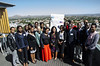
SUSI scholars take pictures of the sunset from The Sun Dial Restaurant.
To end their time in Atlanta, the scholars experienced U.S. nightlife at the Havana Club, where they enjoyed music and danced.
Monday, August 6, 2012
Scholars travel to Atlanta

International Mass Media: July 23
By Lindsay Boyle
On Monday, July 23, the fifth International Mass Media summer course was held in Copeland Hall at the Ohio University campus. During each class, two SUSI scholars give a lecture about their own country’s media systems, journalism practices and political cultures. All of the lectures are streamed live through Ohio University distance learning and are available online to 35 students who are taking a summer class instructed by Dr. Brook Beshah.
The SUSI summer institute — in which scholars from all over the world come to the E.W. Scripps School of Journalism at OU to study journalism and media — is funded by an annual renewable grant from the U.S. Department of State’s Study of the U.S. Branch in the Office of Academic Exchange Programs.
Dr. Huei Lan Wang
Taiwan
Dr. Huei Lan Wang, the scholar from Taiwan, began her presentation with a personal background describing her education, work experience, academic memberships and research areas.
She then briefly introduced Nanhua University, where she is an assistant professor. It was established in 1996, includes five colleges and has sister schools in more than 20 countries.
Wang also briefly explained the history and demographics of Taiwan, which is officially known as the Republic of China. Although Taiwan spent more than 35 years of the 20th century under martial law, it now operates as a multi-party democracy. Its population is 23 million.
When martial law was instated in 1949, new newspapers were banned in Taiwan, Wang explained. However, martial was lifted in 1988, and since then, several laws have worked to increase the media’s freedom and to allow new media outlets to exist.
Media in Taiwan are affiliated with many different things, including the government, political parties, businesses and more. According to Wang, there are about 1,900 domestic news agencies. The biggest, Central News Agency, provides news in Chinese, English and Spanish, and has correspondents in 17 countries.
According to Wang, newspaper readership was at its highest in 1991, but is now around 40 percent. The top four papers in Taiwan are Liberty Times, Apple Daily, United Daily News and China Times.

SUSI scholars and staff listen as scholar Dr. Huei Lan Wang presents a lecture that is streamed live through OU distance learning, and is available online.
In Taiwan, there are more than 8,000 magazines that cover a wide variety of topics. However, Wang said books are less likely to succeed. They typically need to sell more than 5,000 copies to be profitable, but most do not sell more than 3,000.
Of the 171 existing radio stations in Taiwan, Wang said that 141 of them were established after 1993. Some stations, such as Radio Taiwan International, broadcast in more than 10 languages.
Wang explained that there are also many different television stations in Taiwan, a country that has the highest television penetration rate in the Asia-Pacific region. Television in Taiwan is expected to switch from analog to digital in the near future.
Taiwan is considered a leading e-society in Asia, according to Wang. Cell phone and Internet usage rates are high, and citizen journalism networks and social media websites are very popular. Overall, the country has a liberal stance on Internet regulation, and the media is, in general, free.
Wang described her experience presenting as “wonderful and unique,” and said she has really enjoyed listening to others’ presentations. She has especially enjoyed the discussions that come afterward because of the insightful questions that are asked.
“I have gained many different perspectives on other colleagues' thoughts, stimulating me to not only expand my knowledge about other countries' media structures, but also to treasure their rich and diverse cultures,” she said.
Prof. Karlyga Myssayeva
Kazakhstan
Professor Karlyga Myssayeva, the scholar from Kazakhstan, first spoke about her institution, Al-Farabi Kazakh National University. She then gave a brief overview of Kazakhstan, which is the ninth largest country in the world.
She explained that there are about 2,970 registered media in Kazakhstan. The majority are newspapers and magazines, while about 240 are electronic media such as TV channels and radio stations. In addition, there are about 2,400 foreign media outlets that distribute in the country, including the BBC, CNN, Deutsche Welle and Freedom Radio Station.
As far as ownership goes, Myssayeva said that about 75 percent of media are not government-owned. A combination of social associations, political parties and movements, and religious organizations own much of the media. According to Myssayeva, the media cover many different topics.
Of the nearly 1,300 periodicals published in Kazakhstan, Myssayeva said that most are printed in Kazakh, Russian or both, while about 130 are printed in various other languages.
Additionally, TV programs broadcast in up to 12 languages, and radio stations broadcast in six. Myssayeva explained that the government often provides financial support to mass media outlets owned by ethnic minorities. There are about 100 TV channels and radio stations total in Kazakhstan, as well as satellite TV stations such as Caspionet.
Myssayeva explained that there are many popular newspapers in Kazakhstan—some that are government-backed, others that are considered opposition papers, and some that are simply private. Those include Kazakhstanskava Pravda, Vremya, Zhas Alash, Karavan and more.
According to Myssayeva, the Internet in Kazakhstan is quickly developing, and there are thousands of Kazakh blogs. However, the most popular social website is Vkontakte, rather than Facebook, Twitter or YouTube.

SUSI scholar Dr. Aysha Abughazzi asks scholar Karlyga Myssayeva a question during her lecture that is streamed live through OU distance learning, and is available online.
In Kazakhstan, there are two primary news agencies: Kazinform and Interfax Kazakhstan. Additionally, Myssayeva said that more than 80 accredited representatives of foreign mass media from 20 countries reside in Kazakhstan. There are also more than 15 non-governmental organizations working to improve different aspects of media in Kazakhstan.
Shortly after gaining independence in the early 1990s, Myssayeva said that mass media actively progressed. However, toward the end of that decade, many popular, independent TV and radio stations that criticized the state authority were closed.
Now, Myssayeva said that media need to work on improving quality while keeping risks in mind. She said that many reporters and editors are interested in and willing to attend trainings and seminars. However, she also explained that the development of media in Kazakhstan greatly depends on the political situation in the country.
Though media in other countries act as governmental watchdogs, Myssayeva said that media in Kazakhstan are more likely to cover ongoing events rather than act as analysts who predict future developments. She pointed out that, according to both Freedom House and Reporters without Borders, Kazakhstan mass media is not free.
Myssayeva said she was excited but also sometimes uncomfortable during her presentation, because giving a presentation in English was not easy for her. However, she said that it turned out well, and that many people in the audience asked her questions.
She said that her experience with the course has been incredible. Because she teaches International Mass Media at her university, she is looking forward to having new material for her course next semester.
“From the International Mass Media class, I found that it is never too late to learn,” she said. “All of the technical and performance skills I've learned in the class will really pay off when I'm in Kazakhstan.”
U.S women basketball players stay humble and hungry for gold


Photo by Jillian Fellows
Sunday, August 5, 2012
Journalism: the fine art of hanging around
- I have mastered the fine art of “hanging around” that some call journalism
- I know what it means to finally #partylikeajournalist
 |
| The USA BMX team press conference. Photo by me. |
 |
| This was at the Michael Phelps press conference. Photo also by me. |
Saturday, August 4, 2012
Athens: Town of education and ghosts
By Dr. Ibaa Awad
Athens is an ever green town accompanied by the Hocking River water, which makes it ever beautiful. It is located in the state of Ohio. It is not an old town, the age of which is just more than 200 years. However, what makes it famous is Ohio University, which has been a safe haven for students not only originally from the United States, but also from all over the world.
I was informed about OU by my professor who studied in the E.W. Scripps School of Journalism during the 1960s. He is now 75 years old. Nevertheless, he still keeps nice memories with him of friends, colleagues and professors.
A number of sites are in Athens for gifts and souvenirs, including restaurants, handmade glass and ceramics stores, and stores with funny clothes and accessories.
History and nature are also found in Athens. One well-known historical site in this town is the Ridges Cemetery, in which unidentified people are buried. It was used by a mental hospital that no longer operates. Authorities in Athens work to identify the people who are in the cemetery according to information collected from the relatives of people who may be in the graves.
In the town, stories are also circulated about ghosts. Some people consider the stories to be just rumors and a matter of making fun, but other people believe in the ghost chats. I wonder if children of modern societies believe in ghosts or not?
Thursday, August 2, 2012
Amish: Simple life in modern country
By: Dr. Ibaa Awad
Amish are just people like you and others. They live as any humans live and do whatever they like to do while looking after their families. Their life, whatever it is, is full of brightness and gloominess. They live behind the scenes in a world of seriousness and obedience to their religious believes. They resisted the reforms which were created by Martin Luther and his followers in Europe.
They are known as Amish and Mennonites, named after their leader, Menno Simons.
Amish refuse child baptism, however they believe in adult baptism. They also believe that God called his followers to isolate themselves from the surrounding world in order to secure their life from materialistic desires and stick to nature by leading a simple life style. Thus they use buggies in their transportation, away from all signs of modernization and new technology which make people’s lives easier than in the past.

Some SUSI colleagues try out an Amish buggy.
Amish people think that higher education is not a necessity in their life. Their children go to until the eighth grade. Most of the Amish prefer to send their children to parochial schools which are specially designed for them.
Who could believe that such people live in the United States and still stick to an ancient lifestyle? We believe that because we met them. Their younger generations still stick to their traditions and they are still upbringing their future generations on the current beliefs.
Some people love to live in this simple life away from the complications of technology, while others can’t imagine such life. However, we are obliged to respect their beliefs for what they are.
Wednesday, August 1, 2012
SUSI - Name of New Bonds by Aazadi Fateh, Pakistan
SUSI 2012 Scholar
 SUSI ... half an year ago this title was nothing else for me but a name
of some fellowship. When I heard about my nomination in SUSI I got so
excited and happy, but all I could think of SUSI before actually
being a part of SUSI was just academics, media visits and study. When I arrived
in Columbus July 5, 2012, the warm and friendly welcome by Prof. Yusuf
Kalyango, Sally Ann and of course Camilo made me feel so secure and
home. The next morning, I was the first to arrive for introductions in the University Courtyard lounge and met Prof. Aimee. The very first impression of her
was so caring and helpful. Then Prof. Mary, Jean Marie, Jim, Lindsay, and Ashley, all Scripps colleagues. They did a great job in breaking our
hesitation and formal covers with their attitude and care. In
Pakistan, we think developed world people always remain self-centered and they never care about others, but this idea was proved wrong when I entered the world of SUSI.
SUSI ... half an year ago this title was nothing else for me but a name
of some fellowship. When I heard about my nomination in SUSI I got so
excited and happy, but all I could think of SUSI before actually
being a part of SUSI was just academics, media visits and study. When I arrived
in Columbus July 5, 2012, the warm and friendly welcome by Prof. Yusuf
Kalyango, Sally Ann and of course Camilo made me feel so secure and
home. The next morning, I was the first to arrive for introductions in the University Courtyard lounge and met Prof. Aimee. The very first impression of her
was so caring and helpful. Then Prof. Mary, Jean Marie, Jim, Lindsay, and Ashley, all Scripps colleagues. They did a great job in breaking our
hesitation and formal covers with their attitude and care. In
Pakistan, we think developed world people always remain self-centered and they never care about others, but this idea was proved wrong when I entered the world of SUSI. The first week was all about introductions and orientations. Eighteen of us
from different cultures and languages mostly interacted in smiles and
formal sentences only. I remember Prof. Mary mentioned in our earlier
classes that we are so quiet, but there would be a time when she'll be
asking us to stop talking and pay attention. Her statement seemed a
fantasy at that time, because we all were so different from each other and
so strange. But in only a couple more days, she proved to be right. We
discovered our bonds of friendship and frankness very soon.. In class, the van, computer labs or Walmart, we started chatting and approaching one
another. And now we talk, joke and share everything like family. This
is a very intense study and travel plan, and our little jokes, fun and
sharing, and most of all being together all the time is something that adds a
very beautiful color to those routines.
The first week was all about introductions and orientations. Eighteen of us
from different cultures and languages mostly interacted in smiles and
formal sentences only. I remember Prof. Mary mentioned in our earlier
classes that we are so quiet, but there would be a time when she'll be
asking us to stop talking and pay attention. Her statement seemed a
fantasy at that time, because we all were so different from each other and
so strange. But in only a couple more days, she proved to be right. We
discovered our bonds of friendship and frankness very soon.. In class, the van, computer labs or Walmart, we started chatting and approaching one
another. And now we talk, joke and share everything like family. This
is a very intense study and travel plan, and our little jokes, fun and
sharing, and most of all being together all the time is something that adds a
very beautiful color to those routines.From my apartment mates Ibaa and Trang, to Karla, Huei Lan, Guoping, Taimoor, Rachael, Dana, Suren, Silvia, Sasha (Alexander), Aysha, Divine, Wilberforce, Murad, Hugo, and Alexandre, I feel a very different affiliation with all of them. We have our little secrets and joys in or out of the class, and we act like students and even kids sometimes.

Now, SUSI is the name of memories, and friends for me :) !!


Tuesday, July 31, 2012
International Mass Media: July 12
By Lindsay Boyle
On Thursday, July 12, the fourth International Mass Media summer course was held in Copeland Hall at the Ohio University campus. During each class, two SUSI scholars give a lecture about their own country’s media systems, journalism practices and political cultures. All of the lectures are streamed live through Ohio University distance learning and are available online to 35 students who are taking a summer class instructed by Dr. Brook Beshah.
The SUSI summer institute — in which scholars from all over the world come to the E.W. Scripps School of Journalism at OU to study journalism and media — is funded by an annual renewable grant from the U.S. Department of State’s Study of the U.S. Branch in the Office of Academic Exchange Programs.
Dr. Murad Abdullah
Yemen
To kick off his presentation, Dr. Murad Abdullah, the scholar from Yemen, began with an overview of the Yemeni political structure.
Abdullah explained that about 16 months ago, just one man — who claimed the government was a republic — essentially ruled Yemen. During that time, Abdullah explained that news was predictable — there was no criticism of basic government policy, except for complaints about lower-level government employees.
However, in 2011, the Yemeni Revolution ultimately brought a new leader into power. In Yemen today, Abdullah explained that there are five main types of media: government-controlled, party-affiliated, international, independent and social.
The government-controlled media includes two TV channels and several radio channels, as well as some print outlets. Today, the press is used primarily as a tool of political mobilization of the public.
There are several different party-affiliated media, which are run and sponsored by political parties. Abdullah explained that those media typically target the ruling regime with heavy criticism. They publish issues directly concerning their members, and often neglect human rights issues. However, Abdullah said that party-affiliated media did play a positive role throughout the Yemeni Revolution.
Independent media in Yemen is complicated. Though there are many different TV and radio channels, Abdullah said they are often aired from elsewhere, such as London or Egypt. That is changing as the constitution, reviewed by the new government, now allows more freedom.

SUSI scholar Dr. Murad Abdullah presents a lecture that is streamed live through OU distance learning, and is available online.
Abdullah explained that there are also independent newspapers, but though professional journalists run them, parties are sometimes behind them. Such papers often tackle only certain issues and help certain parties.
Finally, there are truly independent media, which Abdullah said are preferred by the public. However, he explained that because many journalists do not know much about business management, such media often close down. Additionally, there is not always a lot of fact checking, which can lead to coverage of false information.
During the Yemeni Revolution, Abdullah said that social media were active and vibrant. Though social media did not cause the revolution, he said they did help it continue. Regardless, Abdullah pointed out that users of social media are still a minority in Yemen, and that social media can also have credibility issues.
Ultimately, Abdullah is not optimistic about the future of independent media, but is optimistic about that of governmental media. He said he believes that the latter have truly divorced from the past regime and no longer want to be the tool of a ruler. He also explained that Yemen’s new president seems genuinely willing to bring about change.
Although he prepared for his presentation one day prior to it, Abdullah said he had gathered the information for it while he was still in Yemen. For him, it was not difficult to present in front of his colleagues. However, he did mention some challenges.
“What is special about the event is that it is a new environment and a new audience,” he said. “I had the challenges of deciding how to make the information focused and concentrated to the media in Yemen, and how to give information that the audience would understand easily, as they don’t have background about the country of Yemen.”
Prof. Rachael van der Kooye
Suriname
Scholar Rachael van der Kooye, from Suriname, began her presentation with an introduction of herself, as well as an overview of her country. She explained that Suriname has a very culturally diverse population and that, for the most part, the different groups live in peace with one another.
She said that, in the past, a violent and unfriendly media culture existed in Suriname. However, that culture mostly disappeared after a nearly five-year-long civil war ended in 1992.
Suriname is a republic in which presidents are elected to five-year terms. However, the current president, Desi Bouterse, is controversial and has been accused of killing political opponents.
As far as Suriname’s media is concerned, van der Kooye explained that several TV stations, radio channels, newspapers, magazines and Internet news sites exist, and are owned by a mixture of the government, private groups and political parties.
In Suriname, multiple governmental ministries are responsible for media regulation, which includes granting licenses, dealing with legal matters and property rights, and more.
Despite the regulation, van der Kooye said that journalism suffers from many different things. Media owners rarely pay attention to quality; unprofessional conduct and propaganda are frequent; there is a lack of ethical principles, journalistic training and investigative journalism, and journalists are usually overworked and underpaid.

SUSI scholars and staff listen as scholar Rachael van der Kooye presents a lecture that is streamed live through OU distance learning, and is available online.
Additionally, the history of human rights violations in Suriname caused many journalists to be murdered or imprisoned, or to flee the country, according to van der Kooye.
Because media have been discovered as a way to gain power, influence and money, there has been an explosion of media within the past five years.
Often, journalists are politically affiliated, which disrupts objectivity and independence, according to van der Kooye. Many journalists limit themselves by simply copying press releases and by asking few or no critical questions. That occurs because those who ask critical questions can receive threats.
Suriname’s current government cultivates an image of fear not only through threats, but also through intimidation and boycotting media, van der Kooye said. Journalists are also limited in that the government does not openly provide information to them.
Ultimately, although press freedom is a constitutional law in Suriname, the majority of media operate under a system of self-censorship.
At the end of her presentation, van der Kooye warned that journalists in her country and others should remember that politicians often do not like journalists themselves, but rather the influence that journalists have.
“I don’t want to be a politician to change things, I want to be a teacher,” she said, bringing about applause from the audience.
Monday, July 30, 2012
International Mass Media: July 11
By Lindsay Boyle
On Wednesday, July 11, the third International Mass Media summer course was held in Copeland Hall at the Ohio University campus. During each class, two SUSI scholars give a lecture about their own country’s media systems, journalism practices and political cultures. All of the lectures are streamed live through Ohio University distance learning and are available online to 35 students who are taking a summer class instructed by Dr. Brook Beshah.
The SUSI summer institute — in which scholars from all over the world come to the E.W. Scripps School of Journalism at OU to study journalism and media — is funded by an annual renewable grant from the U.S. Department of State’s Study of the U.S. Branch in the Office of Academic Exchange Programs.
Prof. Taimoor Noori
Afghanistan
In his presentation, Taimoor Noori first described the reach of various types of media in Afghanistan, explaining that both commercial and state-owned TV and radio are currently the most prominent and effective.
Though media on the Internet does impact what appears on TV and radio, Noori said that its reach is minimal throughout his country.
Print publications are doing the least well of all formats, which Noori said is likely due to the low levels of literacy in the country. Afghanistan has no official national newspaper.
In addition, Noori explained that citizens overall are deprived of many media outlets because the current regime does not allow them. However, because of the large amount of international troops stationed in Afghanistan, he said that several international news organizations are present, though they come and go.
Noori himself works for the New York Times doing correspondence about an ongoing war. He explained that the presence of such international publications is important, because their criticism of the current regime encourages local outlets to do the same — something he said he feels could bring about change.

SUSI scholar Taimoor Noori listens to a speaker during a morning class.
When local journalists criticize the government, however, it is not without risk. Although there is no official censorship in his country, Noori said threats from the reigning regime have become increasingly common in recent years. Such threats range from detainment to lawsuits to assassination attempts.
In addition, Noori explained that the government sometimes denies the stories written by journalists by saying the journalists are spreading rumors and lies, or that they are spying for Iran or Pakistan. Such comments can endanger the journalists’ lives and tarnish their reputations.
Also working against the journalists — or at least the ones who work for Western media — is that many Afghans believe Western media work for their own interests, not to bring change in Afghanistan. According to Noori, many Afghans also believe that Western alliance forces have misled them by not making good on their promises to bring peace, stability and prosperity to Afghanistan.
Overall, Noori described most people in Afghanistan as being critical of the government, logical and open-minded. He said that they may need organizational help and assistance to create a more peaceful and stable nation, but otherwise would prefer to no longer be disrupted.
Dr. Alexsandr Kazakov
Russia
SUSI scholar Dr. Alexsandr Kazakov began his presentation with a brief introduction of his institution, Saratov State University.
Afterward, he explained his hopes to learn more about the United States, as well as his desire to dispel some existing stereotypes about Russia. He mentioned some of those stereotypes and how they were not true for him, which brought about laughter in the classroom.
Kazakov then transitioned into a brief history of media development in Russia in the 20th century, from media under leader Joseph Stalin, to Nikita Khrushchev, and onward.
In Russia today, Kazakov explained that the main sources of information are, in order, TV, print, Internet and then radio. He said that national, regional and local levels of media are pretty evenly split.
After explaining that there are more than 26,000 papers in circulation, Kazakov reminded his audience that Russia is a huge country with a large population. He said a good aspect of that is that there is no existing monopoly of information or opinion in Russia.
According to Kazakov, there are two primary approaches to media in Russia, and most Russian media outlets fall somewhere in between the two.

SUSI scholar Dr. Alexsandr Kazakov presents a lecture that is streamed live through OU distance learning, and is available online.
He said the first approach is one that is critical of the current regime and affiliated with the opposition. In 2000, Kazakov explained that the government started to gag that form of media by banning several national TV channels and papers, forcing some journalists to resign, and forbidding live political talk shows. Russian media is far from free, according to Kazakov.
However, he said the second approach is state-oriented, but does not have state censorship. Instead, it is a quickly rising independent media system that holds press freedom as a key value. Regardless, Kazakov explained that many outlets still think that it is better to generally support the government than to criticize it, or to follow Western interests.
Overall, Russian media fall in a mixed category that is transitioning. More and more outlets are trying to push the limits of what they can cover. That is possible especially through Russia’s uninhibited Internet.
In Russia, social media are becoming more popular, but only among youth, Kazakov said. Despite the small age range using the medium, Kazakov explained that social media still affects politics in Russia. Aside from social media and the Internet in general, though, he said the influence of outside Western media is limited.
Kazakov spent much time prior to the presentation preparing, and said that he felt a bit anxious. Ultimately, however, he said that everything went well.
“I think that every scholar feels anxious, and has butterflies in his or her stomach," he said. "But when it comes to presenting, it’s OK, because the atmosphere is very nice, it’s very calm, and nobody asks you very difficult or rude questions.”