Thursday, July 24, 2014
A Different World that is United States of America
By Ellard Spencer Manjawira, Malawi (SUSI scholar 2014)
When I broke news to my colleague in Malawi that I would be travelling to the United States for a six week study tour, his comments were: “Get prepared for a lot of shocks because the US is a totally different world to the one you are used to”.
Shocks? Different world? I did not take him seriously
Throughout the first leg of my journey from Malawi’s capital Lilongwe via Nairobi in Kenya up to the moment of arrival at Schiphol Airport in Amsterdam, Netherlands it never occurred to me to check itinerary departure and arrival times. I paused for a moment to verify if what I read was correct. To my utter astonishment, the itinerary indicated 10.25 as departure time from Schiphol Airport in Amsterdam, Holland and arriving 12.55at Detroit Airport in the US.
I hastily concluded that there was a mistake on the ticket documentation because it was virtually impossible for such a long trip across the huge Atlantic Ocean to take a mere two and half hours. One thing that had skipped my mind was the transition from one time zone to another, from western Europe to America.
I later discovered that because Europe was five hours ahead of US time, the journey was to take approximately eight hours and not two. I had to adjust my clock upon arrival at Detroit. Was this the beginning of the shocks my colleague had referred to? I wondered.
“Go to the passenger’s side,” these were the words from the driver of a van picking me and another scholar from Detroit Airport to a nearby Airport for a short rest before an hour-long trip to Athens. I had aimed at the front left hand seat, only to realize that in US, cars are left hand driven. And to add further to my confusion,the van drove on the right hand side of the road. It was then that I knew I was destined for more surprises and shocks.
One dominant feature that I have experienced during the study tour is time keeping.
“In America we believe in starting and ending schedules on time, no compromise on this”. Program Director of the Study in US Institute on Journalism and Media at Ohio University Dr. Yusuf Kalyango emphasized these words during an orientation briefing. When the program director handed to each of the eighteen scholars a detailed fifteen page program of activities, I realized that the journey that finally got the training schedule in place was not an easy one; it had taken months of planning!
I asked myself whether it would be possible to follow to the letter the schedule of academic sessions and cultural visits spanning over six weeks or 44 days. Five weeks into the program, I have come to realize the possibility of what I have for a long time considered impossible. Among many Malawians time keeping is a big challenge. It is practically impossible to follow schedules even for one day. Functions are delayed because organizers, presenters or participants report late. The SUSI program has taught me that it is possible to keep time.
One weekend a Malawi citizen resident in Athens took me out to a shopping outlet in Parkersburg some forty miles out of the town. On the way, I pondered several things that make the US experience very fascinating including that in summer the sun does not set until around 9 o’clock at night.
“I have had problems going to bed when there was no darkness thinking it was still afternoon,” I joked as our journey progressed. He then branched off to refill the tank of his car. The filling station or what is called gas station here in the US looked deserted. I was about to advise the friend to check at the next one when to my utter amazement, he got off the car and got the service we wanted “You don’t need an attendant because self service transactions are possible using a bank card. It is the same as withdrawing money at an auto teller machine.” He schooled me. While such a self service system would be convenient to motorists in Malawi, I fear that would mean job losses and a threat to survival of hundreds of filling station attendants.
For easy communication with fellow scholars and staff, I was provided with a Samsung mobile phone with prepaid airtime for calls within the United States. I compiled a long list of colleagues, friends, acquaintances, relatives living in Washington, New york, Arkansas, Chicago, Los Angeles, Pittsburg, Atlanta, San Francisco, and other cities whom I was calling time and again, sometimes even when there was nothing serious to talk about. I was deceived by the month long “unlimited call” clause. Then in the middle of a conversation with a friend and long time workmate based living in Washington, suddenly the line got cut. I shouted “Hello! Hello! Hello!”, but still no voice from the other side. I then decided to call back and then a phone voice came “You do not have enough credit to make this call!” Goodness me! It was like a dream. What? Enough credit? What credit? Was the airtime not for unlimited calls for a month?” Upon enquiry from fellow scholars, I realized the facility had a call duration limit too. And in addition I was charged even for calls received. I then realized that part of 500 minutes of call time worth 35 dollars were consumed by in coming calls. In Malawi, only outgoing calls are charged. Thereafter, it took two days without getting a call from any of the people I had been communicating with frequently. This was unusual. Later I got a face book message from one friend that he was unable to get me on the phone. I later learnt that one must have credit on their phone to receive calls. This was unthinkable in Malawi where there are lots of people who rarely top up their phone air time but receive calls any way. Others even specialize in sending “please call me” messages. I spared a thought for thousands of Malawians who would be cut off from any communication with friends and relatives if the “no credit no outgoing and incoming calls“ facility were to be implemented by cellphone operators.
The experiences of the few weeks of my stay in the US have made me reflect on the advice by the friend prior to my departure Malawi that I needed to be “prepared for a lot of shocks”. I nodded in agreement that truly the United States of America was a totally different world from one I am used to back home in Malawi.
Topics: susi 2014
Fighting Discrimination 100 Years On
By Ellard Spencer Manjawira, Malawi (SUSI scholar 2014)
I have
fond memories of my African American lecturer who taught me The African
diaspora course module at the University of Malawi almost fifteen years ago. He
used to narrate the experience of blacks in America since the abolition of
slavery and how they have suffered from racial discrimination. That memory was
rekindled during a visit Call and Post
Newspaper in Cleveland, Ohio.
![]() |
| Editors of Call and Post |
![]() |
| Scholars reading Call and Post newspaper |
According
to the newspaper’s associate Editor and publisher
Constance Harper, the weekly, was established almost a century ago to propagating the rights of African Americans. Harper who has worked for the paper for the
past 50 years explained that the Call and
Post with a circulation of 25,000, also fondly known as the people’s paper
by its admirers was set up to compete with national and local papers which are
predominantly pro-white.
It was a
unique media set up, with all editorial staff of African American extraction, a
direct opposite to other media organizations I visited during the Study in US
institutes program such as CNN, Budget newspaper, Columbus Dispatch, and News
19 Television among others. Was such a set up by design? Harper put it
that they have had experience of recruiting white reporters but did not stay
long. She was was non committal when
asked to elaborate on what drives them away.
Because
its audience was predominantly African American community which is under-priviledged,
the paper has continued to be in print form.
However despite its orientation, the paper’s editorial policy is non
–partisan. Its advertising targeted both white and African American clients.
The editor put it that it avoids derogatory and discriminatory terms to refer
to any race and does not print any “inappropriate
words.”
When
asked what issue dominate coverage in the paper, harper was quick to mention
crime especially gun violence.
According
to her, crime rate especially gun violence in particular was dominant in African American communities
in Cleveland. “African Americans are victims and victimizers of crime, two or
three people get killed every day, its pathetic and leaves a lot to be desired”
Harper lamented. Almost every edition carry stories of brutal killings and
other forms of violent crime in the community. Concerned with the high rate of
gun violence, the faith community in the city has raised an alarm and called
for an end to the vice. Call and Post carried a front page story in its June4-10,
2014 edition titled ‘Greater Cleveland Congregations calls for an end to gun
violence”. The story reported that the largest interfaith, multiracial
organization in Greater Cleveland organized its members from 40 congregations,
schools and associations to call for a stop the flow of illegal guns into the
community. So acute are cases of crime and violence that the paper has a
special ‘police blotter’ section dedicated to major criminal cases of the week most
of them violent gun shootings.
One violent
gun shooting issue that has dominated debate in front page coverage for some
months was that of a couple shot by police inside a car. This, according to the
editor has led to a protracted battle between the family of those two killed
and the African American community on one hand and the state prosecutor and the
white community on the other. Going through stories on the saga in the back issues
of the paper , I got touched by how the case had dragged without prosecution of
the perpetrators of the crime for over one and half years
It is
reported in the paper that on November 29, 2012, 13 officers fired their guns
in a 23 minute police chase in Cleveland that ended up with 137 shots fired at
shot range into a car killing a couple, Mellisa Williams and Timothy Russell.
The African American community has been seeking for answers why such brutality
happened. The community believed the delayed justice is a form of racial
discrimination since the perpetrators of the crime were white while the victims
were African Americans.
When in 2
years time Call and Post will be
commemorating 100 years since its existence , it will be time of celebration
and reflection. It will be celebrating
the hard battle it has fought and endured for rights of African Americans. It will
also be time to reflect and realize that the battle is far from over and ‘aluta
continua’.
Topics: susi 2014
Treasures of Ohio University
By Zin Mar Kyaw, Myanmar (SUSI scholar 2014)
Our SUSI scholars 2014 went library tour to Alden Library in the Ohio campus. It locates
beside the Scripps Hall of Edward Willis Scripps School of Journalism, which is
the father land of SUSI group. Dr Jatin introduced our group with Reference
Librarian Sherri Saines. She warmly welcomed to us and detailed explained about
the Alden Library.
| Alden Library |
I have learned
about the history of Ohio University
libraries. Ohio University was founded in 1804 and libraries were moved
forwarded from throughout the years. The
evolution of Ohio University libraries firstly started from the Academy in 1808
and second step in the College Edifice in 1818 and third pillar as the Carnegie
Library in 1905 and fourth monument as
Chubb library to today unique treasure as Alden library in 1969. Ohio libraries proudly marched from index
card system to network and digitalized system according to the passage of time.
At present, Alden library gathered the print collections up to 3 million
volumes. Alden library warmly welcomes all learning commoners to study, to
research and to cooperate every day.
| I outside Alden library |
| Children's section at the library |
The learning
commoners, students, faculties and community members can study the widest available of
international collections, children collections, current periodicals, and
government documents, special collections of manuscripts and rare books, and
fine arts. Besides these qualitative contents, the Alden library fills his
building with quantitative needs of
multi-media room, computer lab, teaching and learning center, media production,
and student writing center and so on. I
suppose that the Ohio library is designated as the 64th largest
library in North America because of these complement.
Being the
University library, it emphasis on the children is proved that the section of
children collection. I never seen there are children collection section in most
of the libraries. There is a saying
word; “today youth would be become leader in future”. At the moment, I have
seen practical activities of Ohio Library. I have seen many students’ studies
in the library. All of the students do the emphasis on self-study as the
faculties train the students to improve critical thinking skill.
Now, I have
known the strength of U.S education system during my studying on Journalism and media in Ohio University.
I decide that my knowledge to be share in my University and to beneficially apply
in transforming my country’s education system’s weakness, and facing the
challenges.
Topics: susi 2014
The morning walk in Ohio University...
Shashwati Goswami
Athens reminds me so much of the quaint little town I grew up in, tucked away in the far away country of India's North- eastern state, Assam. The Hocking River silently flowing by the University, the geese quacking and welcoming the morning... I wake up at 5.45 watching the morning break out. That is also the time I talk to my family back at home in India...the boys back home with stories of school to tell. I walk on the bike path and it is a spot in the campus which I will take with myself from Athens.
I like to walk towards the left of the bike path
which goes by the residential units for the students as well as a playground
and a school. There is a construction site far ahead from where I retract my
steps.
Athens reminds me so much of the quaint little town I grew up in, tucked away in the far away country of India's North- eastern state, Assam. The Hocking River silently flowing by the University, the geese quacking and welcoming the morning... I wake up at 5.45 watching the morning break out. That is also the time I talk to my family back at home in India...the boys back home with stories of school to tell. I walk on the bike path and it is a spot in the campus which I will take with myself from Athens.
I remember the school days when I used to walk alone to
school as the only school bus met with an accident and I was hurt and too
scared to board one since then. As I was the only student from our area going
to the convent which was two miles away my school trips was full of imaginative
stories that I weaved in my mind. This also left me with time to look at
nature, small dainty wild flowers and chirping birds. I started to recognize
them and ask my grandmother about them. I would pluck a new flower or a leaf of
a new plant and take it home to my grandmother. Some she could name and some
she could not....but she did try to tell a story around a few. That tryst with
plants continued and it grew further when I married and met my mother-in-law.
She is a store house of knowledge about small herbs and plants with medicinal
value. It needs to be mentioned here that the North-east of India is known for
its medicinal plants as well as orchids. She also taught me which plant was
useful in which sort of sickness and also in which climate. She taught me how
to cook them as well.
The reason for this long introduction was necessary because
in Athens I saw a few herbs/plants as well as wild flowers that we find in
Assam. Let me take you through them and introduce you. This is a wildly growing
herb which I found to be growing everywhere in the campus of Ohio University.
We call it Tengeshi. There are three
varieties of this herb that I know and all of them I could see in Athens. While
two of them are different in the size of the leaves, one is of the color of
deep purple. It has bright yellow color flower. This herb cooked with very
minimum effort is excellent for stomach ailment.
This is another plant which is eaten as greens in almost all
parts of India. The Assamese name is jilmil or bhotua, whereas in Hindi it is
called bathua. When cooked it is a very tasty green rich in nutrition. It
generally grows wild but due to the growing market it is being grown in farms
as well.
This plant I saw in the Farmers' market as well as in the
campus. Though I don’t remember the name it is called in Assamese, but we do
make very tasty dish of this. I found them growing just outside the Adams Hall,
our residence during our time at Athens.
This plant is another medicinal herb which is very
beneficial for the lactating mother as well as debilitating people. It is
called mati kaduri. This I found
growing everywhere, by the bike path, by the sidewalks of the South Greens as
well as by the road to Scripps Hall.
The
most interesting and nostalgic of all the plants is the flower on the flower
bed near the library. It just took me back so many years to my school days.
This flower is never grown in the flower beds in Assam. It grows wild and
people mercilessly chop them off. The town that I spent my childhood is called
Diphu. That district was notorious for cases of malaria. It was believed that
this shrub breeds malaria and in dirty places. However I had seen this flower
being grown in flower beds in Delhi as well. My memory of that shrub and its
flower is very personal. As I had mentioned above I was the only student going to
the convent and so my walks would be always alone. The school that I studied
in, Don Bosco School, Diphu had a very big campus on the slopes of a hill.
Towards the left side of the campus was an undeveloped patch where these
flowers grew rampant. Interestingly this shrub yields a very sweet tasting
small berry like fruit which grew in bunches. I liked to while away a lot of
time under these shrubs plucking those berries and eating them straight away.
It was a personal journey and has been never shared with anybody till now. I
don’t know the name of this shrub but it is deeply rooted inside me.
This was interesting sojourn for me to reconnect with my childhood and my home! Ohio University you will be remembered in a special way!!!
All photographs by the author.
Digital media should challenge oligopoly in media market
By Nisha Garud
Study of the U.S. Institute (SUSI) on Journalism and
Media(SUSI) 2014 entered its full second week with
lectures on the media and political structures and journalistic practices in
two nations of Chile and Costa Rica. Then it was turn for the Indian
sub-continent with lectures by Zin Mar Kyaw from Myanmar and Aruna Lokuliyana
De Silva from Sri Lanka.
![]() |
| Lionel Rossi from Chile during his lecture. |
Lionel Rossi , an Argentinian working in Chile at the
University of Chile, compared the media structures and journalistic practices
in both countries. Sime of dictatorship has a lot of influence on the Chilean
citizens. The situation is exactly opposite in Argentina. Talking about media
ownership, Lionel said, The media market is oligopolistic, especially the
newspaper industry. It is in the hands of powerful economic groups and
politicians of the right wing. There is no political diversity i0n the
ownership. He added that to ensure freedom of the press, it is important to
create and encourage new spaces of information and to use the growing digital
media to challenge oligopolies.
Lorna Chacon-Martinez from Costa Rica
said that media ownership in her country was similar to Chile. There was
monopoly in the internet market but the situation is now changing. The scholar
was proud to inform that the reach of cellular network in her country was
almost 100 percent. There is lot of political pressure on the journalists but
the press is relatively free and ranks 18th on World Press Freedom Index. At
times, the media favors the left wing, which the youngsters do not approve of.
She said that there was friction between the traditional media and the social
media and social media relied on traditional media for its news.
The media censorship is stricter in Myanmar and Sri Lanka and the once war-struck nation of Sri Lanka is not a favorable ground for journalists, concluded scholars Zin Mar and Aruna. The government owns newspapers and internet in Myanmar. There has been a strict censorship since 1962 but with the new government in 2011, censorship laws are becoming less strict, said Zin Mar. She added that documentaries about Burmese culture, Korean and Indian movies dominate the television content. The army, which has to play a major role to avoid domination by neighbors China and India has its own station, which broadcasts educational programs and is a mouthpiece for the army.
The Rajapaksa family dominates politics and holds most of the ministerial positions in Sri Lanka, informed Aruna from Sri Lanka. Using interesting info graphics, the scholar who has won two national awards for the best cover pages and written numerous books and directed short documentaries, said print medium was dominated by private owners until the government took over the biggest organization called Lake House. The main issues are lack of right to information and lack of investigation into atrocities against journalists.
Topics: susi 2014
SUSI 2014 warms up for diverse media discussions
By Nisha Garud
The full first week of the Study of the U.S. Institute(SUSI)
2014 on Journalism and Media saw an exchange of ideas among 18 scholars from 18
countries. As part of the online International Mass Media Class, scholars from
Lebanon, Kyrgyzstan, Hong Kong and Malawi gave lectures on the political and
media structures and journalism practices in their home countries.
![]() |
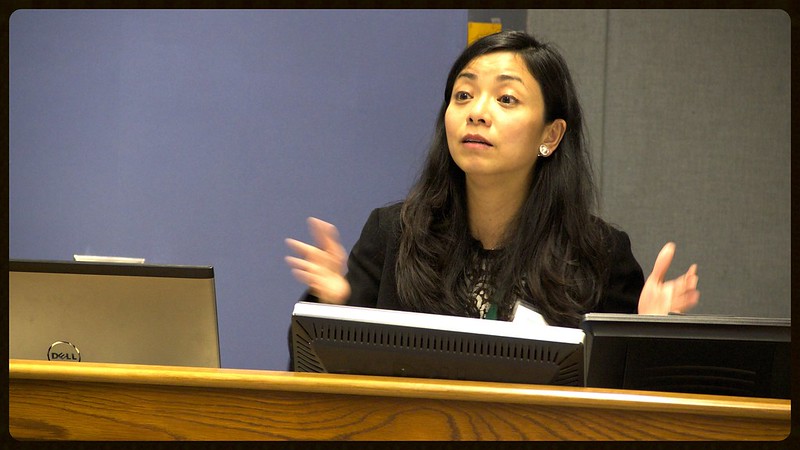
| Bonnie Chiu from Hong Kong |
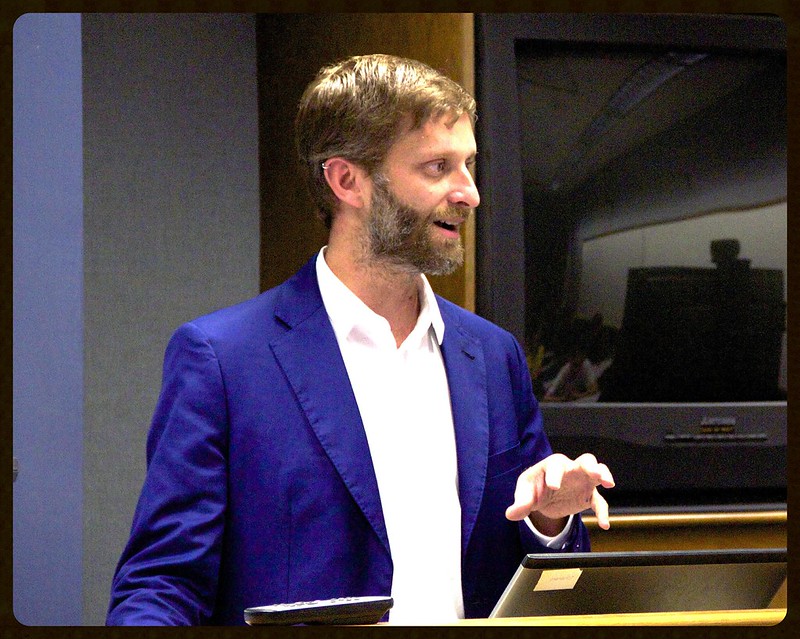
Ellard Manjawira, a scholar from Malawi, explained how there
were two groups of untrained but experienced, and young but trained journalists
in his country because no journalism training was allowed in Malawi from 1964
to 1994. For a period of 30 years, there was only one newspaper for the whole
country. Today, newspapers are the major news media in Malawi and they are
largely private and independent. Comparing with other media, newspapers have
the widest reach in Malawi, he said. He said that online and social media were
growing but the access to technology was still limited to elites and in urban
areas.
The scholar from Lebanon, Mirna Abou Zeid, told the audience that administrative power is divided between three main sects in her country, which influences the media system and ownership. The president is always a Christian Maronite, the Prime Minister is always a Sunni Muslim and the speaker of the Parliament is a Shia Muslim, she said. While enlightening on the media in Lebanon, Mirna explained that there is a limit of 25 on newspaper licenses, out of which 11 licenses have to be given to Arabic newspapers. Political parties are not allowed to own media but it is still covertly controlled by the politicians. Newspapers engage in self-censorship, however, there is no distinction between facts and opinions.
Talking about the influence of Russia on the media in her country, Kyrgyzstani scholar, Nargiza Ryskulova, said that there are innumerable Russian channels which have helped form a pro-Russian opinion. Kyrgyzstan press is not free and is divided into two major languages: Russian and Kyrgyz. The media are in a transitional state in the country and Nargiza hopes that with new technology, it will soon move towards being liberal.
Topics: susi 2014
Media are still covertly controlled, say SUSI scholars
By Nisha Garud
Lectures and discussions on media
structures and journalistic practices in the online International Mass Media
class of the Study of US Study of US Institute (SUSI) 2014 summer
program continued with insights into journalistic practices in Russia, India, Philippines,
and Kuwait.
![]() |
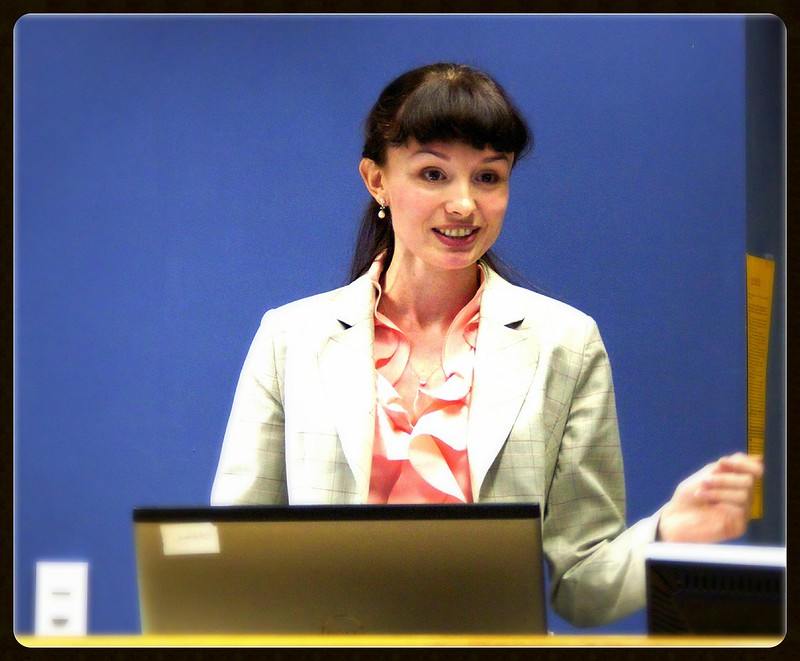
| Russian scholar Inna Shumkina |
Talking about the television, Inna said
that television was the most popular medium in Russia and most of the
television content was about entertainment. “There are about 300 television
channels in Russia. The content is about television serials and films. It has
changed a lot. In the 90s, Russians watched a lot of Latin American shows but
now it is completely Russian,” she said.
Shashwati Goswami from Indian Institute
of Mass Communication in Delhi, India reflected on the state of community radio
in her country. “It takes 11 approvals
from ministerial departments to start a community radio station. People, who
need such a radio station are from remote parts of the country and do not have
the money to travel to the capital city and to apply for license. The situation
is worse in the country’s north-eastern part, which is secluded from the
mainland, because there is only one community radio station. This station is
owned by an educational institution and plays no role in the development of the
rural people.” Shashwati discussed media
ownership in India. She said India has a liberal democratic regulated media
system. She said that the media ownership dictates the media content in India.
The struggle for Filipinos to overthrow
an autocratic ruler and restore democracy was the main feature of Agnes Nepomuceno’s lecture.
The scholar from Philippines gave a glimpse into
the history of her country when it was a Spanish colony. Talking about media in
the Philippines,
Agnes said the country was the 2nd
deadliest place for journalists. “The media coverage has a high concentration
of political and corruption news. If the government dislikes some coverage, it
can sue the journalist for libel,” she said. She added that the internet is
catching up but people still rely on radio for breaking news in the Philippines, which is
at a risk of natural calamities.
Yousef Al-Kazim from Kuwait presented a video that he and his colleagues shot and edited to give the audience a glimpse into Kuwait’s culture. He noted that Kuwait is the most liberal country in the Gulf but the press is still controlled by the government and does not enjoy the freedom like in some Western countries. “It is an unsaid rule that Congress and the state leader are not to be ridiculed. There is pre-censorship on movies and theater. Television and radio hold the second biggest share of the advertising market.”
Scholars were curious to know about gender equality in Kuwaiti media. Yousef elaborated that the ratio of women journalists to the men is almost negligible. However, the television news channels are initially recruiting one female anchor per channel.
Topics: susi 2014
Wednesday, July 23, 2014
Tunisian protests were 1st phase of a revolution: SUSI 2014 scholar
By Nisha Garud
Lectures on the role of media and their influence on the
politics continued for the online international media class for Study of the
U.S. Institute (SUSI) on Journalism and Media(SUSI) 2014, when Tunisian
scholar, Sayf Mohamed , gave an insider’s account of how social media like
Facebook, Twitter and YouTube enabled people to bypass the government
censorship in his country and to overthrow the dictators.
![]() |
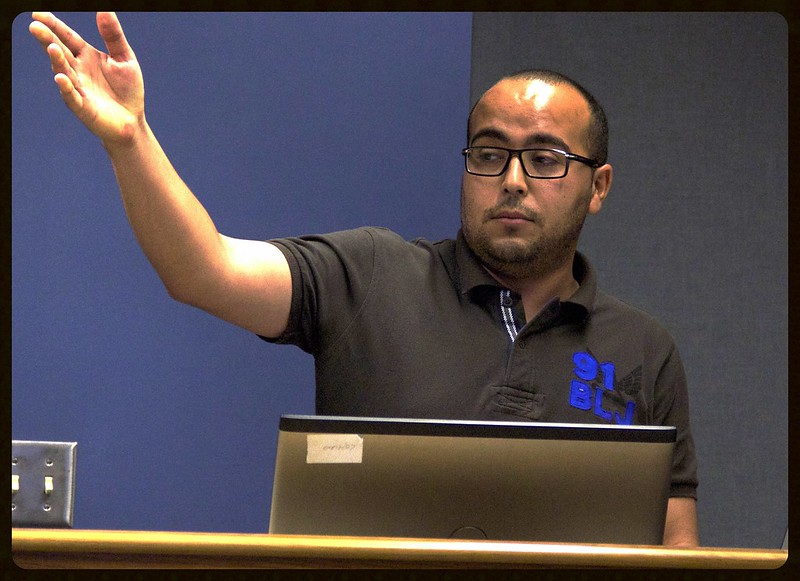
| Sayf Mohamed from Tunisia |
Sayf said that the protest was not a revolution, as the
Western media defined it, but it was only a first phase of an uprising. Tunisia
is still in transition. The transition is from a strict media to a dynamic one.
iled bloggers, activists and journalists were released after the government
collapsed. For two months, the journalists were not sure if there was freedom
of press. He also spoke on the status of women and said that women had equal
status in Parliament and got the same salaries as men.
Sports dominate television content in Australia, said the
scholar and lawyer Sarah Harmelink from Australia. This is because Australians
love their sports, she added. Media companies owned by Murdoch and Fairfax
dominate the media market. These companies dictate the media content. Talking
about the growth of the internet, Sarah said, There is internet censorship and
the police and the government have the right to ban websites. They have created
blacklist of blocked content. Typically, there is no public scrutiny of such
censorship. She added immigration was a major issue in Australia but the media
do not give it much attention.
With three doctoral degrees and a United Nations
ambassadorship serving to fight against tuberculosis, Ibrahim Awad from Sudan,
said that factors like custom regulations, lack of paper, printing regulations,
literacy problems, and slow marketing affect print media in his country. The media
industry is not developed in Sudan. Media production centers cropped up as a
result of photographing weddings, covering political issues, documenting
educational events, said Awad, who has travelled to more than 20 countries. The
government owns the cinema because movie production is expensive. Only 10
movies have been made till now in the country.
Radu-Mihai Meza from Romania said that the highest
advertisement revenue was from television. The television market is worth about
193 million euros. He said, In Romania, businessmen have used the excess
profits from illegal business to buy and start media companies. He added that
media mogul, the Intact Media Group, controlled the major media. The owner was
lobbying with the government and used the influence to stay out of jail.
Radu-Mihai said that the print medium is slowly dying. The tabloid market was
at peak in 2008 but started declining over the years.
Finland, Zambia present two opposite worlds of press freedom
By Nisha Garud
Study of the U.S. Institute (SUSI) on Journalism and Media
2014 scholars Brenda Bukowa from Zambia and Merja Drake from Finland brought
the online International Mass Media class to a successful completion with
lectures on their countries media and political structures and journalistic
practices. The lectures were held at Copeland Hall on the Ohio University
campus in Athens on July 14, 2014.
![]() |
| Brenda Bukowa during the online International Mass Media Class in Copeland Hall. |
![]() |
| Merja Drake speaks during the online International Mass Media class in Copeland Hall. |
Brenda said that her nations president determines media
policies, which keep changing every five years with a new president in power.
The media do not need licenses to start their business. New newspapers and TV
channels crop up every day and disappear without any notices. Some newspapers
are weekly but are published only monthly. Hundreds of newspapers are published
during the elections and die immediately. The media are not expected to
criticize the president, who gives no account of his whereabouts to the
citizens.
She explained that factors like political influence, censorship,
lack of finances and technology, low wages, lack of good journalism education
were killing the media in Zambia. She believes that a new constitution that
guarantees freedom of information, establishes Public Information Commission,
and defines its functions and provides for the right of access to information
will guarantee freedom the press.
Merja presented a small video about Finland to show the
audience its geographic beauty. Finland, which ranks first on the World Press
Freedom Index, is a bilingual country with a population of five million people.
Merja explained that the secret behind the countrys top ranking is that media
are not biased towards any political or social organization. The news reports
neatly present both the sides of the story, which at times, make the reports
look bland. If an individual is criticized in a news report, then he has the
right to replay i.e. to present his side of the story.
She added that every document is a public and very few
documents are classified as government secrets. All data are available on the
internet for the people. She informed the SUSI scholars and the online students
that the Finnish government had digitally archived every single paper right
from the beginning and they were welcome to access and archive for research.
Topics: susi 2014
Beyond Cultural Boundaries
By Agnes Jacob-Nepomuceno, Philippines (SUSI scholar 2014)
“The ultimate test of a man is not where he stands in moments of comfort and moments of convenience, but where he stands in moments of challenge and moments of controversy.”
– Martin Luther King Jr.
If the renowned icon of American Civil Rights Movement, Dr. Martin Luther King Jr., had lived his life of service for others as a key player in advancing equality between white and black people during his time, “ he played a pivotal role in ending the legal segregation of African –American citizens in the South and other areas of United States from the mid 1950s to 1968,” (http://www.biography.com/people/martin-luther-king-jr9365086#synopsis); everyone in the present time is also called to fulfill same noble mission of Luther, who received Nobel Peace Price in 1964, by bravely standing up for equality and truth in order to bring order and peace in a world that is beset with gigantic issues, challenges, conflicts that come in various shapes and sizes.
My journey for this 5-week cultural study; I owe much to the United States of America through the Scholarship for the United States Institute for Journalism and Media is a fulfillment of a dream of achieving the pinnacle of professional growth and competence as an educator, journalist, and broadcaster working for a premiere state-run university serving a region of six provinces, a developing and yet promising progressive nation, the Philippines.
The SUSI 2014 PROGRAM is full-packed with a series of holistic academic activities and cultural exposure that tickled the intellectual minds and expanded the band of interest and excitement of scholars from across 18 countries; a world representation of carefully selected media professionals from Russia, Costa Rica, Zambia, Hong Kong, Finland, Australia, Kyrgyzstan, Lebanon, India, Romania, Sri Lanka, Kuwait, Sudan, Malawi, Tunisia, Chile, and Philippines. A gathering of brilliant professionals with distinct cultural background and unique personality is one of the outstanding achievement by the U.S. an icon of democracy and the host of SUSI scholarship by being instrumental in forming and bringing together a group of scholars; thus provided a network of cultural sharing of opportunities for future collaboration in dyad forms; either by formal association (professional ties) and informal (continuing friendship) in a wired world or by actual visits to the member countries of the program.
Certainly the SUSI program provided the scholars with an exponential growth of knowledge; a wisdom that is strongly built and embedded in everyone´s memory and heart; oozing out with enthusiasm of going back to one´s country and transfer and share the information and experiences gained to hundreds of young minds eagerly awaiting for their comeback.
The scholarship administrator, Ohio University through the International Institute of Journalism, has been successful in bringing to the session room a number of practically experienced and seasoned media practitioners and educators who definitely rocked the intellectual bank of scholars who were passionate to learn newest inputs on media practices in America vis-à-vis educational thoughts and practices that would help the scholars further understand their deeper and significant roles in training and preparing youths who will be tomorrow´s builder of informed society and keeper and guardians of the crucial role and place of media in the world.
The 2014 SUSI SUMMER days rolled by smoothly from day 1 to the last 10 days as of the writing of this piece before the conclusion of the 5-week exchange visit program. On academic note, theories and practical applications made during the long hours of session were found to be mind-boggling, physically challenging, and yet intellectually satisfying. To research enthusiasts, the teachings and discussions on rigors of research was helpful, inspiring and challenging not to mention the role play activity that served as wake-up call particularly on seeing the realities that universities must adapt to in teaching Journalism and MEDIA. That students in communication schools must not only be led towards mastery of domestic issues that occur in one´s country but must go beyond borders and understand international issues that affect the world in its entirety. Certainly, lessons on international relations, laws, politics, economics, and ethics must be seriously taught to maintain the communication competence of media personalities as reliable sources of information by the people and whose sensitive news performance is crucial in shaping the decision-making and action of every man.
The Director of Ohio University, International Institute of Journalism (IIJ), Dr. Yusuf Kalyango, fanned the intellectual pressure among the scholars by assigning Peace Conflict Cases among four (4) small groups. The task required peaceful resolution of conflicts, which along the process of brainstorming challenged each individual’s take on the issues. But giving PEACE a chance consequently made the system’s theory work with the activity, which placed greater emphasis on the premise that “the whole is better than its parts.”
On a lighter note, if the term justifies it so, the task to handle the CASE STUDY CONFLICT activity was assigned to me by Dr. K. And while I was also required to present my own country’s peace conflict issue, a 40 years old armed conflict in the Philippines (available by email: docaj36@yahoo.com). When Martin Luther King’s struggled in his time to realize his dreams for racial emancipation, through his historical speech, I HAVE A DREAM, all of us have our own share of LONG WALK TO FREEDOM AND PEACE.
“….and when this happens, when we allow freedom to ring, when we let it ring from every village and every hamlet, from every state and every city, we will be able to speed up that day when all of God’s children, black men and white men, Jews and Gentiles, Protestants and Catholics, will be able to join hands and sing in the old Negro spiritual, “Free at last! Free at last! Thank God Almighty, we are free at last!” (Full text, I Have a Dream Speech: http://m.huffpost.com/us/entry/809993).
When I was made to experience with the real working of PEACE CONFLICT, by placing me in a challenging role, which, of course, required studying the two different peace issues that the SUSI scholars were also dealing with. Paradoxically, I was really fighting a personal peace disturbance issue on the same day and exact hours of the scholars’ role-play, when my hometown was being hit by a super typhoon that had its strong landfall in the very city where I live. And when worries further snowballed when electricity and communication services were downed by furious winds and heavy rains. But life-threatening and personal issues back home didn’t have to stand in the way. The show must go on and in the end; it did turn out well.
Thus: “The ultimate test of a man is not where he stands in moments of comfort and moments of convenience, but where he stands in moments of challenge and moments of controversy,” really made sense to me at the very moment when I had to perform my special task as a CASE STUDY MANAGER for the given activity.
Topics: susi 2014
Subscribe to:
Posts (Atom)
.jpg)