by Richard Jung Lee
edited by Stine Eckert
I believe that any country that violates human rights should be criticized. The United States,
Is there a human rights double standard in the
by Richard Jung Lee
edited by Stine Eckert
I believe that any country that violates human rights should be criticized. The United States,
Is there a human rights double standard in the


I would include these developments of the United States international human rights incidents during President Bush’s terms with all other incidents of the same nature from other countries throughout the world. These actions violated human rights and should be called such. The United States should not be held to any different standard.

by Lu Tang
edited by Stine Eckert
If I were to write an editorial, I would try to conceive it from a balanced angle. I would put this issue in context to help the readers understand why Zimbabwean President Robert Mugabe slammed former President G. W. Bush over human rights and what the responses from the Bush administration were. I would prepare some background knowledge of what happened in the past between these two countries and what reaction to Mugabe’s accusation of Bush is in other countries.
It is true that
Actually if countries are not satisfied with what the Bush administration did to prisoners of war in
Generally speaking, the act that

It is possible that no nation is completely in compliance with the United Nations Declaration of Human Rights. Many nations who have subscribed to these policies make great attempts to follow through with them. They were founded to recognize all people of the world as human beings, who should be treated as such.
While Zimbabwe's President, Robert Mugabe, exaggerates the situation, he brings to light some criticisms of former President G.W. Bush. In his address, he takes no responsibility for his own human rights abuses and attempts to put Mr. Bush's failings on par with his. This is almost laughable, as he is almost solely responsible for creating chaos in Zimbabwe, driving the inflation rate up so their currency is no longer viable and people cannot afford food. Even Nobel peace laureate Desmond Tutu said he was devastated by the human rights violations of Mugabe's government.
His criticisms, however, are not unwarranted. He is not the first to speak about the abuses at Guantanamo Bay and Abu Ghraib. Suspects held without being given a trial violates the U.S. Constitution and international codes. The interrogation techniques used at Guantanamo Bay were illegal and went beyond the bounds of U.S. standards and those of the UN Human Rights Declaration. Certainly former President G.W. Bush is at fault as Commander in Chief for allowing such atrocities to stain the image of the United States.
The same can be said for violations of rights within our borders. After 9/11 heavy security measures were placed on Americans in the name of national security such as monitoring their phone calls and records without restriction or notice. Terrified by the possibility of another attack on the United States, former President G.W. Bush put in place measures that many feel violate our freedoms.
In looking back at Mr. G.W. Bush's presidency, many will remember the egregious errors he made in entering a war prematurely and without full information, in allowing torture techniques that had been made illegal, and in holding prisoners hostage in what Mugabe calls "concentration camps." All of these were done (we have to believe) with the best interest of the United States in mind and for the protection of our citizens against a second terrorism attempt.
At what cost was this done, however? Are we better off having killed thousands of innocent citizens in Afghanistan and Iraq, having spent billions upon billions of dollars putting our economy in a tailspin, having violated the freedoms of American citizens, and having violated international codes of human rights just to prevent another attack? Most Americans would probably say no. There is no justification for such egregious violations.
This is why our new President Obama ordered Guantanamo Bay to be closed on his first day of office and has said that the military must follow the prescribed interrogation techniques. He is attempting to right some of the wrongs of the former president and restore some contempt other nations hold for U.S. hypocrisy. Healing needs to take place.
For this reason, writing about other nations' violations of human rights is made easier by the promise of change. Since Mr. Obama took office, he has taken steps to ensure the United States can pursue other nations' failings in this area without President Mugabe's counterargument.
No country is perfect, and no country will ever completely uphold the example of human rights without moments of failure. The range of violations, however, is important to note. Just because the United States does not have a completely unblemished record does not mean our violations are on par with those of Zimbabwe or other nations whose tyrannical dictators suppress the rights of all people in their countries and make violation a habit. We still have a responsibility to attempt to correct the wrongs of other nations, even if we have some problems ourselves.
It is the responsibility of American journalists to expose other nations' human rights violations, but they have an equal responsibility to expose our own. These will appear most likely in separate articles, but there should be articles about our own government's failings and make an attempt to put us on a better path.
 Photo Courtesy: Museum of Islamic Art
By: Sally Ann Cruikshank
The building rises out of the bay, its unique angles carving a new shape in the Doha skyline. It is the new $300 million Museum of Islamic Art, commonly referred to MIA. It represents not only a change in the aesthetic of the Qatar city, but also a shift in the country’s future as a cultural hub of the Middle East.
The Museum opened its doors to the public in December 2008, and one visitor calls it a “treasure of ancient Islamic history.” The MIA’s design is the work of renowned Chinese-American architect I.M. Pei, who designed the glass pyramids that are now part of the Louvre in Paris, France. The Museum sits on a man-made island in Doha Harbor because Pei did not want any other structures to compete with it.
Pei’s task was to blend the Islamic traditions of the past with modern architecture. Nesma Adb Elaziz, an editor for IslamOnline.net who visited MIA to cover its inauguration says Pei has succeeded. “In every corner you will find both styles going side by side,” says Elaziz.
It is that blending of Islamic tradition and modern ideals which authorities in Qatar hope will translate into a learning experience for visitors to MIA. Inside the Museum, more than 14 centuries of Islamic art and culture are on display, a collection over a decade in the making. Philip Beech, editor of the Qatar Visitor website, says the country’s Emir and his wife want to emphasize Islam as a humanitarian religion and “emphasizing the artistic and scientific achievements of Islam adds another facet to this.”
It is a notion that struck Roxanne Piper Davis, a U.S. expatriate living in Qatar, when she visited MIA for the first time. She calls the Museum a “unique place that allows Muslims and non-Muslims to appreciate their religion and culture at the same time.” “One of my favorite pieces is a picture of the Virgin Mary with Arabic Calligraphy written at the top: ‘There is no God but God,’” Beech says. “There’s speculation that this is meant to emphasize the similarities between Islam and Christianity.”
The opening of MIA could mean more people will get to experience those similarities. The Museum is the first step in Qatar’s plan to become a tourist destination. Elaziz says it is a plan that’s working. “The museum has already attracted the attention of the whole world, with its grand design and extravagant inauguration,” she says. “It gives an opportunity to Qatar to establish itself as a cultural center after being labeled as an oil rich state for a long time.”
Beech says preparations are already underway across Qatar to prepare for an increase in international visitors. A new, larger airport is under construction and more hotel rooms are being built. He says the hope is people will come to see MIA and stay to enjoy the other attractions in the area, such as the singing sand dunes, camel racing, and world-class golf courses.
The curators are already working to make MIA more appealing, by partnering with the British Museum and other museums around the world to display its rare works of art. The Qatar Museums Authority has also announced plans to open a library inside MIA next to an educational center. Piper Davis says it all could lead to a greater understanding between the East and West. “We obviously cannot expect MIA to solve major conflicts, but perhaps it will contribute at least to a small level of understanding and tolerance.”
by Stine Eckert
Change. That was not only the buzzword for the recent U.S. election and President Barack Obama, but also for Sheik Hasina, the president of the Awami League (AL) party in Bangladesh. Just like the United States presidential campaigns, the promise of change brought an overwhelming victory in Bangledesh’s general election on December 29, 2008. The AL party-led alliance won an absolute majority by taking 258 of 294 parliamentary seats against its main opponent, the Bangladesh Nationalist Party (BNP). Before, a quasi-military government ran the country during a state of emergency. During these 23 months, citizens' fundamental rights were suspended. For Bangladeshis the first general election in seven years was a breakthrough in returning to democracy; 70% participated.
What hopes and concerns harbor Bangladeshis for the promised changes of the new government? – An unemployed biologist, environmental analyst, high school student, human rights activist, journalist, and university administrator answer.
No Proper Democracy Yet
“It is true that Bangladesh is yet to get the proper democracy, but we are in the process,” writes Muhammad Aminul Islam, senior staff correspondent at the Dhaka-based daily newspaper New Age in an e-mail interview. He says that it is yet too early to judge the new government. “Absolute power means absolute corruption,” he says. “I am concerned whether this government can control its members.” Mr. Islam says that between 2001 and 2006 the BNP-led alliance enjoyed a similar majority but crushed the people’s hopes with “unabated irregularities by the ruling party men.” Violence after the recent election by AL rulers and its student wing, he says, has brought back the fear that this government might be a déjà-vu of the BNP rule. He says that his hope lies with the young and fresh but inexperienced ministers whose help the AL administration needs to tackle corruption, reduce inflation and hunger in society.
Despair and a Digital Bangladesh
Twenty-year old Dhaka resident Rukshana Sultana, who recently earned a Master’s degree in biology but is unemployed, writes in an e-mail interview that the election means a lot to her. She says as much as the country is approaching the AL-led administration positively, the people will carefully watch its every step. Sultana says that with the number of unemployed young people rising, the new government should prioritize job creation and lower food prices. Nabila Naomi, an 18-year old high school senior in Dhaka said in an e-mail interview that the new government must lower the price of rice and invest in road repair in smaller areas. She says that she “hates politicians.” Meanwhile, 26-year old Sayed Mohammad Mosharof, who holds a Master’s degree in soil and environmental science and works as an environmental analyst in Dhaka, says in an e-mail interview that he had awaited the election with the “hope of an unlimited horizon.” His wish list for the government includes curbing corruption, state accountability, and lowering food-prices, creating a more technologically advanced “digital Bangladesh.”
Self-Censorship, Torture, and Freer Expression
Dr. Kazi Anis Ahmed, Director of Academic Affairs at the University of Liberal Arts in Dhaka, similarly banks on the government’s promise for increased investment in information technology to benefit higher education. Under the rule of the quasi-military interim government, Dr. Ahmed says in an e-mail interview, “a great deal of self-censorship” was going on among citizens but also writers, intellectuals, and journalists. He disclosed that after some riots had started at a university campus “on very flimsy ground” and spread countrywide, thousands of people including students and some prominent professors were arrested and allegedly roughed up in detention.
One of them was human rights activist and independent journalist Tasneem Khalil. A Human Rights Watch report published in February 2008 details the “The Torture of Tasneem Khalil.” At the time of his arrest Mr. Khalil reported for the respected English language newspaper The Daily Star, CNN, and Human Rights Watch. Among other issues, he covered extrajudicial killings and minority rights. In the report he says that on May 11, 2007 men of the Directorate General of Forces Intelligence, the military intelligence agency of Bangladesh, arrested him. Khalil writes that during the 22 hours in captivity he was repeatedly verbally abused and beaten. A photo in the report shows a dinner-plate sized purple-red bruise on his left lower back. Mr. Khalil now lives in Sweden.
In an e-mail interview Mr. Khalil writes he would “love to see” the free press as the main weapon to fight hunger and poverty this time. The overwhelming victory of AL was no surprise to him. He predicted such a victory two years ago if free and fair elections were conducted. “People power has once again won the battle for democracy, something to be excited about.” He says the new government appears to be “very serious” about fulfilling promises such as quickly fixing the steeply rising food prices – an issue he says will make or break it. He says AL president Sheik Hasina has selected “some of the brightest and honest faces” in Bangladeshi politics. This, Mr. Khalil hopes, signals a pro-people, left-of-center government for the next five years. But he also says he’s worried about the “fascist tendencies” AL has shown in the past. “[I’m] keeping my fingers crossed, so that we don't have to watch the orgy of political violence anymore or see yet another sham parliament in Bangladesh.”
Everything possible, even reelection
Dr. Ahmed warns of “a certain tendency of partisan administration in public academic institutions will persist but needs to be kept within limits.” He hopes the urgent help needed for the economy is really coming as the AL-led alliance seems to be more “economically aware” than previous administrations. If the government keeps it own members in check and insures that the opposition does not leave the parliamentary process, he suggests, “it may become the first to get re-elected in five years.”
Bangladesh needs to take one step at a time. “Only the struggle for a democratically elected government,” writes Mr. Islam, “can ensure that the people will get the proper democracy one day.” Whereas Mr. Mosharof is enthusiastic that “everything is possible in Bangladesh;” Ms Naomi remains pessimistic: “Neither this government nor [its opponent] BNP can do anything for our country.”
Professor Yusuf Kalyango, director of Ohio University's Institute for International Journalism, recently spoke about international reporting with OU's Society of Professional Journalists chapter. He specifically addressed the challenges and risks of international correspondence. You can view excerpts from the video interview below.
A Nation Reborn... Australian Coverage
Edited by Sally A. Cruikshank
Author: Ellen Schnier
Photo courtesy of WAToday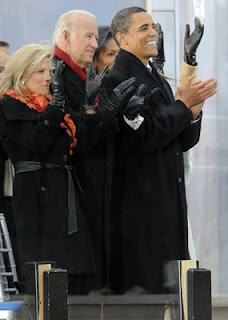 Aretha Franklin sang 'Our Country 'Tis of Thee' just before President Barack Obama was sworn in and delivered his inaugural speech. Michael D. Shear and Anne E. Kornblut of the Washington Post included this in their article, 'A Historic Inauguration Draws Throngs to the Mall.' Geoff Elliot, Washington Correspondent for The Australian, in 'A Nation Reborn Under President Bush,' left out such details as this and that Mr. Obama used the same Bible Abraham Lincoln used for his first inauguration.
Power of People... German Coverage
Edited by Sally A. Cruikshank
Author: Stine Eckert
Capturing the moment, saving it for the next generation - this seemed to be the purpose of German newspapers on January, 21st.. But it was not Obama, foreign correspondent Matthias Rüb (Frankfurter Allgemeine Zeitung) was focusing on - it was the American people. He observed and described a moment, where people stood together, sharing a moment everyone was waiting for. The correspondent experienced a united America, where citizens, whether they were Black, Hispanic, Asian or Caucasian, looked up to and believed in the words of one man. Matthias Rüb witnessed a day, where the American people re-gained their pride, and he shared this day with the German people. Also the New York Times appreciated the sea of flags and red, white and blue between the Lincoln Memorial and the Capitol. 'Beyond the politics of the occasion, the sight of a black man climbing the highest peak electrified people across racial, generational and partisan lines,' the paper wrote. And this new hope is needed, to solve all the current and upcoming problems. Two wars, an economic crisis, terrorism, lost jobs and health care are only a few challenges the newspaper lists.
Photo courtesy of CreativeSoulPhoto "Capturing the moment, saving it for the next generation - this seemed to be the purpose of German newspapers on January, 21st.. But it was not Obama, foreign correspondent Matthias Rüb (Frankfurter Allgemeine Zeitung) was focusing on - it was the American people. He observed and described a moment, where people stood together, sharing a moment everyone was waiting for. The correspondent experienced a united America, where citizens, whether they were Black, Hispanic, Asian or Caucasian, looked up to and believed in the words of one man. Matthias Rüb witnessed a day, where the American people re-gained their pride, and he shared this day with the German people. Also the New York Times appreciated the sea of flags and red, white and blue between the Lincoln Memorial and the Capitol. 'Beyond the politics of the occasion, the sight of a black man climbing the highest peak electrified people across racial, generational and partisan lines,' the paper wrote. And this new hope is needed, to solve all the current and upcoming problems. Two wars, an economic crisis, terrorism, lost jobs and health care are only a few challenges the newspaper lists.
In contrast to that, the Frankfurter Allgemeine Zeitung focuses on the overall goals of Obama's politics: hope over fear, and unity over conflicts. Detailed challenges, or overall goals - The newspapers from the two continents seem to agree. There are problems to face in the next couple of months and years. But a President that has and values the support of the people is a step in the right direction.On January, 21st, German and U.S. newspapers had the same opinion. It was a glorious day, that was a result from the power of people." --Carolin Biebrach"On both sides of the Atlantic, journalists tried to get an overall feel for Obama’s tone during his inaugural speech; German and US journalists covered the event rather homogeneously.German foreign correspondent Gregor Peter Schmitz in Washington who was reporting for one of the major political publications in German, weekly Spiegel magazine, dubbed Obama the 'new national chief psychologist' for his motivational spirit; CNN gave Obama a thumbs up for 'the right speech for the times.' Whereas the Spiegel article was titled 'Obama proclaims his American dream,' the analysis of his inaugural speech by Nancy Gibbs of Time magazine was more specific and somber: 'Humility, Gratitude, Sacrifice.' She concluded her story taking the perspective of the audience who looked up at 'a man in the very far distance accept[ing] the full weight of their hopes.'
Hope over fear was just one topic that German and U.S. journalists addressed. Both also emphasized Obama’s willingness to face what ails the United States openly, his call for duty and sacrifice. Another German foreign correspondent Oskar Piegsa of weekly newspaper Zeit, another major political publication in Germany, gave examples of people in tears due to the historical meaning of the moment, pointing out Obama’s background. A theme that came up with every U.S. media I read. Piesga also likened the event to public viewing for a major soccer game with everyone on the same page, booing Bush and obsessing about Obama, a big game easy enough to play for everyone. Interestingly, the Spiegel article reported about Obama’s emphasis on a new and more appreciated position for science and his mentioning of wind and solar energy whereas environmental issues where absent in the U.S. coverage I followed on NPR, CNN, and Time.
The mirroring of topics was reflected in a number of same quotes: In their assessment of Obama’s inaugural speech, Spiegel as well as CNN referenced John F. Kennedy in 1961: 'Ask not what your country can do for you. Ask what you can do for your country.' Both publications quoted the America-as-a-friend line, his acknowledgment of a nation not only at war, and in an economic crisis but also the 'nagging fear that America's decline is inevitable and that the next generation must lower its sights.' In this transatlantic homogeneous mixture of hope and fear only one sentence struck me more than the rest, provided by Nancy Gibbs of Time Magazine: "You could almost pity the pundits as they groped for extravagant new ways to say what didn't need to be said in the first place.
 The purpose of the Young African Leaders Initiative (YALI) Connect Camps is to invest in the next generation of African leaders through intensive executive leadership training, networking, and skills building, which will prepare them to make social change in their communities. The core Ohio University team working jointly with The Collaboratory at the U.S. Department of States Bureau of Educational and Cultural Affairs has designed a program for the YALI participants called Connect Camps taking place in sub-Saharan Africa to pursue the following goals:
1) Give up to 160 young African leaders the opportunity to collaborate, learn, and network with U.S. and African resource experts and with each other during the eight YALI Connect Camps; to develop innovation strategies that build on their professional skills, engage in hands-on experience with low-bandwidth technologies, conduct community outreach, and build their capacity through mentoring, networking, and using strategic civic leadership for social change.
 2) Use a stimulating canvas model of leadership to develop skills in entrepreneurship and creating social change by engaging in five-days of facilitated interactive sub-group workshops, and fostering mentorship relationships between the Mandela Washington Fellow alumni and their chosen mentees for the Camp.
3) Demonstrate some community-oriented enterprises using applied technology that supports innovation and collaboration in community development and entrepreneurship, civic leadership, and public management.
4) Develop leadership skills among delegates through mentoring relationships, between themselves, as well as with American and African facilitators.
5) Provide participants with opportunities for face-to-face networking and to facilitate a collaborative, innovative project or projects that further YALI goals.
Various U.S. Embassies in Africa have been instrumental in the selection and coordination of hosting the Connect Camps. The YALI Connect Camps are funded by a grant from the U.S. Department of States Bureau of Educational & Cultural Affairs and administered by the Institute for International Journalism (IIJ) at Ohio University.