Saturday, July 30, 2011

Random Thoughts from My CNN Experience!


By Dr. Nnamdi T. Ekeanyanwu
Nigeria

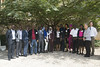
The visit to CNN was one of the major high points of the cultural and media tours for me during this summer program. Apart from the classy nature of Atlanta, Georgia, CNN is truly a bride to behold.

Coming out of that study tour and the interactions that followed, I feel obligated to share these thoughts with you:
  1. CNN does not own any satellites. The company rents space on satellites because it is cheaper to do so! Considering this, it has done well meeting the news needs of its numerous audiences.
  2. At CNN currently, it is no longer about being FIRST but being ACCURATE. I was really impressed about this vital shift in operational focus!
  3. The accusation leveled against CNN that it is the mouthpiece of the American Government or that it is sympathetic to the American cause is just perspective. I honestly think it depends on who is analyzing the issues.
  4. The coverage of Africa on CNN has improved drastically. There are currently high definition programs like Inside Africa and African Voices that specifically focus on other areas of Africa other than news, which most of the time may be negative.
  5. On a lighter note, no one in CNN knows the number of TV monitors/screens at the Atlanta Head Office! I could not count but from visual impressions, we could start from 10,000! That is an idea about the hugeness and operational size of the Atlanta Head Office.
Again, I sincerely want to thank the State Department in Washington and the Administrators of this year's SUSI program under the Directorship of Professor Yusuf Kalyango for including such an important place in our media itinerary. I am completely impressed. We have visited community media firms, national media firms and now CNN, which is a recognized and reputable global brand. What more can we ask from SUSI? In fact, I am now tempted to regard myself as not just a Professor of International Communication but a Professor of American Media Systems!!!

Thank you SUSI 2011,
Dr. Nnamdi Ekeanyanwu
SUSI Scholar for 2011
Representing Covenant University and Nigeria.

Friday, July 29, 2011

The Common Word

By Abdulrahman Al-Shami
Yemen

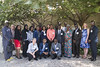
It doesn't matter if it's a private TV station or a public one or a private citizen. The common word that we heard during our cultural and media tours was “community.” They all work hard and dedicate their time for the benefit of their community. It is a great deed to dedicate some of your time to your community. This is a lesson we learned from those tours.

Wednesday, July 27, 2011

We Did it!!

By Abdulrahman Al-Shami
Yemen

We were almost 100% sure that we will fall asleep in today’s afternoon session on social media due to travel exhaustion from our trip to Atlanta. But things went completely differently. We were involved in a hot discussion and the session lasted for more than two hours. I still can’t believe that we did it despite of our fatigue.

Sunday, July 24, 2011

Understanding the conflict

By Syed Irfan Ashraf
Pakistan

Perhaps, understanding the conflict is more important than plunging headlong to report on it from the first shot. This is the way a reporter can help save himself/herself by not becoming a victim to wars and also making it possible to provide uncontaminated news to readers.

Last week, such observations were part of the discussion at the E.W Scripps School of Journalism, where 17 scholars from different countries of the world gathered as part of the SUSI program. Though, the scholars realized that it is increasingly difficult to understand conflicts in an era of proxy wars. Because in such a situation shadows are fighting, which makes it hard for reporters to understand the issues.

What to do then? Should a reporter leave the job and go home or should he work harder to understand what is going on? The first option is not possible as no media outlet can afford to shift focus from reporting wars and conflicts in their respective regions. The latter case, though, is not only possible but also preferable. However, it will add some more responsibilities on the shoulders of the already overburdened war reporters.

Keeping in view the changing patterns of global conflicts in terms of technological development and usage of new warfare strategies and tactics, it is increasingly important for a journalist to work extra hours. "We need 'thinking journalists' to stay aware in a conflict zone," one of the SUSI scholars said. "They must understand what is happening around and how he should report about it in the safest possible way," he added.

In fact, to get it done properly, it is important for a reporter to understand the history of the conflict and to stay in touch with the local people and conflict players. In addition, personal observations and analytical skills are the most sought after requirements of conflict sensitive reporting. It all will help a reporter to put information in proper context.

Usually, journalists are the victims of their own dull routines. Since they, in most cases, are used to work in normal environments for long periods of time, they expect the same when they find themselves in abnormal situation or when they are sent to a war zone to cover it. In some areas like the north west of Pakistan, such insensitive coverage of the sensitive issues are increasingly leading to the death of journalists.

Under abnormal circumstances, a better journalist is the one who is more professional. Who is not only aware of the skills of reporting but also understands the changing nature of conflict dynamics. And most important of all, who knows how to present information in its proper context. This is the job of a "thinking journalist." Such measures will help a reporter to access himself/herself every time by not becoming party to the conflict and also to avoid losing to it personally.

Friday, July 22, 2011

Global Spotlight-Special Edition for SUSI 2011

by Ashley Furrow
SUSI 2011 Program Assistant

In this issue of Global Spotlight, we have gathered a series of stories that provide an insight into the 2011 SUSI summer program at the E. W. Scripps School of Journalism at Ohio University.

The Study of the U.S. Institute (SUSI) on Journalism and Media is an annual summer institute of international journalism scholars and media experts from universities and academic institutions from around the world. The SUSI summer institute is funded by an annual renewable grant from the U.S. Department of State’s Study of the U.S. Branch in the Office of Academic Exchange Programs. It is administered by the Institute for International Journalism.

The first two pages — a map of the world with each scholar’s nation in various colors — give a glimpse into each scholar’s thoughts on the first two weeks of the program.

The program combines academic sessions with cultural experiences to enrich each scholar’s knowledge of the different media systems in the U.S. while also expanding each scholar’s knowledge of our nation’s history and culture.

We hope that with each story, you will experience a different aspect of the program.

Thank you for taking the time to read and appreciate the effort of each SUSI director, scholar and program assistant who participated in this special edition.

Click here to read this edition

Tuesday, July 19, 2011

IIJ-SUSI Scholar Cooperative Visit in Istanbul, Turkey

By Xueying Luo

SUSI 2011 scholar, Prof. Dr. Erol Nezih Orhon, organized a campus tour of Anadolu University in Eskisehir, Turkey for the delegation led by the director of the Institute for International Journalism (IIJ) and professor of journalism, Dr. Yusuf Kalyango. The IIJ’s mission to Anadolu University was to survey possible cooperative opportunities between the College of Communication & Journalism and the IIJ in the E. W. Scripps School of Journalism at Ohio University.The visiting team from the IIJ included Dr. Petya Eckler from the University of Iowa. Professor Eckler is a member of the advisory board of IIJ.

Dr. Orhon’s student also organized a city tour of Istanbul as well as the city of Eskisehir for Dr. Kalyango. The domestic travel from Istanbul to Anadolu University, Eskisehir was personally funded by Nezih Orhon and his university.

During the visit, Kalyango tweeted, “I’m getting the royal treatment in Turkey… What an amazing lively, historical, diverse city. Lovely people!” Kalyango said, “It’s a great research trip, it’s a promising IIJ-SUSI alliance tour, the delegation of E.W. Scripps School of Journalism will visit Anadolu University again.”

Nezih Orhon is one of the 17 international journalism and media scholars from universities around the world who are participating in SUSI summer institute. SUSI is funded by an annual renewable grant from the U.S. Department of State’s Study of the U.S. Branch in the Bureau of Educational and Cultural Affairs.

Kalyango was in Istanbul to attend the 2011 annual conference of the International Association for Media and Communication Research (IAMCR). During the second week of the SUSI 2011 program, Kalyango traveled to Istanbul give a research talk at the conference.

Anadolu University- a world class university

IIJ Director, Kalyango was warmly received by the president/rector of Anadolu University, Prof. Dr. Davut Aydin and his vice president/vice rector, Prof. Dr. Ender Suvaci. The IIJ plans to lead a delegation of the Scripps College of Communication administrators for an official visit to Anadolu University in 2012.


Anadolu University was established in 1958, it annually educates 1.7 million students from around the world. It is one of the preeminent innovative universities in Turkey. As a state university, Anadolu University houses 12 faculties or main colleges and three of which offer distance education. The university has the most successful distance education programs in the world that several national and international educational institutions replicate as a model.

Its main campus is located at the center of Eskesire, a city known as a scientific and cultural center. In Turkey, Anadolu University is the only authorized university as a center of excellence in aviation and railway systems and it facilitates the progress of transportation in Turkey.

A Glance at the City of Istanbul, Turkey

Istanbul is located on the Bosphorus Strait and it extends both the European and Asian sides of the Bosphorus. It is the only city in the world that goes across two continents. Istanbul is situated in the northwest of Turkey; the whole city encompasses the natural harbor, Golden Horn.

Istanbul is a city of long history; its historic areas have been added to the UNESCO World Heritage List since 1985. Istanbul served as the capital city of the Roman Empire (330–395), the Eastern Roman (Byzantine) Empire (395–1204 and 1261–1453), the Latin Empire (1204–1261), and the Ottoman Empire (1453–1922). After the Turkish War of Independence on Oct. 29, 1923, Ankara replaced Istanbul as the capital city of Republic of Turkey.

Currently, Istanbul is bidding to host the 2020 Summer Olympics. In the year 2010, Istanbul served as a joint European Capital of Culture and was chosen as the European Capital of Sports for 2012.

Yemeni Media System Presents at Ohio University

By Dr. Abdulrahman Al-Shami

As part of the ongoing SUSI program at Ohio University, Dr. Abdulrahman Al-Shami delivered a presentation on the media system in Yemen, in which he reviewed the development of Yemeni media, including the private one, as well as the legislative framework governing the work in Yemen.

It is noteworthy that SUSI’s program is the U.S. State Department's media exchange cultural program, hosted for the second year by E.W. Scripps School of Journalism, which is one of the top-ten media schools in the U.S. Seventeen scholars from different countries in the world participated in this program. More/Arabic

Saturday, July 16, 2011

A Visit to Athens Farmers Market

By Syed Irfan Ashraf

Excursion trips and study tours are the prominent parts of SUSI fellowship. However, experiencing the American culture is another fun during the SUSI program. To explore the cultures in small towns, about 15 SUSI 2011 scholars visited the Athens Farmers Market on Saturday morning. One could see vegetables and fruits including green onions, kale, basil, chard, peppers, cucumbers, zucchini etc. and the market is put up twice a week.

Frankly speaking, about 80 small vendors set up along the street is not a glorious view at all. However, the fun part of the activity is not in what the farmers were selling there, it was in how they were selling them. Perhaps any vegetables' market in my home country (Pakistan) would offer a much more glorious look, but here in Athens I observed a unique approach to business. The way farmers were talking and exchanging views with their customers seemed to me more of a family affair than a business.

To get a feeling of the market, I reluctantly went close to a farmer selling pies by the name of Grandma's Rolling Pie. Both the husband and wife sitting in the stall were extremely cordial fellows. Not only were they friendly but also they offered me a piece of pie to eat. Ummmmm it was really a treat to eat the home-made pie out from a 100-year old recipe that the gentlelady claimed to have learnt from her grandmother. Here started the family story. In fact, the story was more juicy than the pie itself. " I am not happy with my husband because he doesn't like to do enough work with me," said the lady while looking away from her husband. But her husband Tom was quick to reject the complaint saying, " If I am right, and I know that I am right, the whole of the kitchen work is my duty, which I always did." It took me half an hour to enjoy their conversation and observe the way they were handling their customers.


Moving around for another half an hour in the remaining stalls, I got to know that this is how thing works in the farmers market. Buyers and sellers enjoy so much intimacy that one cannot distinguish between them. Why? Because they all are members of a single large family called Athens.

Thursday, July 14, 2011

Hugo and Me

By Adam Liebendorfer

In Venezuela, the popular chant for solidarity with Hugo Chavez goes as follows:

"Ooooh... Aaaah... Chavez no se va."

"Ooooh... Aaaah... Chavez isn't leaving."

After hours of telephone interviews, countless Venezuelan state television reports and transcribing speeches, I was beginning to the same feeling.

For the past two weeks or so, my life has been Hugo Chavez. Though not as adventurous as going into flood country, reporting from my desk in Bogota was just as entertaining. In some ways, I know him better than my best friend. When Hugo is on painkillers, he riffs about his idyllic childhood, Nietzche, being Superman, and how Fidel Castro brought him homemade peanut butter when he was recovering in the hospital.

"He promised me lamb," Hugo blathered.

Hugo was admitted to a hospital in Cuba about a month ago and had been under the radar for most June, while his country was dealing with prison riots, blackouts and runaway inflation. Back home, where Hugo needs permission to travel abroad for more than five days, legislators were contemplating the constitutionality of Hugo governing from Cuba for a month, at times under anesthesia. At the end of the month, he announced to his people that he had undergone two surgeries, the first to remove a malignant tumor, which threatens to tarnish the indefatigable, saint-like image Hugo has established among his discipular supporters. The whole situation showed weaknesses in Hugo's socialist Bolivarian Revolution, with his brother alluding to a military coup to stay in power and many questioning whether or not it's a good idea to have all the aspirations of a revolution rest on one person.

Hugo came back in typical Hugo fashion — fanfare and metaphor-laden speeches. His arrival coincided with Venezuela's Independence Day, but it was apparent he wasn't quite up to where he was. Rumors are abound that he has colorectal cancer and will need chemotherapy, and he addressed the military Independence Day parade from his presidential palace — an odd thing for a man who has been known to give several-hour speeches in the hot sun.

The stories we did for The Post explored the underlying dynamics behind Hugo's illness. When things were still uncertain, we did a story on how Hugo's insulated himself, and later we looked at what would happen for Cuba, which receives 100,000 barrels of subsidized oil from Venezuela, should their closest ally fall from power.


http://www.washingtonpost.com/world/americas/chavezs-cancer-highlights-close-partnership-with-castro/2011/07/13/gIQAHa1WCI_story.html

Wednesday, July 13, 2011

Working on My Golfing Handicap at SUSI 2011

By Isaac Mutunga (Kenya)

My view of golf has been like Mark Twain's; a good walk spoilt by occasional golf shots. Other than that, in Kenya we view it as an elite game. Golf club membership fees and other incidentals like bending elbows at the 10th or 19th holes can bankrupt one.

This was the word on the street and I never tried to prove its authenticity. My reasoning was simple. Why waste good pasture or farming land with grass that no herds of cattle grazes on and tuffs of mini-forests with no wild animals to attract tourist?

My perception of the game took a 360 degrees turn on Sunday 10th July 2011 morning when I joined Dr. Yusuf Kalyango, the Director of IIJ, and two SUSI scholars, Dr. Vajaya Laksmini, from India and Dr. Olga Gresko from Ukrain for a game of Golf. For the three SUSI scholars it was our first time in a golf course.


The nearest I have ever come to playing golf was using a slasher back home in Kenya to trim the lawn. But it looked easy. Place the golf ball on a knoll (sorry a tee) and whack it hard. Good eye to hand coordination. This is what I thought. The other two had their own perceptions about the game.

Perceptions without practical experiences can be deceiving. Most of the information we have about other cultures and people is through 'words' on the street without any proof or personal experiences. Like my perception about golf.

I learnt that golf is not a good walk spoilt the hard way. It's not only use of imagination, shot making skills, unlearning previous practices and beliefs but also interpersonal communication skills. Getting personal and professional information without intruding.

To start the game one has to tee. Simply put placing the golf ball on raised platform (tee) and hitting it as near as possible to a hole on the ground marked by a flag. May be the flag is supposed to elicit discovery of new experiences. I am yet to ask Dr. Kalyango why a flag and may be not post with faces of the player.

I bit my lower lip and wielded my wedge (the one that looks like an angry cobra) like a Maasai 'rungu.' Another of my colleague gripped it like a hockey stick. All from our previous experiencves.

Dr. Kalyango took time to show us how to grip not wield the golf club.I struggled between adapting the standard way and retaining my maasai rungu swing.Change is good but old ways seems more comfortable.

I managed to unlearn the maasai rungu grip and adapted the correct way but hitting the golf ball was a different story. It looked easy when Dr. Kalyango hit the ball but my efforts turned the driving range into a garden.Instead of hitting the ball I hoed the ground. My two other colleagues were not faring any better.

This humbled me. I Learnt that before criticizing anybody I had to try to walk in their shoes. I am who I am because of my past experiences, socialization and culture. I have to accept to unlearn somethings in order to learn new and efficient ways.

Lesson number two from Dr. Kalyango. Keep your eyes on the ball and not where it is going. With eyes on the ball I hit it into a beautiful lop and I was elated. At least I managed to put the ball on the air.


To me this was a metaphor of life in general. Life is like a game of golf, Our challnges are the golf balls we want to hit. We must keep our eyes on the challenges and not look at where we will be if we overcome the challenges. One has to hit the ball before it flies where he/she wants. Keep eyes on the ball.


I am not hoping to compete in Masters any time soon but I experienced something that I have never thought of in my life.

I found the discussions in the golf course spontaneous which allowed for diversity of topics about our own countries punctuated by pauses to allow for golf shots and ruminate on the discussion threads. It made us know more about each other than it would have been possible in other circumstances.


As I left the half hoed golf course and the driving range courtesy of the different golf clubs I wielded, I found a parallel between a game of golf with international collaboration and scholarship.

It is not a competition. We all know our handicap and are working hard to improve on it. Colleagues advice us on how to improve our handicap, not because they are better than us but because that is not their handicap.

I now know my handicap not only in the golf course but also academically. I am working hard to improve on it and with the SUSI program I am sure I will improve it. I am joining Dr. Kalyango for another round of game not because I want to finish hoeing the driving range with my wedge but to learn and unlearn my past experiences, beliefs and practices that are causing my handicap