Monday, July 15, 2013

Looking for similarities

By Gulnura Toralieva, SUSI scholar from Kyrgyzstan

When discussing a diverse range of issues with people from different parts of the world one will often hear, “We have the exact same situation in our country!” Are the similarities of seemingly different countries really that surprising? Sometimes they just might be.

The Study in U.S program, or SUSI for short, has brought together media scholars from 16 countries spread across every corner of our small globe, with Malaysia and India at the one side, Chile and Honduras at another, and having Mozambique and Zambia somewhere in the middle. This is a very simple map overview for a person who has never studied geography and who thinks that their homeland is very different from the rest of the world, when in fact most of us share common concerns.


Kyrgyz Artur and Honduran Arturo

Kyrgyzstan and Honduras are not as different as you may think. They are small countries in Central Asia and Central America fighting for democracy; they are going through political and economic turbulence. Both countries have the highest poverty rates in their regions but share a dream to become rich and happy in the nearest future. Honduras and Kyrgyzstan have nearly the same land area and population size. They also have hydropower potential and significant deposits of metals, including gold. One may disagree on all the similarities we have but why should I care if I’m looking for similarities. Moreover now we have more to share: my son’s name is Artur and my Honduran roommate’s husband is Arturo too…

Ladies’ interests

 “I share the room with ladies from Bangladesh, Zimbabwe and Equator. These are such different countries, but we all care about the same things. Every morning we dress up nicely, do our make-up routine and in general we do everything to look good. Oh and of course we think of ways to lose weight,” says Sharon from Malaysia. Most of the ladies in our small group of SUSI scholars have pleasant appearances, but there is a special lady from Bangladesh who makes us enjoy her beautiful national dresses. “In our country you cannot wear any of this casual type of dress that you have in your countries and in the U.S. It will look really weird,” says Shabnam from Bangladesh.

The huge world of popular culture has created a set of “ideals” where people are pressured to believe that we should look all skinny and full of makeup…

Men are men everywhere and they love beer

It is always good to see how beer can help make friends. Ohio State has several dozens of beer breweries which most of our male scholars really enjoyed. Drinking beer is a social experience and part of tradition for most people and cultures worldwide. However, you cannot write about this openly in U.S as the regulation of the alcohols market is very strict here. Though my point is different, the beer-drinking culture around the world is something that is very similar for most of our male scholars.

Saturday, July 13, 2013

The greatest asset in humankind


Sibongile Mpofu (Zimbabwe)

I learnt a great lesson today, that history is one of greatest assets for human identity and it connects people to their nature and creates a sense of belonging and a positive view for the future within a community.
Every society has deep-seated wounds, but very little stories about those wounds are told. The process of self-discovery through telling historical stories that I saw today in the Little Cities of Black Diamonds is proof that history can build a nation.
Most communities are not aware of their rich histories and it is only in the past 15 or so years in Zimbabwe that ecological and cultural tourism, for example, has been explored on a big scale and identified as one development tool for historically- endowed communities.
The ‘Moonshine Project’, which is a historical heritage here, reminded me of the illicit beer my maternal great-grand mother used to brew and how this beer would be secretly delivered to the nearest mining communities. This beer was also the economic lifeline of the people in the village, who had no other source of income, and it enabled them to build homes and access roads. So, this illicit beer was, in a way, some form of heritage for this small community, because it defines that community’s history.
The Little Cities of Black Diamonds in Ohio is a good example of history giving people a sense of life and belonging following years of derelict and poverty, after the only economic source in the region – the coal mines closed in 1925.
For over a decade, people in the region have been working to rediscover and collect local history and share it in an effort to understand the past and determine how best to re-develop the area.
It is mazing how dedicated community members, through the Sunday Creek Associates have collected and, document the history of the region, and are now using it as a marketing tool to economically transform and develop the area, for their future generations.
Already, there are two volumes of history books, and an annual festival as part of the reconstruction phase.
The four counties are not only home to Ohio’s only national forest, but boasts of a number of arts venues; that include visual arts, music and dance; theatre and film; galleries, shops, and heritage sites such as Robinson’s cave.
Above all, there are intriguing and yet interesting stories that makes any traveller to the region marvel. People here have the passion to see their region regain its fortunes.
This region’s restoration programme, no doubt gives an inspiration as to how people could turn round their fortunes and develop their community, with very minimal resources but their history and heritage.
Lesson learnt here is that history shapes the way we view the present and that we are inspired by our history to make a better tomorrow for generations to come.
This should inspire many wounded communities in all parts of the world that, reflecting and cherishing histories, and supporting each other, can HEAL.


Woodhull and strong women

A couple of days ago on my firs trip to Alden Library at OU I was taken on a tour of the extensive collection of books and journals and services to help students gain knowledge. We were taken to seven floors of wealth. Alden Library to me was akin to a child at Disneyland. But the one thing that struck me the most was the little newspaper article I found on exhibit which depicted a woman being nominated to run for president in 1872. It was quoted that Victoria Woodhull was loud with her doctrines and ideologies on free love and the suffrage movement.

Which brings me to present times. Many women in many countries are tied to tradition and culture to the point of becoming slaves to the conformities of society. They are blamed for the misconducts of society and in some societies are tortured for their forwardness and perseverance and yet Victoria was nominated for presidency some 140 years ago.

The voice of the woman today may be heard as a whisper in some communities where before they were never heard of and in some communities women are given a larger right to express herself and she is able to scream her lungs out.

Strong women are made, born or nurtured. They are opinionated and yet sometimes may be considered bossy, she may enjoy life and yet sometimes be considered a woman of lesser morals, she may be confident and yet may sometimes be considered a snob.
If I was able to shout out loud for everyone to hear me id like to know one thing. What do you want from me (woman)?

In 2 weeks I have met some pretty amazing women. They have portrayed courage, a sense of independence and yet kept the sisterhood. We all have come from different countries and communities which may be very different and difficult, but I have realized that we share the same problems and complaints and we have the same routine. Maybe this is what is known as sisterhood and this would definitely make Victoria Woodhull proud. She may not have been president but she would be proud.


(Top: Victoria Woodhull who was nominated to be president; Bottom: The seven SUSI Scholars and me at the public square, Nelsonville) 

Friday, July 12, 2013

The Métissage of Humanity
by Beatriz Lovo Reichmann

The term finds its basis on the idea that, as we visit and experience other countries and cultures, we take a little bit of them with us and leave a little bit of us behind. It's the blending of all that makes us human: religion, tradition, language, gastronomy...

Is it hard to picture? Well, for the next few weeks I'll share knowledge, laughter, frustration and experience with 15 people that could not have been chosen to be more different. I come from Honduras; they come from countries as far away as Ukraine, Lebanon, Rumania, Kirghistan...

From them I've learned that, despite language and geographical barriers, we share more similarities than differences. And even these differences, which are sometimes traits that make us unique as a people, are based on values that would make any person a better person. For example, in Mongolia, when someone drives or walks to a far away location, they may say "I'm going to Honduras." In countries like Azrbaijan, Malaysia and Bangladesh when someone shares food with you and later you must return the plate it came on, that plate is never to be returned empty. In Zambia, when the father as head of the household comes home from work every evening, he always brings something to share with the family: a loaf of bread, candy, fruit. This way, children will always be excited to see dad come home.

I hope to learn more, to take back with me not only the wonders this country has to offer, but the teachings of these 15 people who, at least for the next few weeks are my family...my only family. So, it will now be my custom to always bring something home after work; I will never return a plate that is empty; and if I must walk or drive somewhere far away, I'll say "I'm going to Mongolia". After all, I have a friend there.

Colour, Tolerence and United Nations

by Sharon Wilson (Malaysia)   


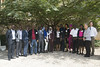
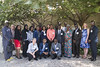
People take pictures. Cliché pictures, posed pictures. Then there are candid pictures. But not many pictures are great pictures. This picture is a great way to depict happy. Especially since these are scholars from all around the world having being chosen from their home countries for the SUSI Program for visiting scholars.

What does this mean? The picture is a fascinating image of colour and camaraderie. Colour not just from the many fascinating outfits but colour in terms of characteristics, personality, behaviours. Apart from the United Nations how many official meetings in the world gets individuals from 17 countries including the United States in one room without the element of arguments or conflict?

Here is a group of scholars with great experience in teaching, research and work behind them grouping in one of the largest powerful countries in the world tolerating each other’s idiosyncrasies and differences to be at peace in one common arena and one common focus. So maybe at some point United Nations should see us and see how we are able to work together and appreciate tolerance.
 (Thanks Rob)

Wednesday, July 10, 2013


Honduras is a Five-Star Country
by Beatriz Lovo Reichmann

In every country, there are events that mark a before and an after in the way of life of its people. In Honduras, there are two such events in recent history: Hurricane Mitch, the deadliest in the history of humanity, and the political events of 2009 that polarized and divided the country and engulfed Hondurans in despair, helplessness and later on courage and pride.

In June 2009, Manuel Zelaya, president at the time, intended to illegally perpetuate himself in office, to what Congress, the Supreme Court, the Human Rights entities and the People (I among them)responded NO.

And as if to say that a people can only fight for their freedom if they have been 20 or 30 years under the rule of tyrant, the international community abandoned us; the country lost recognition from every international organization to which it belonged: the United Nations, the Organization of American States, the International Monetary Fund, just to name a few…as if we had been beggars instead of partners.  And yet, there we were; unrecognized but screaming, and kicking and fighting.

It was called a coup and not what it really was: a presidential succession based on Honduran law. The constitution of Honduras states, in cases where the President is asked to resign, the President of Congress should be sworn into office…and so it was done. Roberto Michelletti became the president we needed at the time, if only for a few months. Presidential elections were held in November of that year, programmed. It is this election in which more Hondurans, in-country and abroad have participated.

Thus, a new president was elected: Porfirio Lobo Sosa (not related to the author). Many thought he would be the answer to our prayers. But, what this man has yet to realize is that people didn’t necessarily vote for him; they voted against the other candidate affiliated to Zelaya’s party.

And so there began a new term of excess, corruption, overspending…In the last few months, not having learned the lesson that Zelaya now understands, Lobo has attempted to trample on Honduran’s most basic right: Freedom of Expression of Thought.

Honduran information media have become a true watchdog: that 4th power of government that every democracy needs. And, in order to force government into action, it has uncovered, reported, revealed every act of corruption and inefficiency of the president and all those in office.

So, on March 2013, Lobo decided to send to Congress a gag law regulating telecommunications, changing it so that it would “benefit the majority”, as if the “majority” couldn’t see that he was the only one obtaining benefit.

CONATEL (National Commission on Telecommunications) is a state-owned, the decentralized entity that regulates, coordinates and administrates telecommunications policy in Honduras. It does NOT, regulate media content for any reason or purpose.

Lobo Sosa proposed to form a commission adjacent to CONATEL that would exercise prior censorship on media content, enforce confiscation mechanisms and promote direct government intervention on news and information. I addition, the new law would include regulation on trade and commerce.

The Constitution of the Republic of Honduras guarantees Freedom of Expression of Thought, stating that freedom of expression and information are INVIOLABLE. “Every inhabitant, without prior censorship, can express his/her thoughts, provide and receive information and discuss own opinion or that of others through written and spoken media or any other graphic, audio-visual or printed procedure.”

So, as we did in June, 2009, we marched and protested and made ourselves heard. The people united again, along with the Association of Communication Media of Honduras, the Association of Advertising Agencies of Honduras, the Association of Independent Radio Distributors of Honduras, the Honduran Council for Private Enterprise, the National Association of Industrials and a dozen other groups that said NO and exerted pressure on Congress to reject the law. And the law was rejected.

And now we await another presidential election. Lobo Sosa will have to step down, but there doesn’t seem to be one single candidate that could truly work for the benefit of the many. Our immediate future looks dim; our democracy is young and feeble and fragile. But we’ll keep on fighting because we are a five-star country.

Monday, July 8, 2013

Kravitz, running and being a student

by Sharon Wilson, Malaysia

When Lenny Kravitz started singing American Woman, I started running. From the University Courtyard at Richland Avenue to Ohio University Park. It has been a hard day. A long day. A fruitful and productive day. And after a after a couple of days of rain, the sun was out and it was truly a beautiful day. The rabbits had come out to play and just outside my window a deer had wandered alone probably enjoying a little bit of sunshine and some alone time as well.

Its interesting to run in such a beautiful park with a lush canopy of trees and a stream passing through (maybe a river maybe a canal - i'm not sure). The air is fresh and the students are out as well enjoying their summer going for a bike ride, a walk or just - running.

As Lenny sang about how colored lights can hypnotize, I realized I am too hypnotized by the reality of the fact that I am in the United States and I am akin to a student again. After some 15 years of leaving 'studenthood', its as though  I had been given a chance card and the chance card reads " jump two places to student'.

In 6 weeks I can catch up on lost time. If I was Julie Andrews i'd be on top of a hill singing "The hills are alive to the sound of music" but i'm not and so I have to run.

(Source: www.cityofart.com)

But in all seriousness, the idea that I could go to classes again, eat lunch at the cafeteria, look as lost as freshmen students, enjoying the company of room mates and classmates without the worry (for the moment) of paying the bills, doing heaps of laundry, preparing for dinner or marking assignments is a breath of fresh air. And I believe it is a time of rejuvenation before heading home after the SUSI program. And as Lenny sings the last line of his song saying he's gotta go, at the moment i'm not going anywhere. I'm going to savour every minute and second of my time as a student albeit the running and the creaky knees.

Sunday, July 7, 2013

Lazy Hazy Sunday

by Sharon Wilson, Malaysia

Its day 3 of the SUSI Programme. Its a Sunday and everyone is relaxed and taking it easy. Nothing much was happening except for that light drizzle in the morning - so mild it felt like someone switched on a faulty sprinkler system and forgot to turn it off.

The morning trip to Walmart seemed quite relaxed and less stressful - possibly because this was our second trip and we were familiar with the lay of the land. But I believe in the back of everyone's , minds we knew it was one of the few Sundays we got off as the real work would begin on Monday with discussions, presentations, discussions and more presentations. Maybe next weekend we could all go watch a movie I heard myself tell another scholar but who am I kidding? There was already a reading list waiting for me.

Reading list and presentations aside, today was an unusually long day. Not because I had nothing to do - yet..but daylight seemed very long. It was my first experience where at 8pm, the sun was still out looking cheery and bright. Back home in Malaysia, 8pm is dark and everyone is having dinner. It was amazing because I could feel my body shutting down for sleep. It seemed like an illusion of the eye but that is life and that is how I ended up typing on the blog and dozing off on the computer doing just that.

Photo: 8pm from University Courtyard room

Saturday, July 6, 2013

My cup runneth over...

by Sharon Wilson, Malaysia

Travelling about 23 hours on a plane from Kuala Lumpur, Malaysia and transiting three airports (KL-Japan, Japan -Dallas, Dallas-Columbus) is not a laughing matter. It gets to the sanity of anyone. One can become cranky, frustrated, confused, tired and angry. The long flights can also become worse if one has a partner on the plane who is also in the same predicament. It would be like two lions going in for the kill. (I was lucky in this regard).Then there's the fact that you are leaving behind family and friends for 6 weeks.

Although travelling to the United States of America for the SUSI programme was all of the above, one important thing which has made me feel at home and not feel lonely and in despair are my room mates. Three beautiful women from three countries who has had a similar experience. Consuelo Aguirre from Ecuador, Shabnam Azim from Bangladesh and Sibongile Mpofu from Zimbabwe. Although Sibo came in one day late but we have all bonded as though we were long lost friends.

It doesn't make sense how four women from four different cultures, religions, backgrounds can laugh about the similar things and worry about similar things. But that is it. From talking about work and journalism policies in our countries to everyday things like shopping for salt at Walmart and cooking breakfast.

It reminds me some-what of Carrie, Samantha, Miranda and Charlotte of the ever famous Tv series 'Sex in the City' although not so wild. But the bond portrayed was equally amazing and something every woman wanted in a group of friends.I wish to continue this friendship. I wish to sustain this and make this friendship a part of a lifelong commitment to stay in touch and to 'grow old together'

(Photo: Getting ready for SUSI welcome dinner)

So thank you dear friends, for allowing me some insight into your lives. For allowing me to be a part of your lives and for taking the trouble to get to know me as well.

Thank you very much fellow Americans

Namaste:

Being a Nepali I used to have a certain assumption about Americans. What I would think was American were aliens, and there could be no meeting points between us. However, I got a chance to come this great nation through a state department’s program almost a month ago, I really felt blessed.

Not only are they very generous and helpful, but also very very hardworking. Moreover, I became so happy that due to the money they pay to the US government, this kind of visit is possible. Unsurprisingly, Athens, Ohio where I have been residing is similar to my own place. Similar greenery, fields and clouds.

Therefore, first of all I would like to thank the American people for making my visit pleasant and successful. I surely will carry a lot of messages to fellow Nepalis.