While in
Ghana we were able to interact and listen to some of the most interesting and
insightful people. Lecture after lecture I left with new knowledge
whether it was about African proverbs, what tree leaves will cure a sore
throat, or about the lack of slavery education in the local schools. These were
just a couple of my favorite speakers. I have gained more than I could ever
imagine from this trip.
But, It
wasn’t the teachers, Rabbis, castles or museums that left the biggest impact on
me. It was the people, the every day people. The cliché saying “a smile is the
universal language of kindness” never rang more truer that it did while I was
living amongst the most generous people I have ever met. The people were so god damn happy. It
was contagious. It is hard not to be happy around them.
The people
I connected with the most were the kids. I have always loved kids but
the children here were so pure, raw, and indescribably happy.
They didn’t hid shyly behind their moms
legs, or cry when they didn’t get their way. They were vibrant, full of life and wanted nothing more than to be loved. One afternoon at the beach I was about to go for a swim and
out of nowhere four little girl came sprinting towards me, a stranger, and jumped into my arms. “Oburoni(white person), Come swim with us! Come on Oburoni!”. After
we swam I sat for another half an hour playing hand games with them.
Over and over again we chanted the same rhyme, and over and over again it ended in a roar of laughter. Something so simple made me, and them, so happy.
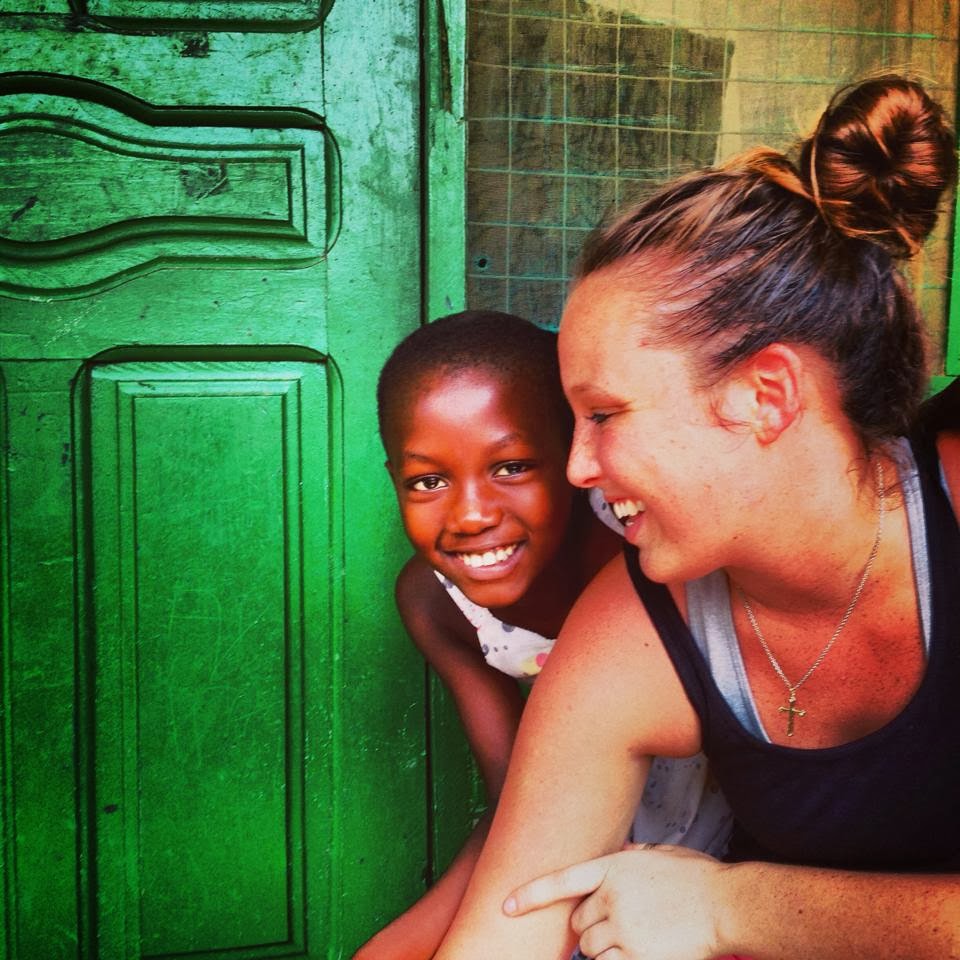
I also got the amazing opportunity to volunteer at a local orphanage called Weep Not Child . Again, these children continued to amaze me.
As we pull through the gates to the orphanage, nothing but smiles. Even though they share one bedroom with 20 other boys or girls with only 9 beds, even though they play soccer on a piece of dirt land covered with rocks and old nails, even though the babies constantly have dirty dippers because they don't have enough to change them; they are happy. Happiness, what is happiness? What does it mean to be truly happy? I don't think I knew the true meaning of happiness until I went to Ghana. There I learned the simplest form of happiness, not needing anyone or anything to create happiness for me. Just being able to love and enjoy the life I was given.
.
Another thing I learned from these kids is that no matter your situation never loose sight of your dreams. These were some of the brightest, well spoken kids I have ever interacted with. You would think that their school work books were the latest video game or a bag full of candy the way they were fighting over them. They love to learn. And they were smart. Daniel, loves math. As we flipped through his math book, page after page, I noticed things that I couldn't even do. After my math session was over I asked Daniel, "What do you want to be when you grow up?" without hesitation he said;
"A Pilot."
"Why do you want to be a Pilot?"
"So I can fly anywhere I want and see the world."
Daniels dream sticks with me, his optimism sticks with me. If he can live in the situation he does and can dream that big, than anyone can. It's astonishing to me that someone with so little can think so big for themselves. Daniel, my sweet boy, I believe in you "there is no passion to be found
playing small - in settling for a life that is less than the one you are
capable of living."--Nelson Mandela
Prior to traveling to Ghana for this study abroad program, I
had never traveled overseas. I would consider myself an experienced traveler
when it comes to the United States and bordering countries such as Mexico and
Canada, but when it came to third world countries across the Atlantic Ocean I
was clueless.
My first impressions of Africa came from movies and
television programs I had previous seen. So basically, my first impressions of
Africa were exotic animals, chase scenes through the desert, and murder. Before
making the final decent to Ghana I did my research, but it is hard to explain
via textbooks and seminars what the Ghanaian culture, people, and environment
is like.
Any thought or opinion you may have formed about Africa
please wash away before you have experienced the continent firsthand. It has
now been two weeks since I have been back in the States, and I am still in
grief of having to leave the people I formed such close bonds with and the
Ghanaian culture.
Like I said above, it is near impossible to try to explain
in text the truth about African countries, and more specifically Ghana. During
my 25 days spent there, there were things that stuck out to me the most, and things
I will never forget. One of those being how overly nice the Ghanaian population
was and how a city filled with poverty could obtain so much joy.
In our group meetings before traveling to Ghana we often got
told that the people, men specifically, were very “forward.” It was repeated
that this forwardness should not be interpreted as we in America would say
“creepy” or “sketchy,” but actually just nice. This in fact, was true. I have
never meet more genuinely nice people in my whole 20 years of life.
Walking down a busy street in Osu,
you will never make eye contact with someone who does not smile at you.
Ghanaians believe that everything in life should be treated as a celebration.
They wake up everyday happy with what they have and cherish all that they are
given, even if that is less than what poverty would be in America. This
happiness is then exerted onto their peers.
One of the first nights we were in Accra, a group of girls and I attempted to
walk to a nearby restaurant to get some ice cream. We clearly got lost and had
no clue where we were headed. A group of Ghanaian friends walked out of a
building ahead of us and we asked them for directions. The language barrier was
tough, and it was concluded that we were not going to understand what they were
trying to explain. So, instead of leaving a group of foreign young women to
walk around aimlessly in Accra, one Ghanaian woman left her friends and offered
to walk us to our destination. We were shocked. She walked the complete
opposite way of her friends, and her home late at night, just to make sure we
got to our desired location safely. On
the way she explained to us that it wouldn’t have been right of her to let us
walk alone at night. She continued by stating that it was unsafe for white
skinned women to walk in these parts of town after dark, something we never
would’ve known without her guidance. We couldn’t have thanked her enough. The
Ghanaian women politely laughed at our endless amount of thanks by suggesting
it was really no big deal, it was just something “they do.” Helping strangers,
something not many Americans do out of the kindness of their hearts.
This is only one out of several stories I could share about
my kind experiences with the people of Ghana. When in lecture at AUCC we asked one of the
Ghanaian professors that had recently traveled to America what he thought was
the most contrastive thing about our culture compared to Ghana. His answer, our
politeness. He said it was hard for him to walk down the street and not feel
warmth from everyone. He said that the American people would quickly pass him
and say, “how are you” without stopping. He followed by explaining that in
Ghana, if a person asks how you are, they genuinely want to hear and know how
you are doing that day. They care. You rarely ever see that in America.
If I could one day walk down the busy streets of New York
and feel the same amount of love that I did in Accra, I will be one happy
camper. I greatly miss the friendships I created in Ghana, and I hope I will be able to go back and visit them very
soon.
The process of buying something in Ghana is a cultural experience in itself. Whether it's haggling with a stranger at a market stall over a bracelet or getting charged 30 cedi ($15) for a box of cereal at the gas station because of your skin color, the Ghanaian retail world is one that's hard to get used to.
Most of the restaurants on Osu Avenue were very straightforward with their pricing. They had a menu with posted prices, you ordered and paid the expected amount. There was no bartering involved which was a relief to a group of American college students who were constantly trying not to get ripped off.
The gas stations were slightly different in that the posted price may not be what you paid when you approached the register. Many time we found ourselves paying three or four cedi more than posted. For example, one time I purchased four bottled waters at one cedi each and ended up paying seven cedi. At the end of a long day, I would usually just pay the 3 cedi ($1.50) tourist charge instead of argue my way out of it. One morning on our way to Cape Coast, my jaw dropped when the cashier charged me 30 cedi for a box of off-brand frosted flakes at a gas station. I protested the amount, but was met with a blank stare and handed over the equivalent of $15 because I had nothing else to eat.
A row of stalls in Makola Market
While this was frustrating, the markets in Ghana were downright intimidating. I've been to markets in Asia before - specifically the largest market in Bangkok, Thailand. However, Bangkok's market could in no way shape or form prepare me for the markets in Accra. The first market we went to was Makola Market which is in the center of Accra. It is known by Ghanaians outside of the capital, and many West Africans are aware of it as well. Produce, seafood, clothing, cooking utensils, jewelry, fabric, and different imported brands can be found here. Navigating this market was an adventure as it is spread over multiple blocks and is a maze of alleyways, stairwells and roads. The market is frequented by locals so pale-faced tourists are a sight to see, especially when traveling in a pack of 20.
The other market we went to was the Accra Arts Centre. While the size and setup of this market was more organized and logical, the hassling was not. We stepped off the bus clutching our cedis tight as we all spread out in different directions to go look for art, clothes, and jewelry made from all over the country. Bartering at the Arts Centre was intense. After walking down a row of stalls and hearing each shop owner call out to you - and some grab your arm - the next step is to settle on an item you like and begin the bartering process. Because we are foreigners, the prices initially charged to us are upwards of 400% higher than they would be charged to those of a Ghanaian. Working a shop owner down to a reasonable price is a process, but one that can pay off is you are patient and aggressive in your hassling.
You can't visit Ghana without experiencing authentic African trading and the culture shock that comes with it. Now back in the States, I'm relieved that I can go into a store and know that I will be charged a fair price. I also will now welcome an American sales associate asking if I need help finding anything, as it is far different than the aggressive nature of the shop owners in Ghana. Retail therapy does not apply in Africa. I felt like I needed to go to therapy after the culture shock of the African shopping trip.
One of the most notable experiences on any trip abroad is
trying all the various types of food that are staples to the people and their
culture. Little did I know that the Ghanaian food and dining experiences we had would become some of the moments that left the biggest imprint on our trip.
I was a little worried for myself and my classmates at first
because a few of us are vegetarians or pescetarians, meaning eating fish but
not other meat. I came to Ghana knowing that I’d be willing to try all types of
food that I could, but food turned out to be more of a struggle than I’d
expected.
This willingness to try anything took me by surprise though,
seeing as on the second day of the trip THIS was my dinner. Never had I been
served an entire fish on a plate before.
Besides the obvious
distraction of scales and picking bones out of my mouth, the fish tasted great.
But Dr. Kalyango convinced me that I had to try the fish eye,
which he said was the best part. I remember Dr K telling me that the eye
would just slide down my throat like ice cream and that I would crave fish eye
for every meal. I don’t know what he was thinking though, because that slimy eye had
no resemblance whatsoever to ice cream….
Over the next few weeks we all had the opportunity to try
some special Ghanaian staple-dishes. We became very familiar with the likes of
jollof rice, waakye, red red, fried chicken, tilapia, banku, and the ever
delicious fried plantains, which were my favorite.
In fact, we began to expect (and in Josh’s case, CRAVE)
jollof for every group meal.
A video by AdomHomeCooking on how to prepare Ghanaian Jollof
Everyone was very willing to try new things, but we found
that group dinners became a little notorious for being disastrous to a degree.
Now don’t get me wrong, I loved our group dinners and found they were a great
bonding experience for all of us. But customer service in Ghana is so much
different than that in America, which became one of the biggest learning
experiences of all in terms of my ability to be patient.
Unlike what we expect in the United States, restaurants
actually do have a limited supply of food for the day. I don’t think any local
restaurant in Ghana expects a group of 20-something hungry young adults to
swarm their restaurant all at once, therefore weren’t always able to cater to
our needs and stomachs. We often joked that it took so long because the cooks had to go out and catch our fish or chicken before they prepared it for us.
Oftentimes our meals would span over several hours, with
some people being fed super early, some not getting their food for 3 hours, and some
not being fed at all. When the kitchen would run out of a certain type of food
they wouldn’t tell us until it was too late, and orders were sometimes forgotten. It was not uncommon to hear someone say "Where's my jollof and chicken?" at every meal. Although
it was frustrating, we became very good at sharing our food family-style to make sure no one
would leave hungry.
After two weeks I did get sick of eating rice and beans for every meal. Also, the Ghanaians were shocked whenever I ordered food without meat, and would try to force some protein onto my plate, much to my demise.
Even though I was glad to try new things, I’m willing to
admit that we all jumped on the chance to eat pizza whenever we could. I didn’t
realize how much I’d miss bread and cheese, or other dairy products. And even
though we may have all gotten upset stomachs from the food which led to nights with the toilet, and even though I
don’t want to eat rice and beans again for a very long time, I’m happy that
Ghana gave me the opportunity to expand my culinary diary and open my eyes to
new foods. As I reflect on the food experiences from Ghana, I leave you with this closing haiku:
Culture shock. I had heard this phrase day-in and day-out prior to my departure from small town Ohio. Of course, I was prepared for the opposing cultures of travelling to a third world country, but never was I prepared for the culture shock awaiting me when travelling from Accra, Ghana to Beverly Hills, California.
I was lucky enough to land an internship at Ms.Magazine in Beverly Hills before I left for Ghana, effective as soon as I returned home from Africa. Going from an internship at the Daily Graphic to Ms. Magazine gave me a huge perspective and new found respect for journalism in the United States.
Outside of the Daily Graphic. Photo by Zach Bourgraf
The Daily Graphic is the largest circulating newspaper in Ghana; however, as I read the paper on the first day of my internship, it felt like I was reading my local county paper at home. The internship was unaware that we were even going to be arriving. My first (and only) assignment on the first day, was writing a 500 word press release. As a student strictly studying journalism, writing a press release was a completely new world for me...and I was completely lost at where to start. The second day I received a by-line, again, covering a press release from the Ghana National Association of Teachers. Through this experience at the Graphic, I realized that it is important, as a journalist, to have a grasp of the PR side of things as well; however, I do not feel like I did much journalism at all.
At Ms. Magazine, a national magazine circulating quarterly covering women's issues, I was greeted by everyone saying that they were waiting for my arrival. My first week at the internship I received five by-lines in the issue that will be closing in two weeks. I have spent every minute of my day fact checking every word of every article that will appear in the up coming issue. I feel like I am actually immersed in the field of journalism here, where the Daily Graphic seemed disorganized and more like a public relations firm.
One striking difference between journalism here and in Ghana, is the lack of variety in their publications. The Daily Graphic had one page covering gender issues, whereas in America, we have hundreds of women's publications. The Daily Graphic formally referred to homosexuality as gayism and lesbianism, also treating it with bias, saying it will corrupt our youth. Publications in the United States would receive huge backlash if LGBT was treated as anything different then just simply covering the issues.
The bias and lack of hard hitting journalism in Ghana shows that they have a long way before their journalism is up to the standards of how we treat it in the United States. They are making steps; however, by working to pass a law similar to our Freedom of Information Act. This internship at The Daily Graphic, especially being able to contrast it with a current internship in Los Angeles, gave me a whole new perspective and appreciation for being a journalist in the United States. Thank god for the First Amendment.
By: Kaylyn Hlavaty Based in Beirut, Lebanon In the northeast corner of Lebanon is the predominately
Christian village of Qaa. It shares a border with Syria and is located just
about 5 km away from Hermel; a town that is feeling the repercussions of the
neighboring war in Syria. After a four-hour ride in a small ten-person van, I
arrived at night in the small town of Qaa with two of my friends. Our friend, Fernando who is a seasoned
freelance photographer greeted us with open harms as we stepped out of the van
and into the cool, crisp air. The sky was lit up by stars and in the distance a
thick fog casted a white cloud over buildings and the mountains. Once out of
the car, we headed to Fernando’s friend Abuna’s house. In Arabic, Abuna means father. His real name is
Elian Nasrallah. He is a Greek Orthodox priest who lives with his family next
to the church. He welcomes us and we have a dinner filled with labneh, bread,
vegetables and chai. He is one of two priests in the town. Following dinner, we
gather in the room heated by a gas burner and Turkish coffee. The conversation is mostly spoken in
Arabic with the exception of my friends translating for me in English. The
disadvantage of not speaking Arabic is a barrier I’m constantly working to
overcome.
On left: Church and Abuna's house right next to it. Photo taken by Kaylyn Hlavaty
Soon after the coffee was
depleted and our eyes became heavy, it was time to head back to Ferando’s place
and get some shuteye for the long day ahead. Being the kind person he is, Abuna
offered to drive us home. A drive home turned into a tour of the village.
In the short time I was in the car, I learned that,” when I’m with the Abuna,
anything goes and he has the influence to do so”. To prove my point, he drove
us past the Lebanese army at the border. They waved, smiled and ushered us
through. Then we passed a Hezbollah guard and it was the same reaction. From
there, I was literally only 300 m away from the Syrian border. For now, it’s
the closest I’ve ever been to the border. Qaa is a place where any stranger can
enter, but if you don’t have a contact in the village, a person is sure to be
stopped by Hezbollah, special forces, a retired solider and even a local. They
are all working together to tighten security by patrolling the area at all
hours of the night. Once evening falls, around five p.m., the village feels
like a ghost town. The occasional ship owner still keep his door open and
lights on for a villager who wants some fruit, labneh or bread.
On left:the Greek Orthodox church and Abuna's house next to it. Photo taken by : Kaylyn Hlavaty
The following morning, our
day started early. The air was crisp and the sun was shining. It was a pleasant
change from the constant beeping and traffic that polluted Beirut. My lungs and
sanity appreciated the break for two days. I saw more locals proceeding with
the daily tasks of village life. One woman was picking and sorting cotton and
another nearby was hanging laundry on the clothesline. We headed to Abuna’s
house for breakfast before going to the clinic to help treat the injured
children and adults. As we were eating breakfast, we heard the news of a
suicide bombing in the Hermel, which is a town over from Qaa, about 4 km
away. Throughout the past night and the following morning, I heard
rockets launched in the distance. A village that was probably silent and calm
before the conflict was now muddled with the sounds of BOOM, BOOM, BOOM.
In the afternoon, I walked across the street to the building that serves as
a clinic in the morning and a school in the late afternoon. The building is basic in all sense of the word. The top floor is used for medical services and
the bottom is used for classrooms.
Syrian children waiting for a check up. Photo taken by Kaylyn Hlavaty
Since 9 a.m, there was a
constant traffic of adults and children waiting to be looked at by the staff of
only two doctors,one nurse and a couple of volunteers. Ferrando invited us into
the room of general medicine. Lying on the bed was Syrian boy about five- years- old.
He was born paralyzed and was going to die within a day or so. The doctor
recommended the family take him to the hospital, but they didn’t want to bear
the costs since he was going to die anyway. Throughout the day, I saw cases
where mothers waited up to ten days to take their child to see the
doctor. Many of the refugees are not educated and to no fault of their own,
don’t know preventive health practices. Many are afraid of the potential
financial burden.
A doctor examining a young boy. Photo taken by Kaylyn Hlavaty
By mid-afternoon, my
friends and I were planning to head back to Beirut. Since there is no set time
for transportation, we wanted to make sure that we didn't miss a bus.
Ferando suggested we stay another night so we can see the children come in for
school. With no Internet and computer, we opted to get back home and we decided we
would come back the following week. On the way back, a Lebanese solider gave us
a ride to the next town over so we could catch a bus. The trip to Qaa gave me
the opportunity to find many story ideas and it was nice to be in a place that
wasn't saturated with journalists. Once we got back to Beirut, Syrian
missiles struck the town of Qaa. It was a good thing we came back when we did,
but I still wished I was there to report about it. This week, I plan on going
back to no man's land.
A woman getting her foot wrapped. Photo taken by Kaylyn Hlavaty
Young African Leaders' Initiative Connect Camps Underway in sub-Saharan Africa
The purpose of the Young African Leaders Initiative (YALI) Connect Camps is to invest in the next generation of African leaders through intensive executive leadership training, networking, and skills building, which will prepare them to make social change in their communities. The core Ohio University team working jointly with The Collaboratory at the U.S. Department of States Bureau of Educational and Cultural Affairs has designed a program for the YALI participants called Connect Camps taking place in sub-Saharan Africa to pursue the following goals:
1) Give up to 160 young African leaders the opportunity to collaborate, learn, and network with U.S. and African resource experts and with each other during the eight YALI Connect Camps; to develop innovation strategies that build on their professional skills, engage in hands-on experience with low-bandwidth technologies, conduct community outreach, and buildtheir capacity through mentoring, networking, and using strategic civic leadership for social change.
2) Use a stimulating canvas model of leadership to develop skills in entrepreneurship and creating social change by engaging in five-days of facilitated interactive sub-group workshops, and fostering mentorship relationships between the Mandela WashingtonFellow alumni and their chosen mentees for the Camp.
3) Demonstrate some community-oriented enterprises using applied technology that supports innovation and collaboration in community development and entrepreneurship, civic leadership, and public management.
4) Develop leadership skills among delegates through mentoring relationships, between themselves, as well as with American and African facilitators.
5) Provide participants with opportunities for face-to-face networking and to facilitate a collaborative, innovative project or projects that further YALI goals.
Various U.S. Embassies in Africa have been instrumental in the selection and coordination of hosting the Connect Camps. The YALI Connect Camps are funded by a grant from the U.S. Department of States Bureau of Educational & Cultural Affairs and administered by the Institute for International Journalism (IIJ) at Ohio University.