![]() |
| United States defender Jermaine Jones answers questions during a media day outside the team's hotel in Sao Paulo, Brazil on June 13, 2014 | Carl Fonticella |
Thursday, September 18, 2014
Scripps Bobcats take on World Cup, Brazil 2014
By Kate Hiller
From the streets of Sao Paulo, Brazil, to the Westergas Terras restaurant and bar in Amsterdam, to viewing parties at Easton Town Center in Columbus, the 2014 FIFA World Cup was covered and experienced by bobcats around the globe. Through a partnership between the United States Soccer Federation (USSF), the Institute for International Journalism in the E.W. Scripps School of Journalism, seven undergraduate students from Ohio University (OU) were able to do more than just watch the games: they had the opportunity to travel around Brazil experiencing and covering the World Cup firsthand.
OU students Katy Andersen, Katie Foglia, Devin Ellis, Kevin Noonan, Marisa Salopek, Brieanna Charlebois and Carl Fonticella were selected to work with the USSF press, as well as with journalists from well-known publications such as Sports Illustrated and The Washington Post.
“They treated us like we were one of them, we weren't just the interns,” Carl Fonticella, a sophomore studying photojournalism, said about the media professionals that the group worked with. “It was really cool to get to know (people) with that much experience.”
Katy Andersen, a junior studying broadcast journalism, was the group's video intern. Though neither she nor Fonticella, who were both focused on visual journalism, had FIFA credentials and thus weren't on the field during the matches in Brazil, there was plenty of work to be done at practice, during press conferences, and around Sao Paulo. The pair was able to shoot a friendly match between the United States and Turkey in New Jersey before leaving the country, as well as team practices in Brazil.
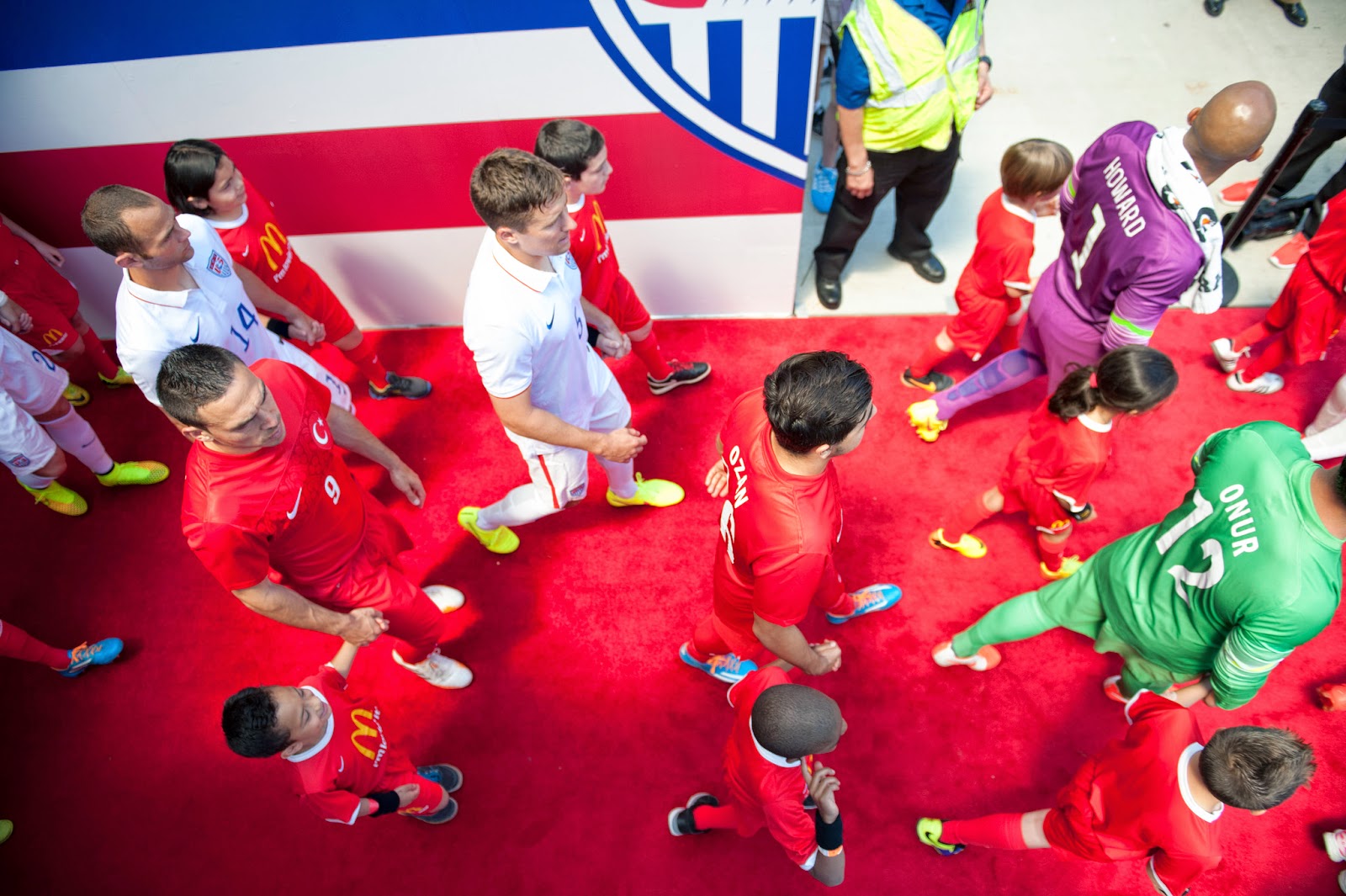
While in South America, students had the opportunity to attend Fan Fests, which junior strategic communication major Brie Charlebois explained were a way to bring the atmosphere of a match outside the stadium to people who werent able to obtain tickets.
“(Soccer) culture is obviously growing in America, but it's definitely not what it is in other countries,” she said. “People are in to it, but were about multitasking now and there are too many sports going on, whereas in certain countries, during that time and always, soccer is the only thing that really matters.”
Charlebois worked under David Applegate, USSF Media Manager, as a PR assistant. In addition to writing stories for the USSF, all trip participants were required to contribute to www.scrippssoccer.org, a website put together for the JSchool's coverage of the World Cup from both Brazil and from another group of students working with the National Soccer Coaches Association of America in Europe.
“I got a mix of journalism and public relations,” Charlebois said. “It was interesting to actually be a part of something so huge but also be a part of that image. I got to know what it was actually like to work for a federation rather than just doing PR for things around campus.”
She also had the opportunity to attend two live matches in Brazil – USAvs. Portugal and the USA vs. Belgium. During the Portugal game, she was able to sit in the family and friends section, which she said was more relaxed than the American Outlaw section, which is where die-hard fans crowd in to cheer on the US team. Though there was not an American Outlaw section at the Belgium game, the area where Charlebois sat sort of morphed into one when people started up the usual cheers.
“(Sitting with the families), I analyzed and watched intensely,” she said. “We were put in a section over from the family members (for the Belgium game) and that section became the American Outlaw section, starting the chants. It was crazy but a lot of fun.”
From media experience and networking to attending one of the worlds largest sporting events, the partnership that was forged after a year and a half of negotiations was a success for all bobcats involved. For Fonticella, this experience was even a deciding factor in his career.
“My life is heading toward sports photography,” Fonticella said. “This internship helped me decide if I wanted to be a sports photographer or if I was just going to be a traditional photojournalist.”
Tips and tricks picked up in Brazil were not left behind when Andersen went through customs.
Wednesday, August 6, 2014
Universities of Zambia and Chile working together on Youth and Communication
It is my great pleasure to announce the incorporation of Professor Brendah Bukowa to the Network of Researchers on Youth and Communication (Rec-Juventud).
The goal of our network, is to generate an associative work of researchers from the University of Chile and other national and international research centers and institutions , in order to promote interdisciplinary collaborative work around the topics of Youth, Gender, Information Technologies and Communication. The creation of the network and its subsequent consolidation, is intended to build bridges of knowledge, allowing researchers to share, discuss and disseminate their work and advances in the field.
The participation of Professor Bukowa, will be of a great contribution and also will help to further internationalize and strengthen the network.
Thanks to the SUSI on Journalism and Media program from State Department of the United States, hosted by the University of Ohio at the Scripps School of Journalism, I could meet Brendah, know about her great work with children and have the chance to discuss ideas about potential collaborative work. Here we have the first result.
Welcome Professor Brendah Bukowa!
Lionel Brossi
Assistant Professor
Instituto de la Comunicación e Imagen
University of Chile
lionelbrossi@gmail.com
Twitter: Lio_Brossi
Topics: Chile, communication, network, Youth, Zambia
Thursday, July 31, 2014
Viva America and Ohio
By Dr. Awad Ibrahim Awad (SUSI 2014 scholar)
Before I come to America I was putting a lot of scenarios in my mind about this great country. All through the way in the plane I asked myself about what form of life I may see in America? After a long journey of twenty-four hours from Khartoum via Cairo via Frankfurt the Lufthansa plane landed at the airport of Chicago. It was 8 pm , despite the fact that sunlight was still emitting from all directions. I could not believe my eyes while I was looking and wandering all over the giant airport. The atmosphere was nice, and the place was so sophisticated and elegant. I found before my eyes an American family consisting of a husband and his wife who also wanted to go to Columbus on the same trip of mine. The accident put us in one place for long hours before the plane took off in the next morning. That was the 20th June 2014. We spent all the night talking about America. They told me about life, and how young generations are handling their own way in all activities they do. On the other hand I explained to them how people survive in Africa, and how they struggle for survival in some parts of the third world.
One of the reasons for that marveling was the distorted picture portrayed in our
minds in many countries of the Third
World about America. They told us over the years that America is the ghoul who
kills people, creates problems, persecutes religions, and colonizes all the innocent
countries of the world. And we lived most of our lives fearing and hating
America. Whenever we try to love America our media makes us turn away more and
more from that love, so that we ignored any positive talk about it when we met
with any Americans in the different parts of the world.
I am now in the heart of America, and even in one of its largest airports, the beautiful Chicago airport. This airport witnesses an aircraft landing and take-off at every minute throughout the morning and evening hours. I saw people of all the human races, colors, and languages going and coming in this international airport. Thousands of people walking around in this great airport as if they were in the greatest day of Hajj. All of us paid tribute to the role of America in the entire world, and to the role played by the University of Ohio which is inviting me and other scholars since its inception. After the expiration of the specified period of waiting I came to the conclusion that the U.S government had really created a prosperous and modern lifestyles for her people and others around the world.
At 8:15 AM an elegant van of Ohio University came and took me with the other colleagues from Adams Hall were we live to the Scripps 211. This is the usual time of our daily departure to resume our activities. The timetable was very rich, and the day was full of lectures like the rest of the days. Through this program we met with many university professors from different American universities. They all came to lecture us in media and communication aspects. They gave lectures about the press, radio and television, news agencies, communication systems, advertising, marketing, management of media outlets, conduct of communication research, techniques of modern media, community media, as well as media coverage during the times of war and peace.
We had many visits to the university libraries which are very rich of references in all aspects of knowledge. We learned how to use the modern networks to save and retrieve information through computers that have been developed all over the place.
As a part of the program all scholars were supposed to fill a weekly sheet of assessment for the activities of the week. This assessment is always confidential and not shown to any person except the leaders of the program for the sake of development. That is because they want to enhance their performance year by year.
Before I come to America I was putting a lot of scenarios in my mind about this great country. All through the way in the plane I asked myself about what form of life I may see in America? After a long journey of twenty-four hours from Khartoum via Cairo via Frankfurt the Lufthansa plane landed at the airport of Chicago. It was 8 pm , despite the fact that sunlight was still emitting from all directions. I could not believe my eyes while I was looking and wandering all over the giant airport. The atmosphere was nice, and the place was so sophisticated and elegant. I found before my eyes an American family consisting of a husband and his wife who also wanted to go to Columbus on the same trip of mine. The accident put us in one place for long hours before the plane took off in the next morning. That was the 20th June 2014. We spent all the night talking about America. They told me about life, and how young generations are handling their own way in all activities they do. On the other hand I explained to them how people survive in Africa, and how they struggle for survival in some parts of the third world.
It was a great surprise to me when I found those
two people, deal with me as if I were a close friend to them. They talked to me
about their family which consists of a son and two daughters. They also
explained how the nature of human life is unique in the U.S. They told me how the
new Americans deal with the current inventions of technology, how they behave,
how they eat, how they learn, and how they build their future. We talked about
the freedom which the American constitution gave to the people through the
first amendment in the late eighteenth century. This freedom had contributed so
much to the development of this great nation. Suddenly we discovered that our dialogue
has involved other passengers who were sitting around on benches waiting for
the departure of their planes to take them to their different places. The
common denominator among all those people around me was their beauty,
simplicity, and their good conduct. In short, they were most beautiful and much
better than what was in my mind about the American people.
I am now in the heart of America, and even in one of its largest airports, the beautiful Chicago airport. This airport witnesses an aircraft landing and take-off at every minute throughout the morning and evening hours. I saw people of all the human races, colors, and languages going and coming in this international airport. Thousands of people walking around in this great airport as if they were in the greatest day of Hajj. All of us paid tribute to the role of America in the entire world, and to the role played by the University of Ohio which is inviting me and other scholars since its inception. After the expiration of the specified period of waiting I came to the conclusion that the U.S government had really created a prosperous and modern lifestyles for her people and others around the world.
At 8:15 AM an elegant van of Ohio University came and took me with the other colleagues from Adams Hall were we live to the Scripps 211. This is the usual time of our daily departure to resume our activities. The timetable was very rich, and the day was full of lectures like the rest of the days. Through this program we met with many university professors from different American universities. They all came to lecture us in media and communication aspects. They gave lectures about the press, radio and television, news agencies, communication systems, advertising, marketing, management of media outlets, conduct of communication research, techniques of modern media, community media, as well as media coverage during the times of war and peace.
![]() |
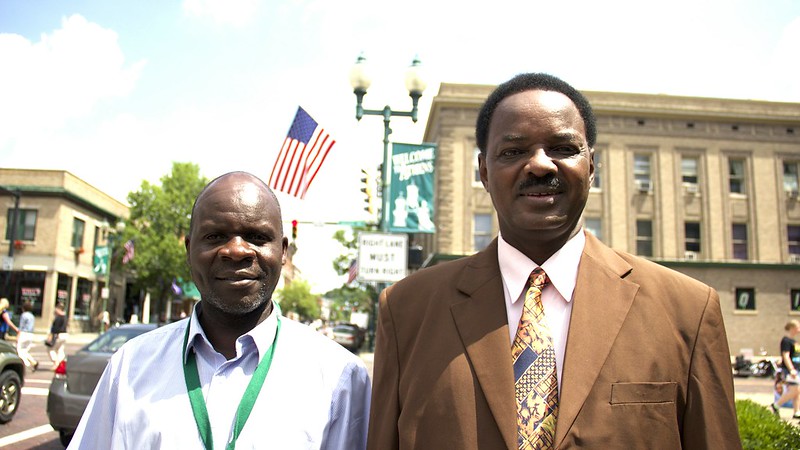
| Prof. Awad (right) with his friend Prof. Ellard Spencer Manjawira |
We had many visits to the university libraries which are very rich of references in all aspects of knowledge. We learned how to use the modern networks to save and retrieve information through computers that have been developed all over the place.
As a part of the program all scholars were supposed to fill a weekly sheet of assessment for the activities of the week. This assessment is always confidential and not shown to any person except the leaders of the program for the sake of development. That is because they want to enhance their performance year by year.
After that nice conversation we entered the plane
heading to the airport of Columbus the capital of Ohio state. Beyond the exit
of immigration and passports procedures I came to the departure lounge to find
a lovely two girls waiting for me at the main gate. They were from University
of Ohio. One of them was American, and the second was Jamaican. They both do
their post graduate studies at the University of Ohio. Therefore they work as
assistances for the SUSI program of communication.
We spent an hour and a half traveling on board the vehicle to the headquarters of Ohio University in the town of Athens. I met Prof. Mary T. Rogus the SUSI Academic Director who took me by her car to Prof. Yusuf Kalyango the director of the Institute of International journalism. Kalyango told one of his assistance to take me to the headquarters of the housing allocated to the professors involved in the program inside the campus. When I arrived at the campus of Ohio University I found the residence was most prestigious like luxury hotels in some countries. My room number is 163, and it is very clean and comfortable. There is a shared toilet between me and my neighbor in the room 161. There is also a small refrigerator which is quite adequate for one person, and a microwave for heating or cooking the food. There are two beds covered with nice sheets and a blanket to face the cold of winter, although we have come in summer. There is also a small table and chair for the writing and reading. Another similar table was found to put the bags and widgets on it. I entered my room and slept for long time after that long travel from home to America.
The program is called the SUSI Program, and it is developed
by the University of Ohio. It invited scholars from 18 countries around the
world to participate in the round of 2014.
The program lasted for six consecutive weeks.
During these weeks we learned a lot from the lectures and the visits which were
also very comprehensive and useful for getting knowledge. We became very aware
of the American media, how it began, how it evolved, how it works, and how it reaps
huge profits from the market. We also met with a number of editors of
newspapers and magazines and different authors of books in America.
During the program we learned a lot about the
international media systems. Each and every participant has talked about the
media in his or her own country. We knew about the media in Sudan, Kuwait,
Tunisia, Zambia, Myanmar, India, Russia, Costa Rica, Chile, Malawi, Sri Lanka,
Philippines, Hong Kong, Finland, Romania, Lebanon, Australia, and Kazakhstan. Through
these lectures we knew how the media works in the different parts of the world.
The SUSI put all the presentations of the scholars on line to be accessed by
whoever enters the websites of the University of Ohio. It is now easy for everybody
to get the information accompanied by pictures and graphics at any time and any
place.
The program involved many visits to a number of
U.S. cities and states in order to identify some of the important media
institutions. It involved beside Ohio the states of California, Georgia,
Maryland, and the federal capital of America Washington, D C. During these
tours the scholars visited a number of media organizations such as: CNN, Voice
of America, the National Radio of the United States, the U.S. Congress, the
headquarters of the Department of Google, many American theaters, newspapers publishing
houses, the house of African-Americans newspaper, museum of journalism, and the
country of Amish in northern Ohio state.
Indeed, I began to think for the first time how this
great America is inviting all this big number of scholars year by year to get a
lot of experience and benefits from this country! For the sake of what do the
officials in the Department of State pay for the travel of these scholars, their
accommodation, their transportation, their entertainment, as well as their
education. At the same time they offer them free visas from the American embassies
located in their countries! Then they deport them to the most expensive
international airlines. And in the end they give them certificates signed by
the heads of departments of the University of Ohio. That is great, and nobody
can do it except America. It was indeed a great experience which made me
one of the biggest fans and lovers of America. So thanks SUSI, thanks Ohio
University, thanks America for all what you have one for us.
Friday, July 25, 2014
The Native American Culture.. a look into the past
Yousef Kazim, 2014 SUSI Scholar
In our first cultural trips as SUSI 2014 Scholars was to the Hopewell Culture National Historical Park in Ohio, which was a great opportunity to have a closer look to mounds and earthworks that were built by Native American hands almost 2,000 years ago.
The most interesting thing about those Hopewell Indians earthworks that they were in the form of circles, squares, and other geometric shapes and in different sites, which might force you to ask yourself: how come that those Hopewell Indians knew that much about geometry and architecture?
During that visit, I tried – for the first time in my life – to practice a new thing which was Video Editing, and to be honest, it was a good start, and I wish you share the result of that experience through having a look to my "Native American Culture" short documentary.
Topics: Architecture, culture, Documentary, earthworks, Geometry, Hopewell Indians, Native American, Ohio, Ohio University, SUSI, susi 2014, video, Yousef Kazim
Thursday, July 24, 2014
I Took a "Selfie" With The President!
Yousef Kazim
A few weeks ago, I thought that taking a "Selfie" will be something that people in United States are used to! Because usually through social media platforms such as "Instagram" you'll find thousands of "Selfie" pictures posted mostly by Americans especially celebrities, or maybe they still remember Allen DeGeneres's 2014 Oscar's Selfie which was one of the most famous examples when you say the word "Selfie"!, but I was surprised that they were looking at me in a strange weird way when I was holding my "Selfie Stick" and waving to my phone's camera! And I was like: What? Am just taking a Selfie!
"Selfie" was one of the most trended terms through social networks and platforms that was used in the beginning by Australian's, and now it’s a well-known term. which is a "Self-Portrait" photograph that typically taken with a hand-held digital camera or a smart phone's front camera and usually used in some social networking services.
In fact, I was addicted to "Selfie's" since I had my first camera integrated phone "Nokia" back in college when i studied at Kuwait University during 2001 and at that time my friends were making fun of me when I face my phone's camera to take a photo of my face.. and posing. But now it became a common thing almost among all smart phones users, especially if they are so into social media platforms and using Instagram to be more specific, and that could be a way for some of them to gain and get more likes, comments and followers in that social network platform.
| Using My Selfie Stick with my fellow Prof.Arona |
"Instagram images with a face in them will get 38% more likes and they’re also get 32% more comments, reveals latest research at the Georgia Institute of Technology and Yahoo Labs. The research analyzed at 1.1 million photos on Instagram and found that pictures with faces in them are 38 percent more likely to receive likes than photos with no faces. Images with faces in them are also 32 percent more likely to attract comments." (Gilbert, 2014).
| "Selfie" with The President Dr.McDavis |
During the welcome ceremony which held in Ohio
University in Athens for the SUSi scholars - who are participating in this
academic program which is founded by the USA Government and organized by the
International Institute of Journalism at Ohio University, I was walking around
using my "Selfie Stick" – as I like to call it – to take some photographs
and treasuring those great moments when suddenly and unlike what I expected!
The President of Ohio University, Dr. Roderick McDavis, was very open and
accept that I take a picture with him on my "Selfie" way and that was
the moment when I had a "Selfie with the President"!
Face It: Instagram Pictures With Faces are More Popular. (n.d.). .
Retrieved July 24, 2014, from
http://www.news.gatech.edu/2014/03/20/face-it-instagram-pictures-faces-are-more-popular
A Different World that is United States of America
By Ellard Spencer Manjawira, Malawi (SUSI scholar 2014)
When I broke news to my colleague in Malawi that I would be travelling to the United States for a six week study tour, his comments were: “Get prepared for a lot of shocks because the US is a totally different world to the one you are used to”.
Shocks? Different world? I did not take him seriously
Throughout the first leg of my journey from Malawi’s capital Lilongwe via Nairobi in Kenya up to the moment of arrival at Schiphol Airport in Amsterdam, Netherlands it never occurred to me to check itinerary departure and arrival times. I paused for a moment to verify if what I read was correct. To my utter astonishment, the itinerary indicated 10.25 as departure time from Schiphol Airport in Amsterdam, Holland and arriving 12.55at Detroit Airport in the US.
I hastily concluded that there was a mistake on the ticket documentation because it was virtually impossible for such a long trip across the huge Atlantic Ocean to take a mere two and half hours. One thing that had skipped my mind was the transition from one time zone to another, from western Europe to America.
I later discovered that because Europe was five hours ahead of US time, the journey was to take approximately eight hours and not two. I had to adjust my clock upon arrival at Detroit. Was this the beginning of the shocks my colleague had referred to? I wondered.
“Go to the passenger’s side,” these were the words from the driver of a van picking me and another scholar from Detroit Airport to a nearby Airport for a short rest before an hour-long trip to Athens. I had aimed at the front left hand seat, only to realize that in US, cars are left hand driven. And to add further to my confusion,the van drove on the right hand side of the road. It was then that I knew I was destined for more surprises and shocks.
One dominant feature that I have experienced during the study tour is time keeping.
“In America we believe in starting and ending schedules on time, no compromise on this”. Program Director of the Study in US Institute on Journalism and Media at Ohio University Dr. Yusuf Kalyango emphasized these words during an orientation briefing. When the program director handed to each of the eighteen scholars a detailed fifteen page program of activities, I realized that the journey that finally got the training schedule in place was not an easy one; it had taken months of planning!
I asked myself whether it would be possible to follow to the letter the schedule of academic sessions and cultural visits spanning over six weeks or 44 days. Five weeks into the program, I have come to realize the possibility of what I have for a long time considered impossible. Among many Malawians time keeping is a big challenge. It is practically impossible to follow schedules even for one day. Functions are delayed because organizers, presenters or participants report late. The SUSI program has taught me that it is possible to keep time.
One weekend a Malawi citizen resident in Athens took me out to a shopping outlet in Parkersburg some forty miles out of the town. On the way, I pondered several things that make the US experience very fascinating including that in summer the sun does not set until around 9 o’clock at night.
“I have had problems going to bed when there was no darkness thinking it was still afternoon,” I joked as our journey progressed. He then branched off to refill the tank of his car. The filling station or what is called gas station here in the US looked deserted. I was about to advise the friend to check at the next one when to my utter amazement, he got off the car and got the service we wanted “You don’t need an attendant because self service transactions are possible using a bank card. It is the same as withdrawing money at an auto teller machine.” He schooled me. While such a self service system would be convenient to motorists in Malawi, I fear that would mean job losses and a threat to survival of hundreds of filling station attendants.
For easy communication with fellow scholars and staff, I was provided with a Samsung mobile phone with prepaid airtime for calls within the United States. I compiled a long list of colleagues, friends, acquaintances, relatives living in Washington, New york, Arkansas, Chicago, Los Angeles, Pittsburg, Atlanta, San Francisco, and other cities whom I was calling time and again, sometimes even when there was nothing serious to talk about. I was deceived by the month long “unlimited call” clause. Then in the middle of a conversation with a friend and long time workmate based living in Washington, suddenly the line got cut. I shouted “Hello! Hello! Hello!”, but still no voice from the other side. I then decided to call back and then a phone voice came “You do not have enough credit to make this call!” Goodness me! It was like a dream. What? Enough credit? What credit? Was the airtime not for unlimited calls for a month?” Upon enquiry from fellow scholars, I realized the facility had a call duration limit too. And in addition I was charged even for calls received. I then realized that part of 500 minutes of call time worth 35 dollars were consumed by in coming calls. In Malawi, only outgoing calls are charged. Thereafter, it took two days without getting a call from any of the people I had been communicating with frequently. This was unusual. Later I got a face book message from one friend that he was unable to get me on the phone. I later learnt that one must have credit on their phone to receive calls. This was unthinkable in Malawi where there are lots of people who rarely top up their phone air time but receive calls any way. Others even specialize in sending “please call me” messages. I spared a thought for thousands of Malawians who would be cut off from any communication with friends and relatives if the “no credit no outgoing and incoming calls“ facility were to be implemented by cellphone operators.
The experiences of the few weeks of my stay in the US have made me reflect on the advice by the friend prior to my departure Malawi that I needed to be “prepared for a lot of shocks”. I nodded in agreement that truly the United States of America was a totally different world from one I am used to back home in Malawi.
Topics: susi 2014
Fighting Discrimination 100 Years On
By Ellard Spencer Manjawira, Malawi (SUSI scholar 2014)
I have
fond memories of my African American lecturer who taught me The African
diaspora course module at the University of Malawi almost fifteen years ago. He
used to narrate the experience of blacks in America since the abolition of
slavery and how they have suffered from racial discrimination. That memory was
rekindled during a visit Call and Post
Newspaper in Cleveland, Ohio.
![]() |
| Editors of Call and Post |
![]() |
| Scholars reading Call and Post newspaper |
According
to the newspaper’s associate Editor and publisher
Constance Harper, the weekly, was established almost a century ago to propagating the rights of African Americans. Harper who has worked for the paper for the
past 50 years explained that the Call and
Post with a circulation of 25,000, also fondly known as the people’s paper
by its admirers was set up to compete with national and local papers which are
predominantly pro-white.
It was a
unique media set up, with all editorial staff of African American extraction, a
direct opposite to other media organizations I visited during the Study in US
institutes program such as CNN, Budget newspaper, Columbus Dispatch, and News
19 Television among others. Was such a set up by design? Harper put it
that they have had experience of recruiting white reporters but did not stay
long. She was was non committal when
asked to elaborate on what drives them away.
Because
its audience was predominantly African American community which is under-priviledged,
the paper has continued to be in print form.
However despite its orientation, the paper’s editorial policy is non
–partisan. Its advertising targeted both white and African American clients.
The editor put it that it avoids derogatory and discriminatory terms to refer
to any race and does not print any “inappropriate
words.”
When
asked what issue dominate coverage in the paper, harper was quick to mention
crime especially gun violence.
According
to her, crime rate especially gun violence in particular was dominant in African American communities
in Cleveland. “African Americans are victims and victimizers of crime, two or
three people get killed every day, its pathetic and leaves a lot to be desired”
Harper lamented. Almost every edition carry stories of brutal killings and
other forms of violent crime in the community. Concerned with the high rate of
gun violence, the faith community in the city has raised an alarm and called
for an end to the vice. Call and Post carried a front page story in its June4-10,
2014 edition titled ‘Greater Cleveland Congregations calls for an end to gun
violence”. The story reported that the largest interfaith, multiracial
organization in Greater Cleveland organized its members from 40 congregations,
schools and associations to call for a stop the flow of illegal guns into the
community. So acute are cases of crime and violence that the paper has a
special ‘police blotter’ section dedicated to major criminal cases of the week most
of them violent gun shootings.
One violent
gun shooting issue that has dominated debate in front page coverage for some
months was that of a couple shot by police inside a car. This, according to the
editor has led to a protracted battle between the family of those two killed
and the African American community on one hand and the state prosecutor and the
white community on the other. Going through stories on the saga in the back issues
of the paper , I got touched by how the case had dragged without prosecution of
the perpetrators of the crime for over one and half years
It is
reported in the paper that on November 29, 2012, 13 officers fired their guns
in a 23 minute police chase in Cleveland that ended up with 137 shots fired at
shot range into a car killing a couple, Mellisa Williams and Timothy Russell.
The African American community has been seeking for answers why such brutality
happened. The community believed the delayed justice is a form of racial
discrimination since the perpetrators of the crime were white while the victims
were African Americans.
When in 2
years time Call and Post will be
commemorating 100 years since its existence , it will be time of celebration
and reflection. It will be celebrating
the hard battle it has fought and endured for rights of African Americans. It will
also be time to reflect and realize that the battle is far from over and ‘aluta
continua’.
Topics: susi 2014
Treasures of Ohio University
By Zin Mar Kyaw, Myanmar (SUSI scholar 2014)
Our SUSI scholars 2014 went library tour to Alden Library in the Ohio campus. It locates
beside the Scripps Hall of Edward Willis Scripps School of Journalism, which is
the father land of SUSI group. Dr Jatin introduced our group with Reference
Librarian Sherri Saines. She warmly welcomed to us and detailed explained about
the Alden Library.
| Alden Library |
I have learned
about the history of Ohio University
libraries. Ohio University was founded in 1804 and libraries were moved
forwarded from throughout the years. The
evolution of Ohio University libraries firstly started from the Academy in 1808
and second step in the College Edifice in 1818 and third pillar as the Carnegie
Library in 1905 and fourth monument as
Chubb library to today unique treasure as Alden library in 1969. Ohio libraries proudly marched from index
card system to network and digitalized system according to the passage of time.
At present, Alden library gathered the print collections up to 3 million
volumes. Alden library warmly welcomes all learning commoners to study, to
research and to cooperate every day.
| I outside Alden library |
| Children's section at the library |
The learning
commoners, students, faculties and community members can study the widest available of
international collections, children collections, current periodicals, and
government documents, special collections of manuscripts and rare books, and
fine arts. Besides these qualitative contents, the Alden library fills his
building with quantitative needs of
multi-media room, computer lab, teaching and learning center, media production,
and student writing center and so on. I
suppose that the Ohio library is designated as the 64th largest
library in North America because of these complement.
Being the
University library, it emphasis on the children is proved that the section of
children collection. I never seen there are children collection section in most
of the libraries. There is a saying
word; “today youth would be become leader in future”. At the moment, I have
seen practical activities of Ohio Library. I have seen many students’ studies
in the library. All of the students do the emphasis on self-study as the
faculties train the students to improve critical thinking skill.
Now, I have
known the strength of U.S education system during my studying on Journalism and media in Ohio University.
I decide that my knowledge to be share in my University and to beneficially apply
in transforming my country’s education system’s weakness, and facing the
challenges.
Topics: susi 2014
The morning walk in Ohio University...
Shashwati Goswami
Athens reminds me so much of the quaint little town I grew up in, tucked away in the far away country of India's North- eastern state, Assam. The Hocking River silently flowing by the University, the geese quacking and welcoming the morning... I wake up at 5.45 watching the morning break out. That is also the time I talk to my family back at home in India...the boys back home with stories of school to tell. I walk on the bike path and it is a spot in the campus which I will take with myself from Athens.
I like to walk towards the left of the bike path
which goes by the residential units for the students as well as a playground
and a school. There is a construction site far ahead from where I retract my
steps.
Athens reminds me so much of the quaint little town I grew up in, tucked away in the far away country of India's North- eastern state, Assam. The Hocking River silently flowing by the University, the geese quacking and welcoming the morning... I wake up at 5.45 watching the morning break out. That is also the time I talk to my family back at home in India...the boys back home with stories of school to tell. I walk on the bike path and it is a spot in the campus which I will take with myself from Athens.
I remember the school days when I used to walk alone to
school as the only school bus met with an accident and I was hurt and too
scared to board one since then. As I was the only student from our area going
to the convent which was two miles away my school trips was full of imaginative
stories that I weaved in my mind. This also left me with time to look at
nature, small dainty wild flowers and chirping birds. I started to recognize
them and ask my grandmother about them. I would pluck a new flower or a leaf of
a new plant and take it home to my grandmother. Some she could name and some
she could not....but she did try to tell a story around a few. That tryst with
plants continued and it grew further when I married and met my mother-in-law.
She is a store house of knowledge about small herbs and plants with medicinal
value. It needs to be mentioned here that the North-east of India is known for
its medicinal plants as well as orchids. She also taught me which plant was
useful in which sort of sickness and also in which climate. She taught me how
to cook them as well.
The reason for this long introduction was necessary because
in Athens I saw a few herbs/plants as well as wild flowers that we find in
Assam. Let me take you through them and introduce you. This is a wildly growing
herb which I found to be growing everywhere in the campus of Ohio University.
We call it Tengeshi. There are three
varieties of this herb that I know and all of them I could see in Athens. While
two of them are different in the size of the leaves, one is of the color of
deep purple. It has bright yellow color flower. This herb cooked with very
minimum effort is excellent for stomach ailment.
This is another plant which is eaten as greens in almost all
parts of India. The Assamese name is jilmil or bhotua, whereas in Hindi it is
called bathua. When cooked it is a very tasty green rich in nutrition. It
generally grows wild but due to the growing market it is being grown in farms
as well.
This plant I saw in the Farmers' market as well as in the
campus. Though I don’t remember the name it is called in Assamese, but we do
make very tasty dish of this. I found them growing just outside the Adams Hall,
our residence during our time at Athens.
This plant is another medicinal herb which is very
beneficial for the lactating mother as well as debilitating people. It is
called mati kaduri. This I found
growing everywhere, by the bike path, by the sidewalks of the South Greens as
well as by the road to Scripps Hall.
The
most interesting and nostalgic of all the plants is the flower on the flower
bed near the library. It just took me back so many years to my school days.
This flower is never grown in the flower beds in Assam. It grows wild and
people mercilessly chop them off. The town that I spent my childhood is called
Diphu. That district was notorious for cases of malaria. It was believed that
this shrub breeds malaria and in dirty places. However I had seen this flower
being grown in flower beds in Delhi as well. My memory of that shrub and its
flower is very personal. As I had mentioned above I was the only student going to
the convent and so my walks would be always alone. The school that I studied
in, Don Bosco School, Diphu had a very big campus on the slopes of a hill.
Towards the left side of the campus was an undeveloped patch where these
flowers grew rampant. Interestingly this shrub yields a very sweet tasting
small berry like fruit which grew in bunches. I liked to while away a lot of
time under these shrubs plucking those berries and eating them straight away.
It was a personal journey and has been never shared with anybody till now. I
don’t know the name of this shrub but it is deeply rooted inside me.
This was interesting sojourn for me to reconnect with my childhood and my home! Ohio University you will be remembered in a special way!!!
All photographs by the author.
Digital media should challenge oligopoly in media market
By Nisha Garud
Study of the U.S. Institute (SUSI) on Journalism and
Media(SUSI) 2014 entered its full second week with
lectures on the media and political structures and journalistic practices in
two nations of Chile and Costa Rica. Then it was turn for the Indian
sub-continent with lectures by Zin Mar Kyaw from Myanmar and Aruna Lokuliyana
De Silva from Sri Lanka.
![]() |
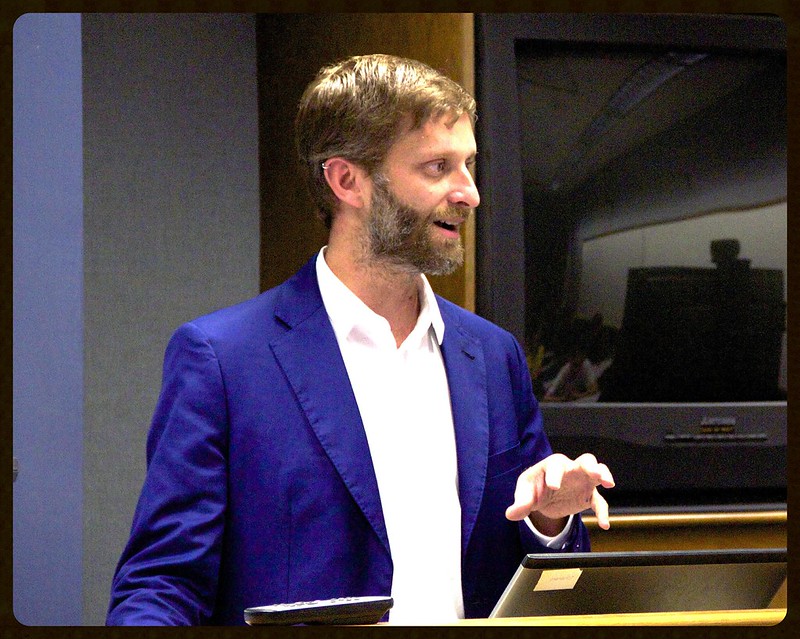
| Lionel Rossi from Chile during his lecture. |
Lionel Rossi , an Argentinian working in Chile at the
University of Chile, compared the media structures and journalistic practices
in both countries. Sime of dictatorship has a lot of influence on the Chilean
citizens. The situation is exactly opposite in Argentina. Talking about media
ownership, Lionel said, The media market is oligopolistic, especially the
newspaper industry. It is in the hands of powerful economic groups and
politicians of the right wing. There is no political diversity i0n the
ownership. He added that to ensure freedom of the press, it is important to
create and encourage new spaces of information and to use the growing digital
media to challenge oligopolies.
Lorna Chacon-Martinez from Costa Rica
said that media ownership in her country was similar to Chile. There was
monopoly in the internet market but the situation is now changing. The scholar
was proud to inform that the reach of cellular network in her country was
almost 100 percent. There is lot of political pressure on the journalists but
the press is relatively free and ranks 18th on World Press Freedom Index. At
times, the media favors the left wing, which the youngsters do not approve of.
She said that there was friction between the traditional media and the social
media and social media relied on traditional media for its news.
The media censorship is stricter in Myanmar and Sri Lanka and the once war-struck nation of Sri Lanka is not a favorable ground for journalists, concluded scholars Zin Mar and Aruna. The government owns newspapers and internet in Myanmar. There has been a strict censorship since 1962 but with the new government in 2011, censorship laws are becoming less strict, said Zin Mar. She added that documentaries about Burmese culture, Korean and Indian movies dominate the television content. The army, which has to play a major role to avoid domination by neighbors China and India has its own station, which broadcasts educational programs and is a mouthpiece for the army.
The Rajapaksa family dominates politics and holds most of the ministerial positions in Sri Lanka, informed Aruna from Sri Lanka. Using interesting info graphics, the scholar who has won two national awards for the best cover pages and written numerous books and directed short documentaries, said print medium was dominated by private owners until the government took over the biggest organization called Lake House. The main issues are lack of right to information and lack of investigation into atrocities against journalists.
Topics: susi 2014
Subscribe to:
Posts (Atom)


.jpg)