Friday, July 15, 2016

Say ‘SUSI’

Written and Edited by Rosette Leung
Hong Kong

Athens, OH – Have you ever been to Ghana? South Africa? Egypt? Mongolia? PNG? The SUSI program this year involves 18 scholars (and me) from countries all over the world. This perhaps is the first time for most scholars to meet people from such a multicultural background. In the Ohio University, ‘SUSI’ not only refers to The Study of the U.S. Institutes (SUSIs) of Journalism and Media, but also symbolises a tiny community that is formed outside the 18 countries’ national boundaries.

The best choice of word for describing the SUSI program, perhaps, is globalisation. 18 scholars travelled from countries miles away to the US, and gratefully, sharing the same language – English. Introducing oneself looks easy, but it can be very difficult if you are asked to introduce yourself to people who come from countries you have never heard about.

Given lots of opportunities to introduce themselves, scholars quickly adapted to a new community called “SUSI”. Names such as Patrick, Daniel, Joanna, Kaman, Jorge and Marina are common and easy to be remembered, but there were names uniquely representing the culture of a country, such as Sofiene, Signe, Thapa, Batzor, Ashfara, Mausumi, Nahria and Fatma. These ‘uncommon’ names in the West became meaningful with their life stories and cultural background exemplified with the self-introductions among scholars.

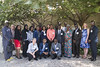
SUSI scholars introduced themselves for the first time during orientation.(Photo courtesy of program assistants of SUSI)

Mikson Senong, scholar from the South Africa, with his inspector hat and badge from home country. (Photo courtesy of program assistants of SUSI)

The Study of the U.S. Institutes (SUSIs) on Journalism and Media is a summer institute funded by the U.S. Department of State and hosted by the E.W. Scripps School of Journalism, Ohio University. Director of Institute of International Journalism Prof. Yusuf Kalyango, is the program director and Prof. Mary Rogus is the academic director of the program.

Scholars and professional journalists from 18 countries, namely: South Africa, Mongolia, Tunisia, Egypt, Hong Kong China, Romania, Indonesia, Bangladesh, Ghana, Papua New Guinea, Uruguay, Nepal, India, Estonia, Sudan, Russia and Melta travelled to the U.S. for participating in the six-week SUSI program from June to August. In addition to classes conducted in the Ohio University, these scholars travelled to Cleveland, Chillicothe, Amish Country, San Francisco, Atlanta, and Washington D.C.

SUSI scholars visited the Republican National Convention venue in Cleveland.

Lifelong learning is embraced in Hong Kong and many countries of the world during recent decades. One of the scholars, Mausumi Bhattacharya from India, said this is the first time for her to live and study with people from so many different cultural backgrounds.

One of the favourite activities the SUSI scholars enjoyed the most was EATING.

“I met people with multicultural background in a number of academic conferences before, but I have never given a chance to stay in the same place with them. SUSI is such a wonderful experience for me to interact with intelligent and high-status journalism scholars and professionals from all over the world," Bhattacharya said.

She added that many academics in the E.W. Scripps School of Journalism have strong academic and research background, the SUSI program was definitely a bright start for her inter-scholar exchanges and understanding of the U.S. media system.

Tom Rosenstiel, co-author of The Elements of Journalism, lectured the SUSI scholars via Skype.


“Make it connect”, one of the mottos of the Scripps College of Communication at Ohio University, has been apparently realized in the SUSI program. Two weeks have passed since the scholars first met, a true relationship between scholars and scholars, as well as scholars and academics of the Scripps School, has been vigorously built among the tiny SUSI community, and in this Schoonover Center for Communication.

Motto on the pillar of the E.W. Scripps School of Communication.

Postscript: “Say ‘SUSI’” was a calling by Prof. Mary Rogus for inviting scholars to smile during photo taking. She was excited to meet her ex-student Katy at the RNC venue.


Wednesday, July 13, 2016

An Estonian with a small appetite

Produced & Edited by Signe Ivask
Tartu, Estonia

I have never had problems with eating. While growing up there was a law, that me and my brother needed to obey: not only eat your greens, but eat the other stuff as well. And there were not foods that I did not like. Really. And now, as a grown up, I have changed, there are so many foods that are not my cup of tea. Maybe the law was not that bad after all and maybe the freedom of choice has changed me to worse?

When talking about Estonian food, then it might seem really bland to a person who is used to lots of spices. We love salt and pepper. That is it and all.

The very first time I had Indian food was back in 2012, in England. My friend’s stepfather is indian, so he took us out on Christmas Eve to eat Indian food. It was their tradition. I agreed to join them, but warned everyone, that I do not take spicy and hot food well. The first experience was bad, my mouth was on fire, I swore I was done with testing other culture’s food. It was just too much to handle for this lover of bland taste.

Until.

Cooperation.
It was after the first shopping tour when my roommate of SUSI2016 asked if she could cook us anything to eat. I was more than happy, because I prefer home cooking to every other food. Everything was going smoothly until Mausumi asked me to chop chilis. TWO of them. “You are a crazy lady!” “Oh you think we should add three?” THREE? I usually add a quarter of a chili to my food (IF ANY). Not two or three!

Probably some kind of voodoo seeds.
To be completely honest, then a huge amount of thoughts crossed my mind, and the thoughts consisted of me and the spicy food and me not eating it. With a brave heart and soul I chopped the chilis like a true champion, considering different strategies in my mind: how to avoid this food and if I manage to do so, what should I eat then?

BUT! 

I was wrong. So very wrong. And I am embarrassed of how wrong I was.

The first food - and every other ever since - that Mausumi made, was excellent. Absolutely perfect. There were hints of hot, but it was not overwhelming. And it was good, believe me, it was very good. It had spices, but they did not damage my stomach or mouth. What is more, she took my weirdness into account and did not add meat to the food. She is lovely. She is a wonderful cook.

Lentils and rice.
The first food was called khichudi, it consisted of rice and lentils and a few of indian spices. Seems such an easy food, but I cannot make it on my own, it would not taste the same. It tasted heavenly. I do not know how she did it. 

This was the beginning of our tradition. We… okay, Mausumi cooks every now and then. I missed her cooking while being on the road. We shop together, but she cooks and makes wonders happen in the kitchen. Amel chops the vegetables and I, well, I take pictures (see below).

Hot.
Amel preparing a fresh salad.

Voilá!
I must confess that I have cheated my way out of cooking. But maybe this helps: I wash up the dishes. Maybe? Anyone?


Saturday, July 2, 2016

Hello

Very glad to contribute in this blog.

Wednesday, March 23, 2016

Journalism Academic Linkage Fosters Triangle Collaboration


By Kate Hiller
Ohio University has engaged in student academic and cultural exchange with Leipzig University for more than 20 years, and journalism school director, Professor Bob Stewart, is excited about the new collaborative academic exchange and linkage.
“I couldn’t be happier about our progress to date,” he said. “We’ve gotten faculty, graduate and undergrads involved, in Athens, Hong Kong and Leipzig, all in a very short period of time.”
The idea to add a university in Asia to the preexisting Ohio-Leipzig relationship is something that Stewart and Werner Süss, Honorary Professor of Communication Management at Leipzig University, had been toying around with for some time. The timing was good when lecturers from Hong Kong Baptist University (HKBU) were selected asSUSI scholars to participate in the Study of the U.S. Institute on Journalism and Media, administered by Ohio University’s Institute for International Journalism, for two consecutive summers. The idea to engage HKBU with the E.W. Scripps School of Journalism quickly transformed into a reality when SUSI 2014 scholar Bonnie Chiu approached the school to initiate some kind of collaboration.
Most recently, students from Ohio University, Leipzig University and Hong Kong Baptist University met in Hong Kong during the first week of March as part of the recently developed triangle partnership between the three universities. While in Hong Kong, students attended seminars and worked together to develop cross-cultural research project proposals in just four days. They spent most of the time at HKBUs Shaw Campus in Kowloon, and also visited Stanley Market on the south side of Hong Kong Island.
“Hong Kong is an amazing city, and I loved going as a representative of the Scripps school,” said Danielle Keeton-Olsen, a senior journalism major at Ohio University. “My visit strengthened my desire to study communications abroad, as well as to continue my relationship withHKBU and my friends in Hong Kong.”
Over the course of the past couple years, students and faculty members from OHIO and Leipzig University have had the opportunity to visit one another’s schools as part of study abroad programs. But the new triangle relationship with HKBU has introduced new engagement activities such as conferences and research workshops.
“Students and faculty all benefit form having meaningful interactions with colleagues from other parts of the world,” Stewart said. “Our students in Athens gain valuable perspectives and broader world views by engaging with their counterparts in Europe and Asia.”
While in Athens, students from both Leipzig and Hong Kong have participated in homestays with current students. Keeton-Olsen is one such host.
“I did not expect I’d have the chance to reunite with the friends I made while hosting HKBU students this soon,” she said. “It was also really cool to hear about their data visualization and research programs in Hong Kong.”
This mutually beneficial exchange is what makes this level of partnership flourish.
“It’s hard to predict where this leads,” Stewart said. “All I can say is that we never would have guessed back in the mid-1990s that wed still have a vibrant relationship with Leipzig University 20 years later. It continues to thrive because we both benefit from it. As long as everyone in the triangle benefits, the relationship will grow organically, taking a shape we cant even imagine today.”

Sunday, December 27, 2015

New Christians Celebrating Christmas in Cambodia

By: Olivia Harlow
Produced & Edited by: Olivia Harlow 

At last Sunday’s annual Christmas-themed church service at the Phnom Penh Church of Christ, Christmas lights decorated the stage, teens reenacted the Bible’s Nativity scene, and a preacher dressed as Santa flung candy into the air.
The congregation was packed with hundreds of Cambodians and several expats. One of the attendants was 24-year-old Phally Ken.
Ms. Ken, who started attending church services in 2013 and was baptized this July, is one of many Cambodians who recently converted to Christianity and celebrated Christmas for the first time this year.
“This Sunday is the first time Christmas has meaning to me,” said Ms. Ken, adding that although she’s attended church for two years, this is her first “real” Christmas. “This year I feel it, I am thankful for it.”


Cambodians gathered after school at the Phnom Penh Church of Christ on Christmas at a party that included various games, dancing, and a massive Christmas feast. 

To celebrate, Ms. Ken—who currently works full-time as a hotel receptionist and part-time as an English teacher—made paper snowflakes with her students, bought herself champagne and chocolates, and attended multiple Bible studies this week with friends.
Additionally, on Christmas Day, she attended a party at church, with dancing, games, a huge feast and a gift exchange.
Ms. Ken said she used to be Buddhist, and that when she first started attending church, she was still unsure of her religious beliefs. She explained that because she comes from a family with “no love”, the compassion she found in the church helped her to feel whole.
After speaking with different pastors and studying the Bible more closely, Ms. Ken said that she became convicted.
Sothea Ket—unlike Ms. Ken, who no longer visits pagodas or practices Buddhism—said that although he too attends the Phnom Penh Church of Christ and considers himself Christian, he also still believes in Buddhism.
“Both Christianity and Buddhism are the same in some ways. It’s interesting. For me, it’s not picking which one is better. It’s whichever one helps me and gives good advice for my life,” he said, adding that he feels rejecting Buddhism altogether is ignoring his cultural roots. “These people who are pure Christian become Western. You know, Asian culture is Buddhist.”
Uong Vibol—former pastor and founder of the National Christian Churches Network Council of Cambodia—doesn’t religiously practice Buddhism, but agrees that it’s important to appreciate its cultural aspects.

Cambodians teens participated in a dance contest at the Phnom Penh Church of Christ's Christmas party. 

“I think it’s part of Cambodian culture. We are Christian, but still Cambodian,” he said, adding that he believes practicing in worship is much different than practicing culturally. “For me, as a learner and seeker, although Buddhism is not the true God, he is a good philosopher and a good teacher.”
In recent years this attitude towards Buddhism and Christianity in Cambodia has become much more accepted, yet according to Khon Dara—Deputy Director of Ministry of Cult and Religion—only about 2 percent of Cambodia’s population identity as Christian.
That said, Mr. Dara explained that very few churches—all within Phnom Penh city limits—existed in Cambodia in the 1990s, and today there are over 1,397 registered churches nationwide.
According to Mr. Vibol, the number of Christians has also increased since the 1990s, when only about .075 percent of Cambodians were Christian.
Mr. Vibol has been an active Christian for 30 years now and said that recently he’s personally witnessed about two or three people be baptized in his church community each month.
“More people open their heart and understanding today, especially young people,” he said, adding that he sees children and teens getting more involved in youth groups and Bible studies. “They come to understand Christianity, sharing the Gospel, and they still have a choice. They choose it.”
Even though the number of Cambodian Christian believers remains relatively small, their faith is strong.
“I am not broken in heart anymore,” said Ms. Ken, adding that she used to not know the meaning of happiness. “I was born again. God is so awesome. He can do everything.”


Wednesday, December 23, 2015

Selen Gulun Piano Performance

By: Olivia Harlow
Produced & Edited by: Olivia Harlow

Pianist, Selen Gulun—the first Turkish musician to perform in Cambodia—played at Doors last night, where she wowed the audience with her original jazz melodies.

The 43-year-old contemporary songwriter from Istanbul started playing the piano at age seven, dabbling in various genres and exploring compositional techniques ever since.
Though her educational background focused mainly on jazz and classical forms, she claims that her music is very improvisational and doesn’t necessarily fit into one label.

“I like to write every form of contemporary music,” said Ms. Gulun, who has worked with symphony orchestras in London, jazz bands in Mozambique and electronic groups in Austria. “I’m trying to use the language of the 21st century really.”

However, according to Ms. Gulun, being a professional musician in the modern world isn’t always easy.“If you’re a musician, it’s a crazy life,” she said, adding that she’s dealt with a myriad of obstacles related to being a jazz-focused female composer. “Somehow though, you have this courage, just because you love it so much.”


© Olivia Harlow 2015  

Since 2006, she has released five albums, with “Answers” (2010) making #6 and “Baska” (2013) making #4 on top jazz charts in Tokyo just last year. 

An album that she recorded with Italian artists earlier this year is meant to release in 2016, along with her latest album titled “The Women’s Matinee”—a collaboration with three Turkey-based female musicians and various instrumental contributors, honoring the life of a dear musical friend who was raped and murdered earlier this year.

According to Ms. Gulun, women’s rights issues and a passion for international travel heavily influence the majority of her songs.

Thus far she has toured to 18 countries— including Mozambique, Japan, Serbia and Cambodia just this year—giving her the opportunity to work with various musicians across the globe and travel to far off places that intrigue her wanderlust spirit.

“That’s why I come here actually—my passion to come to Cambodia,” said Ms. Gulun, adding that she’s wanted to visit the “Kingdom of Wonder” since she was a little girl.
During her two-week visit to the country, Ms. Gulun said she hopes to meet local musicians and experience as much as possible.

“Quite frankly, I don’t know what is driving me here. That’s the excitement. I will find out!”

Ms. Gulun will play again tonight at Chinese House at 7:30, where she said she will most likely play various jazz standards and sing more than she did yesterday evening.

Saturday, December 12, 2015

Hope For Endangered Giant Mekong Catfish

By: Olivia Harlow
Produced & Edited by: Olivia Harlow 

The Mekong Giant Catfish has low-set eyes, a silvery gray scaleless body and a yellowed white stomach. Endemic to the Mekong River and one of the world’s largest freshwater fish, the Mekong Giant Catfish lives a threatened existence, vulnerable to dam construction, overfishing, and habitat destruction.

Rarely seen, this massive fish–capable of reaching a record 10 feet in length and 650 pounds—was listed by the International Union for Conservation of Nature (IUCN) as critically endangered in 2003; and according to the World Wildlife Fund (WWF) there may be only a few hundred left in the wild.

On November 9, this giant fish was found and tagged for the first time this year in the murky brown waters of the Tonle Sap by a team of biologists, including Nat Geo Wild’s “Monster Fish” host, Zeb Hogan, who has studied the species extensively for many years.

Mr. Hogan—who was coincidentally in Cambodia doing research at the time of this catch— said that adult Mekong Giant Catfish are only seen during very specific times of the year in equally specific locations. He added that compared to counting terrestrial animals, tracking fish populations from large ecosystems like the Mekong is very difficult.

“What we do know is that in the late 1800s, thousands of Mekong Giant catfish were caught each year. In the early 1900s, there are reports of hundreds being caught each year. And recently we hear reports of less than 10 caught per year,” he explained.

Youk Senglong, Executive Director of Fisheries Action Coalition Team, clarified that these fish used to be eaten for food, “because those people do not understand.” He added that many people back then used to care more about their income than the importance of protecting the species.

Mr. Hogan said that fish catching often serves as a proxy for abundance, “So, IF catch is related to abundance, then giant catfish has declined by 90-99 percent in the last century.”

Mr. Hogan explained that giant freshwater fish in other parts of the world, including the Yangtze River in China, have completely disappeared. “Unless there is someone monitoring the populations, the same thing could happen on the Mekong,” he said, adding that the Mekong Giant Catfish already teeters on the brim of extinction.

Mr. Hogan said though some people may not care about one species’ potential extinction, this declining population reveals a much bigger issue.

“The Mekong Giant Catfish is symbolic of the health and integrity of the Mekong River,” he said, explaining that this specific body of water is one of the most biodiverse on Earth. “The extinction of the Mekong Giant Catfish would be an indication of declining river health and a red flag for the millions of people who depend on the Mekong for their livelihoods.”

In addition to warnings of the area’s fragile environment and loss of sustainability exists a spiritually related problem.

Traditionally revered among Buddhists, the Mekong Giant Catfish, or “pla buk”, is considered a sacred creature.

“Cambodian people, in particular fishers, believe that this kind of species is the king of other fish,” said Mr. Senglong, adding that Buddhist religion requires that the fish not be killed. “This species also brings other fish to fish. So, if the fishers catch and eat the catfish, the fishers will never [have] chance to catch other fish.”

Mr. Senglong added that when he was young, fishermen would conduct a special ceremony for the fish. “[There was] music and sprinkling perfume,” he explained.  “The role of Buddhist monks and other religious followers is important to educate the fishers not to catch and eat.”

Thach Sophanara, Director of Laboratory at the Fishery Administration Department, said that this kind of ceremony occurred before the fish was set free on November 9, fishermen sprinkled perfume over it for good luck. “Cambodians believe they can wish for something or for good luck with these fish,” he explained.

But unfortunately, this “lucky” fish is experiencing anything but luck.

The Giant Mekong Catfish requires long stretches of open water in order to migrate and environmentally specific conditions to breed, but according to Mr. Hogan, human intrusion and the building of dams have disrupted these patterns.

“The main threats are incidental catch, habitat fragmentation because of dams, and habitat degradation—primarily dredging, rapids blasting, and reduction of flooded forest habitat,” he explained.

Additionally, although it’s now illegal to fish this particular species, enforcement in Southeast Asia’s more secluded areas is minimal.

“The difficulty of enforcement in remote areas is because when they fish Giant Mekong Catfish, they transport into Laos,” said Mr. Sophanara—who was also present at the catch on the Tonle Sap. “Also, we don’t have budget for patrol or to educate them.”

Mr. Sophanara said that fishermen rarely pay close attention to the types of fish they catch when they cast nets. “Fishermen never understand when it’s [the fishes’] season and what kind of fish they are catching,” he said. “They just leave their nets in the Tonle Sap, but they don’t know that impact.”

He added that many fishermen in other Southeastern countries continue to catch and sell the species in local markets, which is out of Cambodian control.

According to the WWF and Mr. Hogan, these social and economic developments make conservation work in the Greater Mekong region urgent, yet challenging.

Fortunately, last Monday, scientists found hope.

On November 9, the Mekong Giant Catfish— also known as the “royal fish”—was caught and tagged, proving its doubted presence in Cambodia.

Mr. Hogan then dove ten feet with the seven-foot long fish, ensuring that it returned safely to deeper waters.

“[I tried] to direct it to deeper water where it normally swims and is less likely to be caught again in a net,” said Mr. Hogan. “The fish seemed strong as I released it, so I hope that it will recover from being captured and continue its migration.”


(Additional Reporting Sek Odom)