Tuesday, November 4, 2014

SOS Russian Union of Women

By: Madina Baimagambayev
Produced and edited by: Olivia Harlow

Hundreds of Russian women have felt cornered and violated, with many locked in their own houses by their husbands until they’ve completed tasks such as cooking and washing clothes.  If they don’t complete household chores, they are then physically beaten.  These women are victims of domestic abuse.
Women's associations are increasingly taking the form of socially-oriented NGOs and have become the most responsive, mobile structures, capable of solving significant social issues.  These NGOS help women all over the country, by offering psychological material and legal aid to women struggling specifically with domestic violence and gender inequality.
Today, in every major Russian city, there are dozens of women's organizations – both those officially registered and those not registered. There are around 800 total, with more than 100 of them charities. These organizations first had to fix statutory, structure, and formalize. In the primary analysis of relevant information, database fields attracted the attention to the fact that the traditional area of ​​activity associated with the public opinion of the women's movement, namely, the "women's struggle for equalization of rights with men in the economic, social, political and cultural fields, as well as their participation in the political struggle," is by no means dominant. Of course, a certain group of women's groups affirms the necessity of building equalization of opportunities for women and men at the state level, both in the political and legal sphere. However, many prefer to stick to investing in "small business" in order to gradually overcome negative effects of the reforms that have touched women since the end of the twentieth century.

© Russian Union of Women

Russian Union of Women (RUW), created in November 1990, is a public, all-Russian, non-governmental organization. RUW organizes women's councils, unions, associations, committees and clubs operating in many Russian regions, on a voluntary basis. It also includes four federal organizations: the Women's Union of the Navy, The Russian Union of Public Associations, Russian Public Movement of Russian women, and Russian School Library Association. RUW also collaborates with other NGOs in more than 100 countries around the world, as well as with UN specialized agencies.
The Department of Public Information of the United Nations has a special consultative status with the Economic and Social Council (ECOSOC) as the holder of an honorary diploma of the United Nations “Messenger of Peace.”
Women in difficult situations can contact the RUW either by phone, written letters, or by visiting one of its branches. If a woman has no place to live, the RUW provides a dorm room in which they can stay for a month, free of charge, with free meals, psychological counseling, medical help, and jurisprudent assistance. The RUW always tries to find ways to help women in need regardless of if they are citizens or not. It is not rare to see RUW helping women from Uzbekistan, Kyrgyzstan, or other countries outside of Russia.
One woman, who hopes to remain anonymous, claims that RUW saved her and her children’s lives from violence in her family in 2013. RUW gave her a place to live, provided a jurist for her case, and offered a psychologist for her and her child. She was a foreigner without Russian residence, so the RUW stepped in to support her family and prevent her deportation to the country where the domestic abuse had taken place. RUW helped the domestically battered immigrant woman earn Russian citizenship, as well as find a job and a place to live.
This union also helps support young families, who don’t yet have an opportunity to buy clothes, household appliances or food. In 2013, RUW provided over 500 families with material aid charity, and by the end of 2014 this number is expected grow by 20 percent.
© Russian Union of Women
In September 2013, a young family from an autonomous republic of Russian Federation, Bashkortastan, applied for financial support for the family. Irina, mother of 2 sons, became pregnant at 17 and did not know where to get help. When she first saw a commercial on Internet for RUW, she did not believe that anyone would help her and her young unemployed fiancé with material support.
“We have a certain image of such organizations.  No one believes that they really can help.  Me personally was thinking that it is another organization where you will wait for help forever and in the end they would ask you to collect thousands of papers and documents you wouldn’t know where to take,” she says.  However, Irina took that chance and later received a call from the Centre for Social Support for Women.

After a couple days, volunteers from RUW contacted Irina and later provided her with clothes, food and vitamins for pregnant women, and even invited her to classes at “University of Maternity”— another branch of the RUW which was established in 2013. That socio-educational program was created to improve conditions of maternal and child health, to give breastfeeding support, and to promote healthy lifestyles that strengthen the family. This program has helped many young families, including Irina and her fiancé Felys to get some critical knowledge for personal development and to acquire necessary parenting skills.

Italian Wine Woes for 2014 Sobering


By: Alexandra Rhue
Produced and edited by: Olivia Harlow
  
At first glance, news about the Italian 2014 wine harvest is bleak.  Newspaper and online sites offer estimates of a 15% to 30% shortfall from previous years.  Carlo Giudice, a partner at Col di Corte Winery in eastern Italy, says that he is aware of the shortfall in the 2014 wine harvest, acknowledging that in wine production this year “many companies in Italy have had less.”  In a country that is the world’s leading wine producer, a shortfall of 15% in an annual harvest that usually tops 1 trillion gallons of wine, is a vital economic consideration.
France, Italy’s closest wine production competitor, will move into first place in the world of wine production if the wine harvest shortfall reaches proportions predicted. The ripple effects could extend beyond the economic impact suffered by Italian wineries. Italian wine experts, as well as bottlers, distributors, and owners and managers of nearly 200,000 wineries are keeping a watchful eye on the wine harvest.
Geralyn Brostrom, Italian wine expert, entrepreneur, and educator, points out that “the actual numbers won’t be calculated until sometime after the harvest finishes and producers have been able to assess and report.”

© Col Di Corte Facebook
With the harvest around 50% complete in many areas, it is an intense time in the wineries. Jim Hutchinson, wine importer at Domenico Valentino in New York, says that in areas “like Valdobbiadene-Conegliano where wines are released within months of the harvest, the impact of a severe shortfall will be felt almost immediately.”
Some well-known wine producing areas such as Puglia, Sicily, and Tuscany—all recognized for their vintage wines—are considering scrapping a 2014 vintage altogether.  Large wineries are able to minimize the impact of an unsuccessful year.  Brostrom says that “farmers, whose sole livelihood comes from growing and selling grapes to wineries, will be much more affected than a winery with multiple wines and perhaps even previous vintages to sell.”
Growing up on a farm in Italy, Carmelinda Chilelli, whose parents produced red and white wines, knows the importance of the grape harvest in family businesses.  “Children don’t go to school when it’s time for the harvest.  Everyone helps each other, because there is a lot of work behind it.”
Weather is the culprit for the recent, consistently poor wine harvest. This summer, Italy was cool and wet, a contrast to the country’s regularly warm, dry summers that usually help produce an array of fine Italian wines.  Brostrom reports that producers she has spoken with “have commented on [the weather] as well.”  High rain totals combined with the lower than normal temperatures caused grapes to ripen so slowly that vine disease developed.  Increasing the damage, hail blanketed many of the wine growing regions as storms swept through, decimating grapes already suffering from the cool temperatures and excessive rainfall.
Popular wines, such as the well known Amarone or Ripasso are likely to still be produced.  Mike Veseth, wine expert and writer for The Wine Economist, says that some producers will “omit their top of the line Amarone and divert grapes to other quality levels.”  He remains optimistic that for 2014, “there will be Amarone!”
Italian social media specialist, Federico Maisenti, suggests that “the majority of the population isn’t much aware of the problem,” and notes that he hasn’t heard of any relatives or friends discussing the issue. If, indeed, the harvest shortfall is 15% or greater, Maisenti believes the industry would face serious repercussions both on a local and global scale. “In addition to have less amount of choice personally, the export market would be heavily penalized,” he says.
Other Italians are more aware of the harvest shortfall. Fabio Venturini, an engineer from northern Italy, believes that the average Italian citizen is always concerned about weather and assumes that this year’s harvesting is not optimal.
Pietro Becatti, a young Italian musician, says that he learned of the wine harvest shortfall from newspapers and friends in the agriculture areas.  “I do not think there will be serious consequences. Probably people will use the reserves of the former years,” he says.  “They will get used to a lower quality!”
Hutchinson states, “There are still a significant number of appellations that were not badly impacted by the poor weather.”  While most producers agree that 2014 wasn’t particularly a good year, the impact on wine pricing is less clear all around.
Hutchinson says that if the general quality of wine is considered inferior, prices may go down regardless of the presence of a shortage. Giudice, taking a more optimistic view of the reduced harvest, believes that despite the bad weather, the economic impact is “not a disaster.”

© Shutterstock
Although this is evident issue in most of Italy, a few wine producing areas of the country expect to have a normal or above level and quality of wine production.  The northwest section of Italy, home to several wineries, should be able to bottle some fine vintage wines.  In the Piedmont region of Italy, the Nebbiolo grapes—now ready for harvest—should produce a hearty quality red wine, perhaps even a quality Riserva.
Clearly, the wine industry remains cyclic.  Good weather brings fine wine harvests, while rain and cool temperatures of the past summer result in poorer quality and lesser quantity of grapes. The ability of the Italian wineries to adapt and rebound must not be overlooked.  Brostom points out, “As global warming has affected the wine industry worldwide, savvy producers have also adapted, and a family or company in the wine business for the long haul is also able to adapt.”  He believes that no matter what, Italian wines have been and will remain popular worldwide. Many growers, buyers, and consumers are already looking forward and hoping for a highly successful 2015 vintage. 


Cambodian Education System Remains Corrupt

By: Olivia Harlow
Produced and edited by: Zainab Kandeh
For thirty-five years, Cambodia has strived to overcome its haunting history in regards to Khmer Rouge.  Today, Cambodia focuses on reclaiming various cultural identities, especially through restructuring an education system that was completely obliterated not too long ago. 
During the infamous 1975-1979 genocide led by communist leader Pol Pot, Cambodian intellectuals were completely eradicated from the country.  Approximately 2 million were killed; specifically those Pot felt were academically superior to him.  According to NGO Education Partnership research, nearly 90% of teachers at the time were murdered, while the rest fled the country.   
Cambodia has progressed but still struggles to replenish what had become a broken, practically nonexistent, educational system.  Cambodia’s constitution disseminates free education for nine years to all of its citizens; however, this service is rarely coerced.

© Olivia Harlow 2014
Wath Saw, is the first of his family to have completed more than six years of education.  Today he attends one of Cambodia’s top universities, Pannassastra, where he studies International Relations. “School doesn’t provide really free and fair education to everyone,” he says.
Almost all schools in Cambodia require students to purchase uniforms, which many cannot afford.  Getting to and from school almost always requires owning a bicycle or motorbike, which again, students cannot easily afford.  Additionally, many teachers require to be paid, regardless of the constitution’s assurance of a zero-cost education.
Poverty remains ubiquitous. According to UN Human Development Report studies, 18.6% of Cambodia’s population lives below $1.25 a day; that’s nearly 20% of a country’s population living below a $456.25 annual income.  The average annual income in Cambodia is $750.    
Even if students could afford this “free” education, without tuition costs and attendance policies, students lack incentive to attend school.
Sadly, around 4% of Cambodians are uneducated their entire lives, with literally no exposure to even one year of primary schooling.  While the other 96% begins attending primary school, only 34% percent of students continue on to lower secondary education (grades 7-9) and only 21% continue to upper secondary education (grades 10-12).  
Sen Su, Deputy Director of This Life Cambodia, says that when he started in primary education, he would walk to school with a group of thirty-five students, but that this number quickly plummeted. Only two people from Sen’s community, including himself, went to high school.  
Sen says parents and friends have a huge influence on drop out rates.  It can become a trend.  “If majorities of parents aren’t sending students to school, then others won’t as well,” states Sen.
Perhaps one of the biggest issues stems from the fact that poorer, more rural areas lack easily accessible education. Roughly 85% of Cambodians as farmers, and 36.1% of Cambodian children work jobs on these farms that, in the United States, would be deemed unfitting for their age.  Because many children are born into families who don’t recognize the importance of education, a large majority of kids are raised with the mindset that labor should be their main focus. “In their image, there is only farming,” Wath says. 
The few schools that exist in pastoral areas oftentimes lack quality in more aspects than general education.  These schools also lack access to clean water, electricity, proper healthcare, and manageable roads during rainy seasons. This contrast when compared to Cambodia’s urbanized educational structures makes it clear that education favors large cities.  
There is an evident disparity between the wealthy and poor, leading to a consequential gap in terms of academic success. Private sectors exist only in high-class areas, proving that typically only the wealthiest children can excel academically.
Without adequate funding for educators and implementation of increased accessible schools in rural areas, Cambodia has no hope to create permanent changes within its education system. 

© Olivia Harlow 2014
Teachers cannot rely on teaching salaries, causing many to pursue better paying jobs.  Many teachers are forced to work two or three additional jobs in order to survive. When trying to maintain various careers, teachers have less time for updating curriculum, building relationships with students, and interacting with students’ families.  It’s clear that low income for teachers drives quality of education down. 
Many teachers generate income by requiring students to pay fees for classes, despite the fact that education is meant to be free.  This corruption can go as far as teachers’ willingness to sell answers and degrees to students. According to Oxfam Country Director, Chris Eijkemans, “You can buy your grades.”
Further economic assistance is crucial. Recent studies reveal that Cambodia’s education expenditures in terms of its gross national product spending are merely 2.6%.   The government pledges $1.50-$1.75 per student in primary schools, in order to fund annual teaching materials and operating costs. This subsidy is insufficient for even the most basic needs.
The absence of proper funding for education results in further corruption and a heightened disparity between the wealthy and poor.
Sen says that had he not paid for private tutoring, he would not have been able to pass the national exam and attend high school. Again this stresses the idea that only wealthier families are able to obtain quality education in Cambodia. 
 “I’m not from a rich family,” Sen clarifies, “but I am lucky to have parents that wanted me to have education.” 
Since Khmer Rouge, Cambodia has expanded education.  The country intends to give equal opportunity to all children.  The number of schools has increased, along with student and teacher populations.  However, drop out rates, inconsistent attendance, crowded classrooms, inaccessible schools, corruption, and disparity persist. UNICEF Reports show that Cambodia’s illiteracy rates remain high, with nearly 75% of men and 45% of women yet to learn their ABCs.
“Education is the basis for everything.  If you don’t build it right from scratch, then it won’t happen in any case.  So what I really hope is that government takes responsibility,” says Eijkemans.
Sen claims that although education has evolved since he was in school, “Compared to now, it’s not really different.” 
While this seems discouraging, the rise of forward thinking, progressive organizations, as well as international aid, have helped push Cambodia in the right direction. 

Self Help Community Centre (SHCC) is one of many NGOs, that provides free education and social services for Cambodia’s underprivileged youth.  Founder and director, Choan Sambath, established SHCC with the dream of providing unique and quality education. “I knew people were struggle, and I decide when I have enough money, I would open school to bring change,” Sambath says.

© Olivia Harlow 2014

Education opens a door for Argentina’s transgender population


By: Rachel Sayers
Produced and edited by: Olivia Harlow

On the evening of August 18, 1996, along the dim back streets of Buenos Aires, a young woman was seen stepping into the passenger’s side door of a police vehicle. For months police repeatedly threatened her, discriminating against her for her unyielding desire to choose a gender different than that which she was born. Later that night she was found lying on the street, bleeding profusely from two gun shot wounds to the penis. She died soon after.
At the time of her death, Mocha Celis was 34-years-old and illiterate. Blatanat discrimination in the education system forced her from schooling, and soon after she took the only job available to her: prostitution. Although legal in Argentina, prostitution often accompanies a lifestyle encumbered by violence, disease, and police harassment.
Despite this, it is a trade that has historically drawn in much of the transgendered population, with some estimates as high as 99 percent, a rate put forth by the Asociación Travestis Transexuales Transgeneros de Argentina (ATTTA).
“People thought I did it because I wanted to, not because I had to,” explained Virginia Silveira, a transgendered woman who spent several years as a prostitute on the streets of Buenos Aires. “They saw me as a criminal, but I did not consider it my job.  It was simply the only way to survive. It was part of the environment. All my friends and every single trans person I knew were prostitutes. They had no other option because no one would have them for any other job.”
“The transgender community used to be excluded from society,” ATTTA director Marcela Romero explained. “They were excluded from health services, education, and work, leaving them very few choices. It was a chronic problem.” The problem was finally addressed in 2010 when a 33-27 vote made Argentina the first Latin American country to legalize same-sex marriage, and again in May 2012, when a unanimous vote in Congress passed one of the most liberal gender identity laws in the world.


© 'Mocha Celis' Popular Baccalaureate
Under the Gender Identity Law, co-written by Romero, all persons are granted the right to recognize their own gender identity, without need for genital reassignment surgery, hormone therapy, or a psychiatrist diagnosis. People are guaranteed a right to be treated according to their chosen gender, including identification on official documents by name and sex, as well assurance that such information will remain confidential. Furthermore, the law also guarantees all persons access to surgical interventions and hormonal treatments if they so choose.
It is an emphatic step for a country that is, in many ways, still emerging from the atrocities performed by former dictator Jorge Rafael Videla, who has admitted to “disappearing” several thousand people he saw as opponents to his authoritarian ideals. Human rights groups estimate that during his reign from 1976-1981, more than 30,000 people were kidnapped and murdered, or simply vanished, including several hundred transgender activists.
The residual attitude from such brutalities can pervade all aspects of a transgendered person’s life, but perhaps it is most impactful in education. A study published in 2006 by a local human rights organization found more than 64 percent of transgender individuals had not completed primary school and another 20 percent had not graduated from secondary school.
“It wasn’t my classmates who discriminated against me, it was the institution itself,” explained Silveira, who dropped out of primary school in a neighboring province before moving to Buenos Aires. “They refused to call me by my real name or let me use the bathroom I wanted to. They wanted me to match my appearance to my biology. They wanted me to act like a boy and dress like a boy, things I wasn’t comfortable with. They made me quit.”
After spending years prostituting herself in the Argentine capital, Silveira came across an article on a trans activist’s Facebook page about opening the world’s first school specifically—but not especially—for transgender, transsexual, and transvestites. She enrolled a few months later.
‘Mocha Celis’ Popular Baccalaureate opened in Buenos Aires in March 2012, just months before the Gender Identity Law would be signed into effect. As a secondary school, it offers an accelerated three-year program for students over the age of 16 to receive their high school diploma.
“We could not live in a country where gender identity stood as an obstacle to the access of a basic right like education, so we hatched an idea that eventually became ‘Mocha Celis’,” said founder Francisco Quiñones. “It was extremely difficult to convince the government of the necessity of a space like this, but eventually we prevailed.”
The school opened its doors as a non-profit with just 25 students, among them Silveira, her long brown hair and impressive stature an unnoticed juxtaposition among the mostly trans inaugural class. Since then the school has grown to include more than 100 students, with the student population becoming an eclectic mix of trans and non-trans, young and old.
“Our school focuses on inclusivity, not exclusivity,” said Vida Morant, co-director of ‘Mocha Celis’. “All are welcome. We guarantee a space free from discrimination, sexism, and institutionalized violence against any group. We want to set an example of what should happen at other schools.”
‘Mocha Celis’ will graduate its first class this year and expectations are high. “I’m going to be a lawyer,” said Silveria, her matter-of-fact tone leaving no room for doubt. “I want trans people, not just in Argentina, but around the world, to know that their rights are not gifts from the government. That [their rights] are basic entitlements, and that they are owed to them.”

© 'Mocha Celis' Popular Baccalaureate

Friday, October 24, 2014

The Truth About Learning French in Belgium

By Caleigh Bourgeois
I was very confident about my French speaking abilities before moving to Belgium. I could clumsily muster a, “Je voudrais un café.” I could even ask for directions! I understood French films! Upon boarding my plane ride to Belgium I was convinced I would be fluent within a few months.
I quickly learned that taking classes in a second language in your home country does not make you immediately proficient in the real world.
"Grande-Place," en Francais, "Grand Place," in English
Surprise, surprise, the locals don’t speak as slowly as my French professors did. While everyone tends to speak quickly in native tongue, the French language in particular lacks staccato. While beautiful, French words flow together with few pauses, which makes distinguishing them more difficult.
My pronunciation needed some work right away. While a Midwest accent may do just fine in a classroom, native French speakers often have a hard time understanding my speech, even when I "technically" pronounce words correctly. Learning not to pronounce an “r” is almost as difficult as learning to roll it.
It isn’t always difficult. For me, the easiest aspect of studying French has always been reading it. I can recognize street signs and decipher food labels quite well. Although in Brussels, they are also in Dutch.
This brings me to an entirely new dynamic I face. There are two official languages in Belgium, Dutch and French. In fact, the country is split up into three regions, Vlaanders, the Dutch region and Wallonia, the French region, and a third extremely small German-speaking region gained after the Treaty of Versailles.
Photo Credit: SicMagazine.Org
Brussels falls in the Flemish (Dutch-speaking) region, but because of its one-of-a-kind status as home to the EU, both Dutch and French are spoken. Every sign, label and metro stop is in both languages.
While I work for a Flemish/American newspaper, my knowledge of Dutch consists of, “allo,” “dank u,” and any Germanic words that cross over with English. This wasn't an issue until I traveled out into Vlaanders for work. I went to a gorgeous city called Antwerp, a major diamond retail hub and former port for emigration. Everyone there spoke Dutch and everything was in Dutch. Even my French knowledge couldn’t save me.
Dutch-speaking city of Antwerp
The opposite happened when I traveled to Wallonia . There, everyone spoke French, no Dutch, but more importantly for me, no English. While most people speak English in Brussels, and insist on doing so after hearing my accent, no one I met in Wallonia could.
After getting off at the wrong train stop in Verviers, Belgium, I had no other choice but to speak French with an attendant at the train station. I was lost and alone and it was the best possible practice I could have received. It was exhilarating and prosperous.
Although I’ve had moments of extreme embarrassment, goofy mix ups and sheer panic, it is so much fun practicing my French with the locals. I certainly am not at the level of proficiency I wanted to be after two months, but my adventures in learning are more memorable than I ever could have imagined.
Every successful interaction in French feels is a victory, whether it’s speaking with a cashier or asking for directions. It’s incredible how some words come back to me seemingly out of nowhere, words I haven’t used since high school French six years ago.
 Speaking in French the only fun part. I love eavesdropping on conversations in the Metro to find context. I buy French magazines and spend up to 30 minutes on a two-page story, finding new words and trying to grasp the article’s purpose. It feels like I’m cracking a secret code.

Last night, I dreamt entirely in French. I’ve heard it said that dreaming in a second language is a sign that you’re well on your way in learning it. Although I’m not going to come home singing Edith Piaf with perfect pronunciation, I am satisfied with the progress I am making, and look forward to working toward true fluency.

Sunday, October 5, 2014

Swedish Journalist, Larsson, Inspires Scripps Students

Cassie Kelly
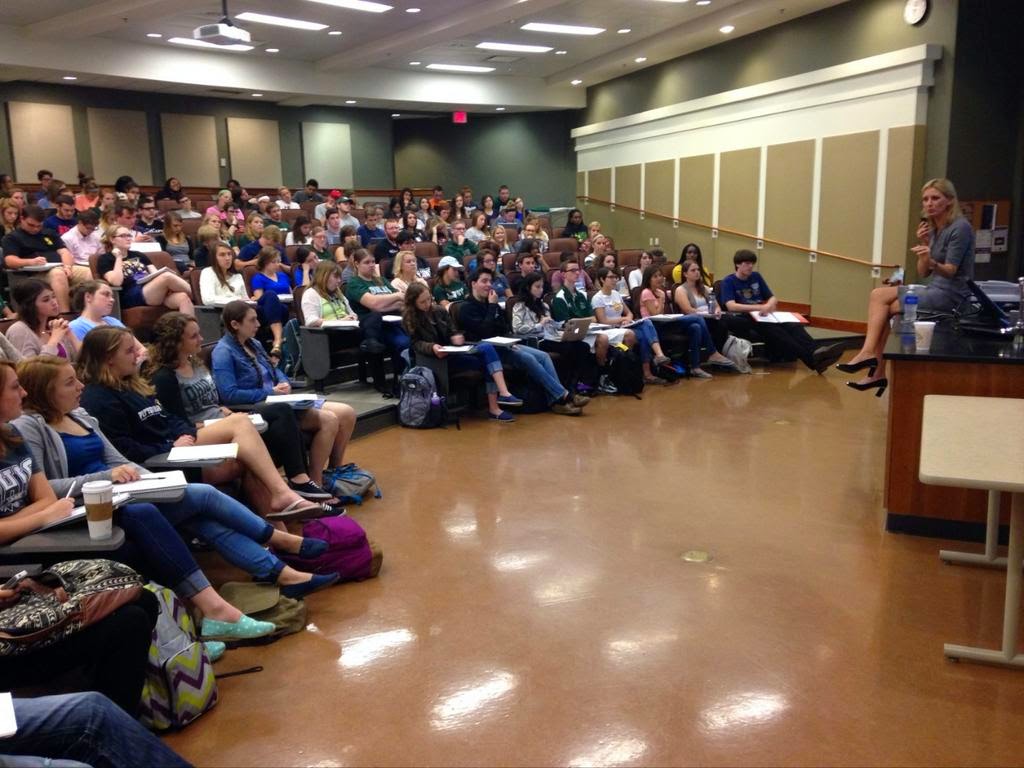
Therese Larsson, Chief Foreign Analyst for Svenska Dagbladet, one of Sweden’s top daily newspapers, visited Ohio University, courtesy of the Institute for International Journalism, from Sept. 29th to Oct. 3rd. She is currently travelling across America on a fellowship with the Center for Strategic and International Studies (CSIS) for three months to study the future of the Democratic and Republican parties, the role of religion in American life, U.S. foreign policy and the changing role of The North Atlantic Treaty Organization. Her many lectures with Scripps students discussed what it’s like to be a foreign correspondent and how American and Swedish lifestyles differ.
Ohio University was the first college campus she visited and she admits her first lecture was frightening. “I have hosted television and radio shows for a million people but it’s not the same thing to be in front of the people,” she said. “But, I hope I managed to be a little bit inspirational.”
So far, Larsson has studied the divide between Democratic and Republican parties and how religion ties into it. “The Republican party interests me because we don’t have them in Europe,” said Larsson, adding that most countries in Europe would be considered democratic.
Income inequality is much less evident between the rich and the poor in Sweden compared to America. Salaries are more evenly spread and everyone pays a high amount of their paycheck into taxes for benefits like universal healthcare, subsidized childcare, free university tuition, unemployment wages and elderly pension. “We just think we should pay taxes, we should have healthcare and childcare. We don’t think any differently,” shares Larsson.
The role of religion is almost non-existent in the Swedish government. According to Larsson only 3.5 percent of the population associates themselves with the religious party and they only receive about 5 percent of the vote overall. In fact, no one truly belongs to a church. “If you’re not invited to a wedding, it could be decades before you go to church,” Larsson said.
She also noticed how in the U.S., presidential candidates must open up about their faith and must believe in God to have a chance at presidency. But in Sweden, it is the exact opposite. “The President can’t say things like that or people become suspicious.”
Larsson hopes to delve deeper into these differences when she visits several churches and universities around the country and to gain a better understanding of how the American government operates. 
Listen to her conversation with WOUB's Tom Hodson about her observations on American life so far.