By Huyen Nguyen
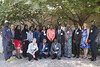
Trung Bui, a lecturer and TV producer from Vietnam, and Unurjargal Lkhanaa, a senior lecturer from Mongolia, joined each other to present about media in transition Thursday afternoon.
"I first planned to present about the role of journalism in modern societies, including Vietnam and the United States. But at a second thought, I switched to a more general view of Vietnam and current media issues," said Bui in an interview following his heavily visual presentation.
He went on emphasizing the positive side of media policies in Vietnam: encouraging the transition to digital media and the practice of citizen journalism, and the deregulation of media ownership.
"Five years ago, only the government owned the media. Right now, if you have money, you can invest into technology and labors and start producing media contents," Bui said. "Next year, we will have the new journalism law, replacing the one established in 1989 and amended in 1999. I look forward to new things that would further improve media situations in Vietnam."
Bui refused to give his opinion on the other side of the transition to democracy in Vietnam. He diverted the very specific question about the Vietnamese context to a more global context. (Click to hear his general statement.)
In contrast, professor Lkhanaa, who taught Mass Communication Theories at the Press Institute of Mongolia, freely discussed both sides of the transition to democracy in Mongolia after 1990.
Among positive changes, she gave the increased accessibility to information the thumb ups. But she despised the political influences on media independence and media business. (Click to hear her full statement.)
"I am very proud of Mongolian readers, though. Long time ago, sensational magazines were sold everywhere on the street. But right now, you no longer see them," said Lkhanaa a night before her presentation. "I guess our readers with the increased perception of media quality refused to read junk news."
During her presentation, she retold the story and was cheered by other SUSI fellows.
Friday, July 17, 2015
Online Exclusive: Media in the Transition to Democracy and Digital Journalism

From Cleveland to Amish Country, local news is alive and kicking

Journalism —reporters, newsrooms, people and organizations that tell stories— are part of that solution. “Journalism permits us to live as creatures of our time and make peace with the awayness of things within some community we identify with,” says Rosen.
In our recent trip through the State of Ohio we had the chance to meet some of the strategies, editorial guidelines, journalism practices and business difficulties that local news outlets face every day. It is the struggle of editors, reporters and other media related professionals to reach their audience in times when print publications and legacy media are being challenged by the digital tsunami.
In Cleveland, the so called “Rock and Roll capital of the World”, we went to two different outlets, but each one with an specific focus in local.
In WOIO channel, a CBS affiliate, we walked around the newsroom, the control room and the TV set. The newsroom was almost empty during the morning, cause all the reporters are out in the streets. A true example of shoe-leather reporting. We also learnt about the importance of weather reports, one of the main reasons why people watch TV. In local news in America, the weatherman is the co star with the anchor. That is was we saw at 19 Action News.

Local TV news around the United States are doing very well. According to the State of the News Media 2015, “Local television stations enjoyed a year of higher revenue and slightly higher viewership in 2014.” The advertisement revenue grew in 2014, reaching $20 billion.
In the outskirts of the city is the headquarter of the Call and Post newspaper, a weekly publication that was started in 1916 and it’s now owned by Don King, the famous boxing promoter.
For them, “black news is the news”. There is no shortest way to sintetize their editorial approach. For almost a hundred years this newspaper has given space for the most influential voices for African Americans in the State of Ohio.
Most of their revenue —around 90 percent— comes from advertisement. In the past the Call and Post cost was 75 cents; now is half a dollar. Pretty weird for a print media environment that sees how the prices go up in every major newspaper.
South of Cleveland we had a third “close encounter of the local-news kind.” In Sugarcreek, a village in Tuscarawas County, we met with Keith Rathbun, the editor in chief of The Budget, one of the most rare examples of community journalism.

Common issues that are relevant to this community. Through The Budget, Amish people provide a solution to the problem of space. They are reporters of their own lives. This is an interesting case of a local and uncommon journalistic experience.
One last thought: The Budget looks like a relic of the nineteenth century. I shoot this short video at Midwest Offset print facility in order to preserve the memory —and my memory— of a process that slowly seems to say goodbye, but refuses to utter that last word.
Thursday, July 16, 2015
Cultural Visit to Sugarcreek
Cultural Visit to Sugarcreek
By Inna Sukhenko
Now I understand that it was necessary for me to cover Europe, the Atlantic Ocean, the eastern part of the USA to realize what I am and where I live. I had to cover 9,000 km to understand the people who live within 200 km in my region.
Click on the link to read the entire story on her blog.
Saturday, July 11, 2015
Contentment- City of Black Diamonds
 |
| John Winnenberg |


Wrong Turn
By Kenneth " Cutrite" Moeng
 |
| Google earth, route 33 |
 |
| Umar |
Friday, July 10, 2015
A Royalty Week
By Kenneth "Cutrite" Moeng
It must be a part of some modernization theory or the extent of a fairly structured participatory channel that gets a number of us in this years SUSI 2015 to meet and express our own media affinities on the backdrop of our own traditions.
 |
| Kenneth, George & Patricio |
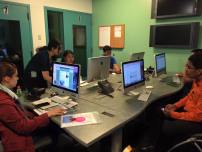 |
| Anna,Irfan & Huyen |
 |
| Fireworks |
Dinner for 2
 |
| Kenneth & Inna |
 | |
| Patricio, Unnun & Kenneth |
Wednesday, July 8, 2015
Online Exclusive: Sara Namusoga and Betty Tsakarestou pick what they like and dislike about their media systems
By Huyen Nguyen
Both lectures from Sara Namusoga, Uganda, and Betty Tsakarestou, Greece for the International Mass Media class are loaded with facts and figures about their media systems. For this short entry, we ask them to provide us with one thing they like and one thing they dislike about the media at home.
According to Namusoga, a current PhD fellow and a former editor of the Ugandan Parliament and various online newspapers, the most interesting thing about Ugandan media is the creative public communication channels, such as the Minibuzz.
On the other hand, she dislikes the government's hiding information from the people. (Click to hear her voice)
Professor Tsakarestou, a senior lecturer at Panteion University, also said that she dislikes the practice of censorship, plus the irresponsibility of the media, plus the lack of local perspective.
However, she is very much interested in the op-ed articles and the use of social media as alternative channels. (Click to hear her voice)
Following are some great moments during the two scholars' presentations.
Namusoga: License is required to practice journalism in Uganda. @scrippsiij #SUSI2015
— Franca (@Mshaw1923) July 8, 2015
Ugandans trust government media more than the private media. @scrippsiij #susi2015 pic.twitter.com/jmHROl3vtC
— Mary Rogus (@MTRogus) July 8, 2015
Uganda's state daily news paper do not allow to cover any news about Gays and lesbian. @snamso @scrippsiij
— Govinda Pariyar (@gpariyar) July 8, 2015
#susi2015 scholar Betty Tskarestou lectures about media in her country, Greece. @scrippsiij #susi2015 pic.twitter.com/QIR4nqazTZ
— Mary Rogus (@MTRogus) July 8, 2015
From Athens, Greece to Athens, OH US, Betty, a Greek scholar explains Greece in debt trap. @scrippsiij #SUSI2015 pic.twitter.com/NAPOsT9vYA
— Bruce, Lui Ping Kuen (@brucelui) July 8, 2015
The media control the state and the state controls the media. It is a picture of mutual blackmail,Betty Tsakarestou #SUSI2015
— Yusuf Kalyango (@scrippsiij) July 8, 2015
Tuesday, July 7, 2015
Shwe Sin Khaing and Bruce Lui talk about their SUSI lectures
By Huyen Nguyen
Shwe Sin Khaing, from Myanmar, and Bruce Lui, from Hong Kong gave the very first SUSI lectures for the International Media Class on Tuesday afternoon, showing a lot of passions.The audience, including SUSI fellows, were thrilled at their unfolding media situations in Myanmar (Burma) and Hong Kong, especially around censorship issues.
Khaing, who has been working in the field for 8 years, was worried but also excited about delivering the lecture for American students.
She was thankful for being encouraged to share the changes in her country's media system before and after the 2012 reform. (Click to hear her voice)
According to Khaing, the political culture in Myanmar has significantly changed after the reform, which steered the country towards a more democratic direction. As a consequence, the first real, independent journalism school was launched on May, 2014, called Myanmar Journalism Institute.
Shaw Sin from Burma says that she never had a chance to study journalism and media in schools in Burma. @scrippsiij pic.twitter.com/EgIKPvlYXZ
— Franca (@Mshaw1923) July 7, 2015
Bruce Lui transformed his academic lecture into a very thrilled speech about how Hong Kong journalists fought for the freedom of press. The experienced journalist unveiled many shocking, bloody events suppressed by the media due to direct commands from the authorities via media bosses.
A compelling, passoniate, reflective talk on Hong Kong media landscape by @brucelui during #SUSI2015 @scrippsiij pic.twitter.com/RmS0Y7JthF
— Betty Tsakarestou (@tsakarestou) July 7, 2015
Bruce Lui: "When you watch the CCTV, it's heaven, but when you watch the reality, it's hell." @scrippsiij #SUSI2015
— Franca (@Mshaw1923) July 7, 2015
Bruce said he believed journalists from different media systems can co-develop solutions for media issues which happened in each other's country.
(Click to hear his voice)
Monday, July 6, 2015
Small Talks with SUSI scholars on Video Shooting Day
By Huyen Nguyen
Camilo Perez was there at our apartments to shoot videos. He's absolutely brilliant. @scrippsiij @USAndKolkata pic.twitter.com/YsQ2q232Ak
— us pandey (@uspindia) July 5, 2015
Video shooting session scholars about our expectations in participating in #SUSI2015 @linyansisu @snamso @scrippsiij pic.twitter.com/gGQbUtZ0Fc
— Betty Tsakarestou (@tsakarestou) July 5, 2015
Surprisingly, many SUSI scholars are not comfortable in front of the camera, because they are more often behind it. Therefore, small talks become very good ice-breakers. Here we recall some very nice stories besides the official video shots.Home-made food is the best!
After three days, Shwe Sin Khaing, from Burma, started craving for home-made food, especially rice. Luckily, she saw a post on Facebook showcasing food from SUSI fellow Kenneth Moeng (nickname Ken), from Botswana. He was actually making his awesome Spaghetti Ala Botswana.
 |
| Spaghetti Ala Botswana, a special dish made by Kenneth Moeng. Photo taken from his Facebook post. |
Following a nice chat, Shwe Sin was invited to Apartment 607 for breakfast on the next day. This time, Govinda Pariyar, from Nepal, was the chef with his fantastic Khukura Ko Masu (Chicken Curry with Rice). "The food was so good. I am glad that they are cooking and inviting me for a meal," Khaing said.
Khaing also let us know that she had shopped enough groceries from Walmart to prepare a traditional fried rice dish. We believe that she would invite her fellows to try a taste very soon.
Similarly, Trung Bui, from Vietnam, has been very active in cooking for his roommates. He brought some instant noodles from home, and mixed it with vegetables, chickens and other ingredients in America. "It reminds me of my studying time in Russia. I cooked a lot," Bui said.
Other scholars who have planned to make food included Patricio Vasquez, from Chile. He told us that he was going to make Pineapple Pie for everyone to try.
Other food options for busy days
Half of the scholars would vote for a convenient, healthy diet with fresh fruits, yogurt, cheese, beans, and vegetables.
"I don't do cooking a lot," said professor Andrea Mino Viteri, from Ecuador. "I bought cereal bars, cheese, hams, some basic stuff for survival."
Sara Namusoga, from Uganda, had her first meal at Buffalo Wild Wing with a combo of mushroom and French fries. Not a big fan of meats, she went shopping for beans, veggies and cheese.
— us pandey (@uspindia) July 3, 2015
Greens was also the best option for Anna Lelik, a young journalism trainer from Kyrgyzstan. She had just had some salad for lunch before her video shooting schedule."I'm a big fan of hummus," she added. "In Kyrgyzstan, we have to prepare it ourselves, but here I can buy it at Walmart. It's kind of painful if I have to make hummus myself. The peas need up to 16 hours to absorb water before we can process it."
Coming from Athens, Greece, professor Betty Tsakarestou was not unfamiliar with American food. Coming to Athens, Ohio, she paid more attention to available healthy food options, especially organic foods, which is a "fast growing global movement."
Poetry night is up!
For Ken, Athens was such a muse. Creative works kept coming out of his mind, and he was really enthusiastic with having a poetry night in the upcoming days. Among his first poems was Sundry Minds. Click on the video to enjoy Ken's poem recited by himself.
Sundry Minds
Bloom so bright and kind in the morning like Athens
Through the day, silk into a colour of scent
Like rain from the milky sky upon these giggles
As sundry minds ponder the next drop.
Who is Who?
Just a few days, but SUSI scholars quickly recognized prominent features of their fellows. Professor Inna Sukhenko, from Ukraine, said she was very impressed by how fast roommate Andrea Mino Viteri can run.
"She makes everyone jog with her along the river, she always encourages us to do exercises," Sukhenko said.
Professor Viteri happily explained jogging would help a lot after days eating fast food like pizzas. "I'm surprised by the size of pizzas here. There are 16-piece pizza, and that's why we have to jog and gym," she said.
In the early morning sun, with somewhere to go~ Fascinating jogging track#Ohio @pfcontrerasv @scrippsiij #SUSI2015 pic.twitter.com/Ls8pii3bBN
— Bruce, Lui Ping Kuen (@brucelui) July 5, 2015
Professor Yan Lin would absolutely agree with her, because she also told us the size of food serving in America gave her an incentive to take a walk on the trail nearby.Also, according to Sukhenko, Bruce Lui, from Hong Kong, was the one who can organize everyone, and Ken always made everyone laugh.