Written and Edited by Rosette Leung, Hong Kong
Athens, OH – Sitting on a delayed flight from San
Francisco to Ohio, what comes to the mind of the SUSI scholars? Time files. One
week to leave Athens, the ‘home’ of the scholars. If every flight is an
adventure, here is the journey of how the scholars experienced American
cultures for their first time.
The first stop: Chillicothe
Tecumseh! The outdoor drama with
real actors, horses, and gunfire effects was fascinating. Based on the scripts written
by seven-time Pulitzer Prize nominee and Emmy recipient, Allan W. Eckert, the
show performed in a valley of the Sugarloaf Mountain, Ohio was based on a true
story about a Shawnee Chief Tecumseh who scarified his life for uniting the
Indians and resisting the Americans during the 1790s.
In many countries, varieties of
shows, operas and plays are very important cultural products for community
revitalisation. In China, the Beijing opera, is a mixture of traditional culture
and Chinese nationality. The Phantom of the Opera performs in the Her Majesty’s
Theatre in London, is a European cultural representation of romance.
Unlike the global popular operas showing in
theatres, the Tecumseh drama is more realistic than many of the European plays. It
informs local and international audiences about a rarely-known history of the
Indian heritage in America. Although the show was only part of the Ohio history, the resistance
and integration of multi-cultural ethnicities have certainly contributed to the
unification of the America.
 |
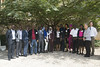
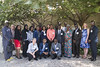
The SUSI scholars took photos
with the Tecumseh actors after the show.
(Photo
courtesy of SUSI program assistants) |
The second stop: Cleveland
Drove away from the university and headed to a downtown with blocks of high buildings, Cleveland is an unfamiliar place to many scholars but most could recall the place won this year’s NBA championship, and Lebron James, a prominent NBA player, was the Most Valuable Player (MVP) in the team Cleveland Cavaliers. But the journey to Cleveland was nothing to do with basketball.
Drove away from the university and headed to a downtown with blocks of high buildings, Cleveland is an unfamiliar place to many scholars but most could recall the place won this year’s NBA championship, and Lebron James, a prominent NBA player, was the Most Valuable Player (MVP) in the team Cleveland Cavaliers. But the journey to Cleveland was nothing to do with basketball.
Out
of many scholars' expectations, Cleveland has significant contribution to
political development in the US. The Quicken Loans Arena, situated in the heart
of Cleveland, was the venue that hosted the Republican National Convention
(RNC) this July. Coincidentally, the SUSI scholars were given a chance to visit
the media centre of the Convention Center just days before Melanie Trump
delivered her suspicious plagiarised speech from Michelle Obama.
Not far away is where the Ohio Statehouse situated – a government building where the Democrat delegates and the Republican delegates discuss bills and legislations of Ohio. The postmodern design of the Congress building and historical painting on walls adduced the doctrine of democracy and freedom of speech that are honoured from the past to the present. Journalists and journalism scholars, what are more precious than freedom to speak for themselves and the unprivileged? Sending a Tweet or a blog post just need a click in a second, but it is still not guaranteed in many countries across the world.
 |
A ‘corner’ of the RNC Media Centre
in Cleveland.
|
 |
Do you know who are the philosophers
in the left and the right statues?
|
The third stop: The Amish Country
Many scholars, including myself, were impressed by the American cultures in the Hollywood movies: modern, fancy, liberal, and a little bit crazy. But in Ohio, people are more dedicated in preserving their traditional culture instead of promoting new culture. Dissimilar to the American culture demonstrated in the Hollywood movies, the Amish Country, which locates in the Holmes County of Ohio, has a unique culture that many scholars have never seen before. Most Amish people do not own cars, mobile phones and other electronic goods. The telecommunication and internet services were very weak and often disconnected. With very limited public and private cars, carriage is the major transport in the Amish Country, and “totally unbelievable” as described by many scholars.
Many scholars, including myself, were impressed by the American cultures in the Hollywood movies: modern, fancy, liberal, and a little bit crazy. But in Ohio, people are more dedicated in preserving their traditional culture instead of promoting new culture. Dissimilar to the American culture demonstrated in the Hollywood movies, the Amish Country, which locates in the Holmes County of Ohio, has a unique culture that many scholars have never seen before. Most Amish people do not own cars, mobile phones and other electronic goods. The telecommunication and internet services were very weak and often disconnected. With very limited public and private cars, carriage is the major transport in the Amish Country, and “totally unbelievable” as described by many scholars.
 |
| The Amish Country is a place with greenery. |
 |
| A huge carriage displayed in the Amish Country museum. |
 |
| The Amish are also called the Pennsylvania Dutch. |
The fourth stop: The Little Cities
of Black Diamonds
The Little Cities of Black Diamond in Shawnee took around 30 minutes’ drive from the Ohio University. With only around 600 people of populations, the SUSI scholars took an adventurous journey to the early coal mines in Ohio. Some SUSI scholars were disappointed when they see no mines and mining activities in Shawnee, but they later realised that heavy pollutions and fatal accidents due to early mining activities were buried and mourned in abandoned mining sites and graves of African-American who were once the forerunners in labor union movements in Ohio. Like travelled through a time tunnel, SUSI scholars visited the Robinson’s Cave and the New Straitsville Moonshine Company, some of them enjoyed samples of distillations produced by the Shawnees.
To battle with the fading population and the missing pieces of history, some warm-hearted Shawnees have made use of the social media sites, such as Facebook and blog to inform the ‘outsiders’ about their life histories and efforts in conserving the natural scenes in Shawnee. Though setting up an archive for preserving Shawnee’s history takes time, the social media do help a lot for connecting the Little Cities of Black Diamonds to the outside world, including the Ohio University and the SUSI scholars.
The Little Cities of Black Diamond in Shawnee took around 30 minutes’ drive from the Ohio University. With only around 600 people of populations, the SUSI scholars took an adventurous journey to the early coal mines in Ohio. Some SUSI scholars were disappointed when they see no mines and mining activities in Shawnee, but they later realised that heavy pollutions and fatal accidents due to early mining activities were buried and mourned in abandoned mining sites and graves of African-American who were once the forerunners in labor union movements in Ohio. Like travelled through a time tunnel, SUSI scholars visited the Robinson’s Cave and the New Straitsville Moonshine Company, some of them enjoyed samples of distillations produced by the Shawnees.
 |
| A SUSI scholar tried the distillations produced at the New Straitsville Moonshine Company. |
 |
| The Robinson’s Cave in New Straitsville, Ohio. |
 |
"New"
Linda Theater established in 1930s. Movies were displayed with motion and sound.
|
The fifth stop: San Francisco
San Francisco has long been named and regarded by the Chinese as the ‘Longstanding Gold Mountain’ for remembering the history that many Chinese migrated to San Francisco to join the gold rush in California. According to Wikipedia, a division of Wikimedia Foundation, the Voice of America and the State of Federal Government are still using the name ‘Longstanding Gold Mountain’, but this name has not been mentioned on the Wikipedia page about San Francisco in English. Clever SUSI scholars noticed about the lost in translation on Wikipedia, yet the speakers from Wikipedia denied the differences in translation have bought much inconsistency in content, and they emphasised that zero censorship has been imposed on the open and collaborative site.
San Francisco has long been named and regarded by the Chinese as the ‘Longstanding Gold Mountain’ for remembering the history that many Chinese migrated to San Francisco to join the gold rush in California. According to Wikipedia, a division of Wikimedia Foundation, the Voice of America and the State of Federal Government are still using the name ‘Longstanding Gold Mountain’, but this name has not been mentioned on the Wikipedia page about San Francisco in English. Clever SUSI scholars noticed about the lost in translation on Wikipedia, yet the speakers from Wikipedia denied the differences in translation have bought much inconsistency in content, and they emphasised that zero censorship has been imposed on the open and collaborative site.
 |
The
SUSI scholars listened attentively to the speeches of Wikimedia representatives.
|
If Wikipedia is a giant online encyclopaedia, the San Francisco Giants is a giant of the Major League Baseball
(MLB) teams. SUSI scholars were so excited to be toured in the AT&T Park. The
Park is famous as it is the ‘home’ of the MLB Giants. Although there was no
match in the park during the day of visit, the scholars were able to see the live
report centre, hotel rooms, and press conference room etc. in the park – all of
them represent the growth of sports marketing contributed to the globalization of sports. But sports journalism, a profession that rely on truth and accuracy, continues to serve as a major information provider about the news of the Giants.
 |
AT&T
Park – outside view
|
 |
| AT&T Park – part of the inside view |
Similar to Hong Kong, San Francisco
is a cosmopolitan city that welcome people from a multicultural background, and
is one of the largest and most famous LGBT communities in the world. The SUSI journey in San Francisco ended with a mouse and the sea (Pier 39). The Walt Disney Family Museum displayed the works of Walt Disney, and explained how different Disney characters were created. From Mickey Mouse, Donald Duck, to Pinocchio,
Three Little Pigs and Cinderella, almost every Disney character in the museum
has ‘grown up’ with the Americans, as well as the children in the rest of the
world (including me again).
Every scholar must have read a number of publications that accused the conglomeration of Disney was an expansion of U.S. soft power. There were long criticisms in academia regarding Americanisation, cultural industry and hegemony. In the U.S., Disney is a giant company producing forms of entertainment. But in the eyes of millions of people around the world, Disney is the representative of America popular culture.
Every scholar must have read a number of publications that accused the conglomeration of Disney was an expansion of U.S. soft power. There were long criticisms in academia regarding Americanisation, cultural industry and hegemony. In the U.S., Disney is a giant company producing forms of entertainment. But in the eyes of millions of people around the world, Disney is the representative of America popular culture.
 |
A
Liberty Magazine cover with Mickey Mouse in 1942, a year during the WWII.
|
From traditional to modern, from rural to cosmopolitan, the SUSI Program has opened a door for the journalism scholars from 18
countries to travel and to explore the multifaceted American cultures.
Next station: Atlanta. Ready to leave in 3 hours. Sleepy but feel excited.
Next station: Atlanta. Ready to leave in 3 hours. Sleepy but feel excited.