Showing posts with label journalism and media. Show all posts

Thursday, July 24, 2014

I Took a "Selfie" With The President!

Yousef Kazim

A few weeks ago, I thought that taking a "Selfie" will be something that people in United States are used to! Because usually through social media platforms such as "Instagram" you'll find thousands of "Selfie" pictures posted mostly by Americans especially celebrities, or maybe they still remember Allen DeGeneres's 2014 Oscar's Selfie which was one of the most famous examples when you say the word "Selfie"!, but I was surprised that they were looking at me in a strange weird way when I was holding my "Selfie Stick" and waving to my phone's camera! And I was like: What? Am just taking a Selfie!

"Selfie" was one of the most trended terms through social networks and platforms that was used in the beginning by Australian's, and now it’s a well-known term. which is a "Self-Portrait" photograph that typically taken with a hand-held digital camera or a smart phone's front camera and usually used in some social networking services.

In fact, I was addicted to "Selfie's" since I had my first camera integrated phone "Nokia" back in college when i studied at Kuwait University during 2001 and at that time my friends were making fun of me when I face my phone's camera to take a photo of my face.. and posing. But now it became a common thing almost among all smart phones users, especially if they are so into social media platforms and using Instagram to be more specific, and that could be a way for some of them to gain and get more likes, comments and followers in that social network platform.
Using My Selfie Stick with my fellow Prof.Arona 

"Instagram images with a face in them will get 38% more likes and they’re also get 32% more comments, reveals latest research at the Georgia Institute of Technology and Yahoo Labs. The research analyzed at 1.1 million photos on Instagram and found that pictures with  faces in them are 38 percent more likely to receive likes than photos with no faces. Images with faces in them are also 32 percent more likely to attract comments." (Gilbert, 2014).


"Selfie" with The President Dr.McDavis
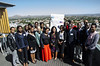
During the welcome ceremony which held in Ohio University in Athens for the SUSi scholars - who are participating in this academic program which is founded by the USA Government and organized by the International Institute of Journalism at Ohio University, I was walking around using my "Selfie Stick" – as I like to call it – to take some photographs and treasuring those great moments when suddenly and unlike what I expected! The President of Ohio University, Dr. Roderick McDavis, was very open and accept that I take a picture with him on my "Selfie" way and that was the moment when I had a "Selfie with the President"!


Face It: Instagram Pictures With Faces are More Popular. (n.d.). . Retrieved July 24, 2014, from http://www.news.gatech.edu/2014/03/20/face-it-instagram-pictures-faces-are-more-popular

Monday, July 14, 2014

Searching for the “real American food”

By Lorna ChacónCosta Rica (SUSI scholar 2014)

What’s the "real American food"? I asked this question as soon as I arrived to Athens, Ohio, for a six week program on journalism and media, at the Study of the U.S. Institute (SUSI). The SUSI was funded through a grant given by the Study of the U.S. Branch, which belongs to the Bureau of Educational and Cultural Affairs of the United States Department of State.
“Hamburguers”, somebody told me. “Fries”, another person said. “Pizza”, assured one young man. “Hot Dogs”, one kid said to me. However, I was sure that the “real American food” was much more than we, as foreigners, usually watch on TV or movies, where it usually is fast food.
So, I started to look for the “real American food” here in Athens, since I'm a person who lives in Ohio University’s bedrooms, and doesn't have a kitchen to cook every day.
During my first week, I realized that Athens, and also Ohio, are like the “United Nations of Food”. Here you can find different plates from many different countries.
I started in “Casa Nueva, Restaurant and Cantina” a Mexican-tex and Mex-vegetarian place. Then, I went to “Habibis” to enjoy Lebanese food, and later I was in “Salaam”, where I found Middle Eastern, Mediterranean and Moroccan flavors.


In “Chipotle”, I tried Mexican food, while in “ChinaKing” I ordered a big buffet with different Chinese plates. On the other hand, I tried a mix  of American, Japanese and Italian flavors in “Fusion Noodle Company” and in “Ginger”.
I also found in Athens all the fast food brands like Subway, Wendy’s, Taco Bell, KFC, Pizza Hutt, and at the Court Street “Diner” (a traditional restaurant) I found  soups, salads, sandwiches and, of course, burgers.
After my second week in Athens I asked myself again the same question: What’s the “real American food”?


Our Ohio University’s professor, Mary Rogus, invited us to her house for the 4th of July celebrations, and we had a traditional barbecue with meat, chicken, salads and corn.
We also went to professor Bill Reader’s farm, and he cooked for us “Cajun Cuisine” from Louisiana. This style of cooking is named after the french-speaking "Cajun" immigrants.
Cajun food has rice, sausages, seafood, vegetables, and very spicey rice and beans, which by the way taste delicious.
Another day, I went to the “Athens Farmers' Market”, in State Street, and I saw a lot of Americans buying fresh organic vegetables and fruits to cook their food at home.
While in the market, I remembered that Americans use to eat turkey on Thanksgiving Day, and also different pies (like apple pie) for special occasions.


But again, what’s the “real American food”? I think there is no answer for my question because America is a country built by immigrants from many different places. In my opinion, the food is like a mirror of its complex demographic phenomenon, because it is impossible to find the “real American food”, and we can only find “fusion food” that mixes all the different cultures.

Nearly 41 million immigrants lived in the United States in 2012. That is 13 percent of the total U.S. population of 313.9 million according to the Migration Policy Institute.

“In 2012, Mexican-born immigrants accounted for approximately 28 percent of the nearly 40.8 million foreigners born in the United States, making them by far the largest immigrant group in the country. India was the second largest, closely followed by the China (including Hong Kong but not Taiwan), and the Philippines (each accounting for about 5 percent)”, said the Institute.
El Salvador, Vietnam, Cuba, and Korea (each 3 percent), as well as the Dominican Republic and Guatemala (2 percent each), were among the top ten countries of origin. Together, immigrants from these ten countries made up close to 60 percent of the U.S. immigrant population in 2012.
In view of this evidence, the real American food has a lot of colors, a lot of flavors, and a lot of heritages. It is a food cooked with a lot of hands, and also with a lot of hearts, that share one land and one hope.


Monday, January 27, 2014

Being A Minority in Ghana

By: Adrienne Green 

Everywhere in the world there are people who look like they belong and people who don’t.

 In Ghana, it was obvious to the many people that we encountered that my nineteen Caucasian colleagues were not indigenous to the city of Accra or any of the other places that we traveled.

They suffered the escalated bargaining prices, received the quizzical looks from small children, and faced barriers when interacting with the people of Accra because they stood out.

But, many of the Ghanaian people didn’t know exactly what to make of me. At first glance I think my dark skin, long braids and ability to blend into the crowd deceived them. If only for the few moments before I spoke, I looked like I belonged.

Though my place within their culture was always fleeting, it was interesting to see how people would approach me compared to my classmates.

People approached me speaking in their native dialects, extending hands for handshakes I did not know, and asking for directions to places I had never been. They would always quickly uncover that I was in fact a foreigner, and quickly that insider treatment would change to something much more distant. Native Ghanaians called me something that I had never been referred to before—Black American.

Although it made sense that they would not call me ‘African American’ since I wasn’t born anywhere near their continent of Africa, it still sounded strange.

 Traditional wrap for carrying children. Photo taken at African dance practice.

I didn’t expect to fit in. We were warned during our orientation that it would be one of the first times in our lives that we would feel different from those that surrounded us. But, I didn’t believe that. I was used to being different my whole life.

Being an African American woman, I understood what it meant to always feel like a “minority”. I had always assumed that because of my African American heritage, going to Ghana would be like a symbolic homecoming where I would discover some lost part of my history. That didn’t exactly happen. And after arriving in Ghana I had an uncomfortable feeling that despite the fact that I don't physically stand out like my classmates, my place as a Black American came with a lot of stigmas. 


After having many conversations with Ghanaian citizens I found that some held very stereotypical views of the Black American community, and I had to defend questions about those negative ideas. I think that the media in Ghana has a lot to do with the way African American people are portrayed to other black and brown people across the diaspora. Interestingly enough, they felt that American media did not give a fully accurate representation of Africa.

Sadly it was rarely discussed that some Ghanaian people knew very little about the African American community outside of pop culture and negative media coverage. But that is similar to the fact that American media broadcasts little about Ghana/Africa outside of poverty or conflict. The lack of a variety of presentation for black men and women as well as the African population perpetuate negative stereotypes for each group. Ideas of the poor and destitute African or the deviant African American stem from the types of images that we are exposed to. 

Media and Society play an integral role in how other cultures come to interpret people when they interact. The portrayal of Africans in the media affected how I sought a relationship with the Ghanaian culture, and heightened how different I felt from the people I encountered and how different they thought they were from me.  

After traveling to Ghana and returning to America I feel that I have learned so much about myself and about how people relate to each other. I now recognize in a more impactful way that the only way you can truly identify or empathize with another group of people is to admit that the things you knew and the assumptions you made might not have been true. I also learned that the way in which someone identifies is much more complex than the location on their birth certificate and

Saturday, August 3, 2013

Call and Post: Blood and tradition


By Fernando Venegas Traba (Chile)

One of the main things that the general public, and a pretty respectable amount of journalists thinks about our profession, is that we have to be objective. We should check the facts, organize the information and communicate it to the public. Well, I have never agreed with this point of view, don´t get me wrong, I believe that we must be accurate, that we must pursue the facts to built a good non-fiction narrative that gives an idea of what is going on in our societies, that we must contrast sources,but I don´t think that objectitivity is possible.

Basically because we are always making decisions, when we choose to cover this instead of that, when we choose to use a source over another one, when we took a photo, we use an adjective or even when we decide the headline, we are, at all time, using our own experience and subjectivity. 
This doesn´t mean that we are blind, or we are slaves of our own perceptions, what it means is that we are always, talking from somewhere, from our experience, culture, religion (or non religion), values and even political point of view. When we acknowladge this, we can start to compromise, to take a stand, not to lie, but to be real honest in our approach to reality.

Constance Harper (Associate Publisher/Editor)
This is what I saw in our visit to the Call & Post, a niche newspaper, founded in 1916 by the inventor Garret Morgan, centered in informing the black community of Cleveland, from a black community point of view, and they are blunt honestly in recognizing this.

As you may have deducted, by seeing the photographies and reading the texts at this blog, we are quite a colorful group, and in the day of our visit, the questions and subjects that we rise were pretty direct, most of them not very politically correct in a society like this one (U.S.), but importants and necesaries to understand the culture and the focus of this publication. Racial issues, editorial focus, salaries, subjectivity and objectivity were discuss by our group and a number of the staff at the Call & Post. It was at least refreshing to see the honesty and how up front they were with their answers. They declare themselves as a commit newspaper, interpreting the reality from an african american point of view, because it is necessary, because the history of the USA has been hard with the black community, and is part of their job to give voice and opinion to those, that in many times, has been abused or forgot by the goverment or the society.

Felicia Haney, Journalist C&P
It was really interesting, and certainlly makes sense that in a place like Cleveland, with a population integrated by a 51% african american, the Call & Post is a very important media. With a circulation of 20 thousand, this newspaper reviews al of the topics that this particular community needs to know, and also, the ones that they are interested in.

This paper is made of flesh and spirit, of real truth, not only the one supported by facts, but the one that is achieved when you are clear in your point of view, in your way to see the world. The Call & Post is ink and blood.


Thursday, August 1, 2013

Building the Tower of Babel


By Fernando Venegas Traba (Chile)

Most of you remembers the story of the Tower of Babel. Is a passage of the Bible, specifically the Genesis. It´s about a group of people, of different parts of the World, that came together at Shinar after the Great Flood, and decided that they will build a Tower that will reach heaven, and around it they were going to establish a city that was going to be known everywhere. When God saw this, he punished the human for their presumptuosness by giving them different languages, wich lead to confussion and the eventual destruction of the edification.

Tower of Babel (Artist Unknown)
It is certain that is a metaphore for humility, but also we can associate it to science, and the pursue of knwoledge beyond religious or spiritual means. How a superior being is offended, and maybe a little afraid of the potential of this insignificant humans and their desire of power and wisdom. And his solution, miscommunication, "the langauge creates reality" saids the chilean Echeverría, when there is no language, there is no communication and everything falls apart.

Well, when we first arrived we had a welcome dinner for all of us, the SUSI scholars of Journalims and Media, at Ohio University; and I couldn´t stop thinking about this story, and how we are in the same path of this visionaries, but with a much better chance of succes.

Why you will ask. It´s simple, we are altogether in one place, from all over the world, reaching for knowledge, and specially for understanding. It was an amazing view, people of every latitude in one place, sharing, talking, eating (wich is always a common aspect between nations), laughing and sharing their experiencies, their vision, without any other goal than to know more about the other, more about life itself.

It´s only a matter of looking at the countries represented by the scholars, Azerbaijan, Zambia, Lebanon, Ukraine, Romania, Ecuador, Honduras, Mozambique, Zimbabwe, Malaysia, Kyrgyzstan, Nepal, India, Bangladesh, Mongolia and Chile. When I would ever dream to meet such a diverse group. But it doesn´t stop there, because between the faculty and staff of the program, we met persons from Zambia, Guyana, China, Rhuanda, the UK and Ethiopia, certainly I am leaving some countries behind.

Only in my table we had natives of two continentes, none of them from North America, actually there was one from Africa and four LatinAmerican. Two scholars (Beatriz Lovo and me), and three faculty members, Brook Hailu Beshah, borned in Ethiopia, and Patricia Cambridge with her husband Vibert Cambridge from the Guyana. At first it was a slow conversation, but after a few minutes we were very openly talking about different subjects, visions and ideas, with one common ground, the Journalism.

For me it has been an amazing experience, I have known people from all over the world and share with them ideas, discussions, memories and feelings,and that get me to my conclusion:

We are in an amazing position, and we have aqcuired a huge responsability. We can build the tower, and now there is no vengeful God that can stop us.