Showing posts with label Lebanon. Show all posts

Wednesday, October 16, 2013

The Begining of Eid al-Adha -the Feast of Sacrifice


By:Kaylyn Hlavaty

Beginning on October 15th, Muslims around the world gathered at mosques for dawn prayers to celebrate one of Islam’s most sacred holidays, Eid al -Adha.  The holiday marks the end of the hajj, the pilgrimage made by Muslims during to the Mecca in Saudi Arabia.

The Eid al -Adha, the feast of sacrifice, commemorates the willingness of the prophet Ibrahim to sacrifice his first-born son Ishmael as an act of submission and dedication to Allah’s request and his son’s willingness to be sacrificed. In the Quran, as Ibrahim is about to sacrifice his son, he hears a voice from heaven that stops him and allows him to sacrifice a sheep instead.

Every year during Eid al -Adha, Muslims slaughter sheep, camels and cows to symbolize the sacrifice Ibrahim was willing to make for God. At dawn, men, women and children go the mosque to pray. Following prayer, families go to the cemetery to honor the loved ones lost.

Inside the Al-Amin mosque. photo taken by Kaylyn Hlavaty
As a journalist and foreigner, I wanted to witness the traditions and hear the meanings of this holiday. Around 7 a.m., I made my way to the Mohammad Al-Amin mosque in downtown Beirut. I wanted to begin my observance of this holiday with the first tradition of the day: going to the mosque. After I took my shoes off and I covered from head to toe, I went upstairs to the women’s praying area. 

The women were sitting in groups, some with children waiting for the morning prayer to start and others already praying. Not knowing where to sit, I slowly made my way over to a group of women talking. I introduced myself and I started to ask them questions about what Eid means to them. Since none of the women spoke English, we used our facial expressions and body language to communicate. Since we couldn’t understand each other when we spoke, we used facial expression and handshakes to show understanding and respect.


The burial of the late Abdalah Hasbalah

Amal Bakri was one of the many women who were gathered at the Mohammad Al-Amin mosque. She saw I was struggling to communicate verbally with the other women. She joined in the conversation speaking French and a little bit of English. It was enough to understand each other. Soon after, it was time for prayer. I sat on the side, watching women, children and men devotedly pray. After prayer, Amal invited me to meet her husband and her son who spoke better English. We sat in the car talking about the holiday and then before I know it, I’m in the car with her husband, mother, son and sister going to the cemetery. This is another tradition associated with the holiday. Family members visit loved ones who have passed away.

Eid is very special holiday for her and her family, like it is for many Muslims because it’s a time to spend with family and a day to be joyous.  Once we got to the cemetery, she explained to me that her father had died four months ago.

“It’s still very hard for me and my family. We are all very close and when you lose someone so close to a holiday that means a lot to us, it’s even more difficult,” said Amal.

Children selling flowers outside the cemetery
As I walked inside the burial grounds, I was told to put my camera away, so out of respect I did. On the way her father’s resting place, there were many other families paying their respect to the deceased. I was standing with the family watching Amal and her sister read verses from the Qur’an. Once everyone started to cry, I started to get emotional as well. I thought to myself, here I am with a family I have only known for about thirty minutes and they were generous enough to invite me to the cemetery during a intimate occasion. Also, they furthered the invitation to spend an entire day with them. I felt honored to be in that moment and witness this special moment. It’s not every day a journalist or an outsider for that matter can experience Eid the way I did.

They invited me for Nescafe and as the avid coffee drinker I am, I immediately accepted the invitation. While Amal was preparing the coffee, her son Ahmad Bakri took me to see the slaughtering of the sheep. I was happy I could see the slaughter just down the street from their house. I was prepared to see quite a bit of blood because I come from a family of hunters so I’m used to this sort of process. According to tradition, the sheep were slaughtered in the front of the mosque. Women, children and men stood to witness the slaughter. There were three sheep already dead when I arrived, which left one sheep to follow the rest.
The slaughter in front of the mosque. Photo taken by Kaylyn Hlavaty

Once I saw the slaughter of the final sheep, we headed to Ahmad’s house in Kornish al Mazraa where his sister, Nada, his father Farook, his brother Emel and his mother Amal all live. From the moment I walked in, I was given such warm hospitality. Once we drank coffee, I wanted to see more of the traditions that were taking place, especially the outreach to the poor. Ahmad took me to Ibad Al Rahman. It resembles a charitable center with an attached mosque. Throughout the year, this center provides prayer classes, medical and food assistance and on Eid, meat donations to the community and the poor. Throughout the holiday, there is approximately 3,600 sheep butchered and donated to the center.

Children witnessing the slaughter. Photo taken by Kaylyn Hlavaty
A man carrying several bags filled with lamb meat walked out of the donation center. I stopped him to ask how Eid is important to him and if he could explain any special traditions he had. His name was Mohamed Mogharbl. He came to the center because a relative of his family donated a lamb to the center and he was picking some up for his family, uncle and the rest he was going to give to the poor.

“I had to get a card from the officials at the center so I could get permission to pick up the meat. On the card it says the price of the sheep, the kind of sheep such as in size and fat ratio and the name of the sheep dealer,” said Mogharbi.

When I asked him how the center knows who is considered poor and ones who are there to pick up the meat, he said there was a separate line for the poor people and the card allows anyone to pick up the meat. On average, to donate a sheep, it costs around $300 USD. As a general rule, the sheep has to be older than five months and it should be in good health.

The butchers passing out the meat inside the center
Photo taken by Kaylyn Hlavaty.
Since part of Eid is about giving to the less fortunate, Muslims make it a goal to donate either money to someone they know or give the extra meat from the lamb to the poor. When Mogharbi was a child, his father would give money to an older lady down the street as part of celebration before Ramandan ending. Mogharibi continues the tradition by giving money to the lady’s daughter.

“It’s very important in our religion that we give when we can, especially during Ramadan and during Eid because it’s these good deeds that we will be rewarded for,” Mogharibi said.

In just my short time walking around the neighborhood with Ahmad, I could feel the energy of happiness and giving in the air. Children playing with snap rocks; aromatic scents occupying the air and sightings of families walking the streets were traits of holiday atmosphere. 

              
                People waiting in line for sheep meat. Photo taken by Kaylyn Hlavaty
On the walk home there was the occasional Syrian refugee women with her children on the streets asking for money. People just walked by them like they didn’t exist. I see more and more women and children begging for food or money as the options to live are far and few in between.

Once we arrived back at Ahmad’s house, we had delicious dinner of rizz with lahmeh. It’s made with rice, cashews and beef. There wasn’t a time that I wasn’t offered coffee and tea and the frequent attention given to me. By the time dinner was done and one of Amal’s sister left, it was already 4 p.m. I decided it was my time to head back to Ashrafieh, which is only a ten-minute drive without the Beirut traffic. As I left the house, I felt like I knew them for much longer than the eight hours we spent together.

I was fortunate to run into Amal at the mosque and for her to welcome a complete stranger into her home and invite me to experience her holiday traditions. From the moment we met, there was a language barrier, but it didn’t stop us from showing our true expressions towards each other, which was respect and acceptance. Despite what some may believe about the views Christians have towards Muslims and vice versa, my experience today proved again that no matter the religion, beliefs or social background, we can all find understanding and acceptance amongst one another. Some say actions speak louder than words, and today they spoke loud with kindness and generosity.
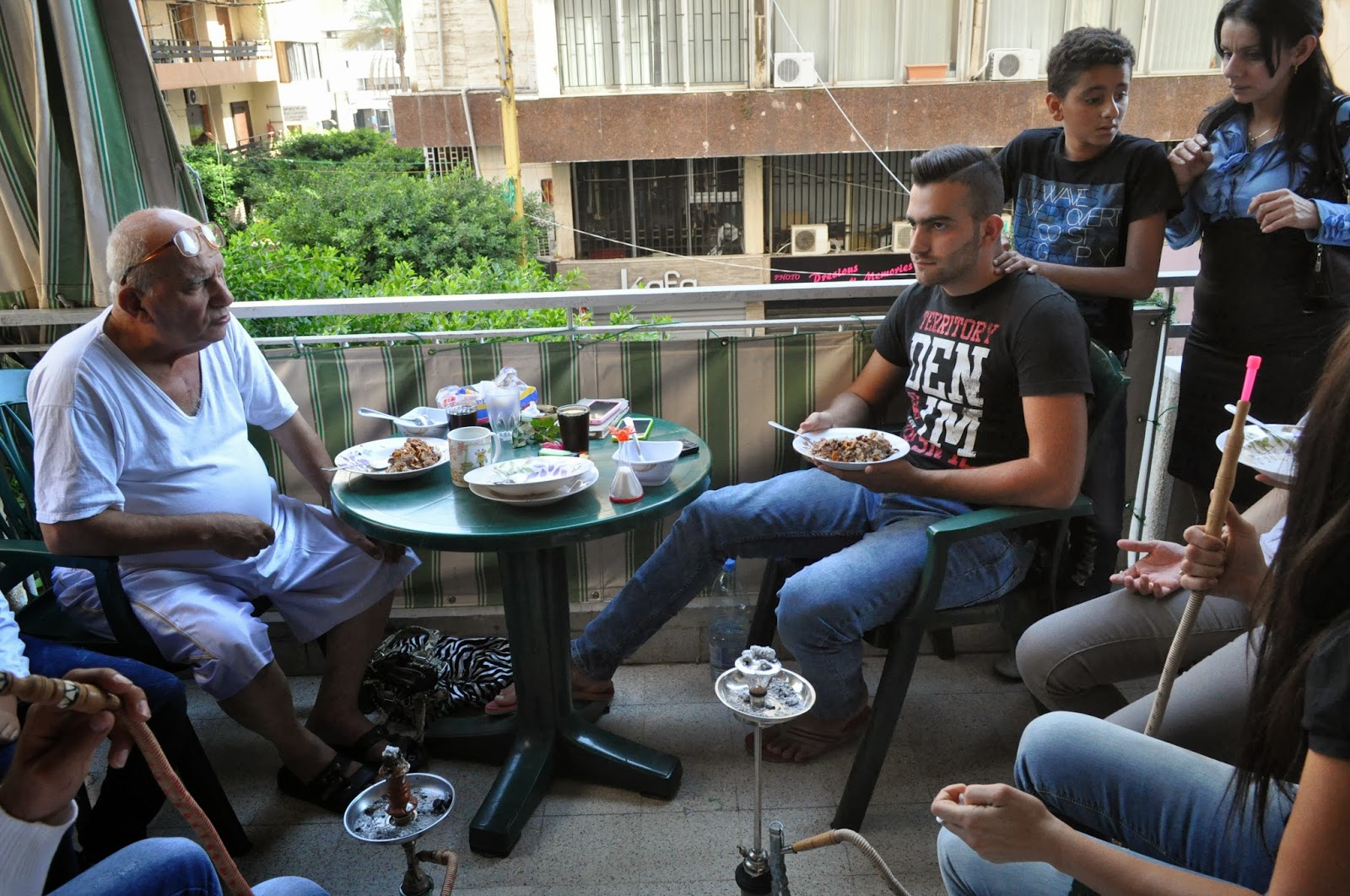
Left: Farook Bakri and  Emel Bakri  at their home in Kornish al Mazraa
Photo taken by Kaylyn Hlavaty


Thursday, December 6, 2012

Lebanon’s pile of corruption and years of neglect


By: Kaylyn Hlavaty 
Produced and edited by: Leisha Lininger

Lebanon is known for attracting tourists from all over the world to see ancient cities like Tyre and natural wonders like the famous Jeita Grotto caves. Sea travelers can see mountains that stand tall and parallel the coastline with waves brashly hitting the permanent structures.

These mountains do not have snow peaks, cedar trees or rocks. Nor do they have the slightest beauty a natural wonder should exhibit. Rather they represent generations of consumption. Plastic bottles and bags, textiles, organic waste and chemicals pile up into a man-made mountain of trash totaling 40 feet of waste.

In Lebanon, there are 670 mountains of garbage scattered across the country. Both within city limits and on the coastal regions, landfills act like permanent structures failing to blend in with the city landscape. These landfills have acted as the solution to disposing of waste in Lebanon and over the years they became permanent sights among Lebanon residents.

In contrast, 40 municipal landfills are scattered throughout the state of Ohio’s 40,860.69 square miles of land according to the Ohio Environmental Protection Agency. These landfills are monitored and operated to ensure compliance with state and federal regulations. Lebanon’s total area is 4,014 square miles which is roughly two-thirds the size of the state of Connecticut. An Ohio resident can only imagine living in a country this small surrounded by 670 garbage dumps.

Fifi Kallab, president of Byblos Ecologia for Development and Environment has been campaigning and researching for alternatives and improvements to Lebanon’s waste management system since the 1980s.

“There is no long-term strategy for the disposal of solid waste or liquid waste,” said Kallab.

Waste disposal did not become a problem until the government had the first emergency plan put in place in 1997. The government signed a contract with the waste management company, the Averda group - Sukleen and Sukomi. This company controls the collecting of waste in the areas of Beirut and Mount Lebanon.

Two incinerators were placed in the Aamorousieh and Quarantina facility as an alternative form to landfills. The increasing popular objection against incinerators led to the residents burning down the incinerator at the Aamorousieh plant.

“We had to deal with our waste, especially in Beirut, because it’s not like the remote areas where residents burn their organic waste so we had to find a place to put it,” said Kallab.

As trash continues to be dumped in landfills along the coast, Lebanon does not have any legislation to regulate how waste is collected and disposed.

A landfill on fire off the coast of Sidon.
 Photo provided by Mohamed El Sarj
“There is no accountability within the Lebanese government when it comes to managing waste,” said Ziad Abichaker, founder of the organization Cedar Environmental.

Cedar Environmental is making an impact on environmental initiatives. Since 1999, Cedar Environmental has built 11 recycling and composting facilities across Lebanon. Achieving efficiency and sustainability is a main feature of the organization because it sorts, composts and recycles all under one roof. Instead of dumping waste that could be recycled and reused, Cedar Environmental founder Ziad Abichaker researched and developed Eco-Board. It is a durable material made entirely out of breaking down everything from plastic grocery bags to flip flops that many consumers all over the world use on a daily basis. These boards are being developed into products such as benches and bins.

“We are the only organization that builds recycling plants and operates them without sending any residues to the landfill. Everything gets recycled or reused, even clothes and shoes,” said Abichaker.

The two contractors, Sukleen, who is responsible for collecting and sweeping the streets and Sukomi who is responsible for land filling the waste have very little incentive to change the way they collect garbage in Beirut and Mount Lebanon. One concept does make Sukomi and Sukleen act like a monopoly, however. Back in 1995, Averda signed a contract for Sukleen to collect and sweep the streets. Then three years later, two more contracts were signed with Averda for composting and land filling by Sukomi.

In 2012, President Michel Sleiman along with his cabinet didn’t want to renew the contract unless new initiatives to combat the waste management were included in the contract. However, the previous prime minister, Saad Hariri, felt that it was too late to think of other alternatives so the contract was renewed, Kallab said.

“There is no solution without political decisions because we don’t need ideas,” Kallab said.“We need a transparent solution, a transparent politician and accountability for them because in Lebanon there is no accountability. They do what they want and nobody can ask them what they are doing.”

Abichaker says both contractors ran out of space for landfills. He said that both Sukleen and Sukomi managed the solid waste of Beirut and Mt. Lebanon which equals 2,500 tons of waste processed per day, but 1,800 tons of that waste is dumped right in landfills and only 400 tons is actually recycled from the contractor’s recycle containers throughout the city.

The collection of garbage in the city of Beirut and the suburb of Mount Lebanon is a daily routine. Tony Jada, a resident in Mount Lebanon who works as an engineer, says that the collection of garbage is politically based and often not done properly.

“We are not that advanced in technologies. We have some factories that help distribute the waste and some of this is used for agricultural reasons and it sometimes gets back into the ground water which causes more problems for us,” Jada said.

Sukleen and Sukomi usually collect garbage every day, which is different than the U.S. waste management companies once a week routine.

Jada adds, “the collection of garbage is chaos because of the crowded streets and the amount of garbage produced by each household.”

The amount of waste just dumped rather than recycled is costing the government more than just money. The waste produced and the way in which it is disposed is detrimentally affecting the fishing industry and marina life along Lebanon’s coastline.

The coastal region of Sidon is located 25 miles from Beirut. Away from the busy city life of traffic and skyscrapers, this ancient city may sound like it carries a natural awe overlooking the Mediterranean Sea. While it carries natural beauty from the water, this coast carries a burden; it holds a mountain of human garbage.

All the products wasted from day-to-day consumption land up here next to the Mediterranean Sea. The pollution of garbage is affecting the fishing industry and marine inhabitants along the Mediterranean coast.

Mohamed El Sarji is the President of the Lebanese Union of Professional Divers who sees first-hand the daily effects of the landfills on the fishing industry and tourism in Lebanon. Most landfills are prominent along the coastline.

“Nobody would allow garbage to be in their backyard. Most of the land is private except for the coastal area because they are public. They chose it simply because it’s free land for the people. They throw it there because no one will say anything,” said El Sarji.

In the winter the waves pound the bases of garbage piles and thousands of tons of garbage fall into the sea. The fishermen get garbage caught in their nets and as a result they have to keep buying new nets. Another percentage sinks to the bottom of the ocean floor. Then the garbage floats with the current and reaches the coasts of Syria, Turkey, Greece and Cyprus.

“For us this is a national crisis. It’s a health problem for all Lebanese,” said El Sarji.
He explains how garbage is one of Lebanon’s biggest and most politically associated problems.

“We have a very corrupt government, very corrupt politicians and they will not solve any problem because they steal the money and bankrupt the country and take so many taxes from the people. It’s a very corrupt country, probably one of the most corrupt.”

There are four major landfills destroying the quality of the water and view of Lebanon’s coast. The landfills are located in Tripoli, Beirut, Sidon and Sour. The fishing industry, once a booming sector during the 1960s and 1970s, but since the civil war has steadily decreased as a major economic sector.
Garbage caught in fishermen's nets.
Photo provided by Mohamed El Sarji
The profits of fishermen are decreasing because of some species living in the region. The caves many fish find shelter is blocked by garbage, making these places inhabitable for the local fish. Once this happens, Lebanon’s most expensive species, the Calico bass and the grouper, will leave the coast of Lebanon causing the fishermen to follow.

El Sarji explains that the coastal areas are losing in two ways. The first victim he describes is not the environment itself but the fisherman because since the sea is full of garbage, waste products are getting caught in the brand new nets. Every time this happens they are losing money. The average fisherman only makes 300-500 dollars a month.

El Sarji said the other victim is tourism in Lebanon. Tourism along with banking is one of the main sectors vital to the economy.

“Nobody wants to come to a country where garbage is covering the whole area of the beach. There are some places where you can see the sand, but there could be a little garbage and this isn’t acceptable. Tourists will not go on beaches that are polluted,” said El Sarji.

The current industries in Lebanon are polluting the environment because they are out of date and have little government regulation. Lebanon is a country of consumption so it is important that the sectors of tourism and fishing stay alive and apparent in the presence of waste dumps.

“We need to make our income from tourist and tourism,” said El Sarji. “The system we have now we are lost between the two. Ministries are trying to encourage industry to grow and we want to preserve the environment. But it’s unacceptable to let industries grow because of the environment.”

Despite the lack of initiatives from the Lebanese government, civic duty has taken over with a number of non-governmental organizations (NGO) and projects trying to defeat this problem that has lasted decades. One NGO working towards a zero waste initiative with participation of local businesses is F.E.R.N, food establishments recycling nutrients.

Meredith Danberg-Ficarelli was inspired to start a project where waste was sorted and collected at the source while studying resource management at New York University. She worked with restaurants to help compost and recycle their waste into bins, which would then be taken off to an appropriate facility for recycling.

“It is an uphill battle. We just have meetings with people trying to get the word out and trying to explain what we do,” said Danberg-Ficarelli.

The project is still in its startup phase and with everything finalized in March, Danberg-Ficarelli said there are currently three restaurants working with them. She explains how one of the hardest parts is getting employees to agree with the new process because many already have their own routine figured out.

Danberg said it has been difficult to convince residents to change their household practices. When she proposes her plan to restaurants, the biggest barrier is convincing the employees that it isn’t a waste of time and explaining the reasoning behind her ideas.

“It is something people don’t know how to do because there is no opportunity to do it,” Danberg-Ficarelli said. “If you see the owners or managers enthusiastic about it than their employees will be willing to follow.”

While there is participation in the movement to reduce waste and find alternative disposal, methods, a country that has a corrupt political system makes the move toward progress long and difficult. Until the government steps up their role and takes responsibility for their country, then Lebanon risks sinking in the piles of garbage they built unless something is done soon.

“You would go nuts because you would be upset,” said El Sarji. “You have no understanding of why any human would do this to themselves and their country. We don’t understand. It’s lack of responsibility from our politicians and failure to manage a country properly.”

Friday, October 26, 2012

Behind the Steel Bars in Lebanon


By: Kaylyn Hlavaty
Produced & edited by: Kaylyn Hlavaty

Behind the steel bars and the barbed wire fence are human beings, with an identity forgotten by the government. Inside are cries for attention and evidence of inhumane living conditions. Their faces are anything but forgotten by their family and friends. Located just a time zone away, is a prison system violating basic human rights and international prison standards.

In American prisons, mothers, fathers and children can visit their loved ones on a regular basis by simply making a reservation. At the Ohio Reformatory for Women in Marysville, Ohio, a child can visit his or her mother on a weekly basis and children can spend their time in a reading room. Unfortunately, the opportunity to visit a parent in a safe environment isn’t available in other parts of the world. In Lebanon, wives, husbands, children and parents have to face corrupt security guards, long distances and uncertainty just to visit a loved one.


Tanya Ghorra, a media professional and collaborator for The National Campaign to Abolish Death Penalty has witnessed the effects of imprisonment on family relationships.


“I once witnessed a young girl who came with her mom and she couldn’t see her dad. Her dad was detained and she was in the courtyard screaming for her father saying ‘I want to see my daddy’. The mother was in tears and so we went to the warden to sign papers and the mother begs him and after the little girl told the warden she wanted to say she loved her dad, he agreed and brought the dad back down again.”


This is the world inside, Roumieh; one of Lebanon’s 20 regional prisons according to the Lebanese Center for Human Rights. It is the largest prison for adult males and minors with a total population of 3,500 people in a facility with the capacity built for only 1,450 prisoners. Ghorra has worked closely with death row inmates in Roumieh for three years and saw the conditions of death row as just one of the problems within the Lebanese prison system.

"The first time was transforming because you enter a completely different world. You can imagine how they are living, but I don’t even call this living. There is nothing,” Ghorra said. A person who signed a false check goes to Roumieh with drug dealers, murderers and rapists.

Ghorra says there are smuggling of drugs and the exchange of sex toys among prisoners that are passed from cell to cell.
 View of Roumieh Prison. Courtesy of AP. Academic Fair Use

“Weirdly enough, death row inmates are the most scared people in the prison. At night they stay in their cell because drug dealers, gangs and offenders occupy the hallways.”

 The ALEF-Act for Human Rights reports the prisons are full of corruption starting with judges and trickling down to lawyers and even court reporters. For example, judges may take bribes to influence other judges or sentence the accused in a certain way. In a corrupt system, the accused may have no chance in winning a case or gaining permission to be released from jail. ALEF observed low-level corruption in a Jdeideh Courthouse. When the time came for lawyers to get access to a court file, lawyers often needed to bribe the clerk and if a lawyer didn’t comply, obtaining the files would be difficult.


“In the prison, you have a mix of inmates who are serving their sentences and then you have others who are awaiting a trial who may be found guilty or innocent,” said George Ghali, who is the project manager for the Arbitrary Detention Project of ALEF.


“The system is full of corruption starting at the court level down to the prisons and I think it’s a system that needs to be amended and the population needs to be addressed.”


Overcrowding is a cause for the poor conditions in the prison, but it’s also the effect of an inconsistent judicial process. The problem is evident because out of Roumieh’s 3,700 detainees, only 721 were serving sentences while the others waited for a trial according to the ALEF report. Ghorra said according to Lebanese text law, detaining a person shouldn’t last more than 72 hours but if you are investigating someone, than this can be renewed up to two times.


Drama therapist and founder of The Lebanese Center for Drama Therapy (Catharsis), Zeina Daccache produced an award-winning documentary called “12 Angry Lebanese”. The film was based off the American film “12 Angry Men”. While filming inside Roumieh,


“In Lebanon, you just wait. It takes a lot of money and energy and at times it’s the prisoners who ask to postpone a trial because a judge can ask for a testimony and sometimes things are made up so the witness is told what to say or may not show up,” Daccache said.


In the U.S. sometimes there are one or two inmates in a 7 by 11 foot cell. In Roumieh, a normal cell is 5 by 4 meters. In just one cell, there are as many as 15-20 people crammed with no plumbing and little ventilation.


   Prisoners inside Roumieh. Courtesy of by NOW Lebanon.Academic Fair Use   
Often the parents come by to take inmate’s laundry to wash and bring back. The Standard Minimum Rules for Treatment of Prisoners says, “Every prisoner shall be provided by the administration at the usual hours with food of nutritional value adequate for health and strength, of wholesome quality and well prepared and served.”

 “Sometimes the food is infected with bugs and it’s often inedible. For example, today is a chicken dish. If you don’t have money to bribe the officers then you will get something not even close to chicken that you won’t even be able to swallow down,” said Ghorra. “But if you have some money, that same exact kitchen will provide you with a decent, edible chicken dish.”

 Many prisoners rely on family members to bring them food, cigarettes, chocolates and basic necessities. Usually walking over 500 meters on a bumpy dirt road in the rain or sweltering sun, mothers, sisters, wives and children will stand in line and experience mistreatment from prison security.

 The conditions inside are eye opening even for social worker of the MH-Bekaa Project, Sarah Hammoud who regularly helps the prisoners inside Roumieh find medical treatment and get in contact with family members.

 “I had no idea when I walked in Roumieh how bad things were inside this place. Everyone said I would see bad things and I did. It’s very inhumane for prisoners. It’s terrible. In the winter it’s very very cold and in the summer it gets very very hot inside,” Hammoud said.

 Torture inside the prison walls remains a problem during and after criminal investigations. Khiam Rehabilitation Center for Victims of Torture is an NGO that supports and protects the rights of prisoners and detainees. All over the world torture is used to break down the personality of the victim for personal motives.

 Mohammed Safa is the Secretary General of Khiam Rehabilitation Center for Victims of Torture who also believes the prison conditions are in no way aligned with international standards.

 Between the years 2007-2012, there have been 70 prisoners who have died in the Lebanon prisons according to Safa. They suffer from AIDS, cancer and other diseases without ever seeing a medical professional and receiving adequate treatment.

 “The Lebanese government didn’t do anything and they promised and promised, but nothing ever happened,” Safa said.

 The lack of medical treatment to prisoners is viewed as tortured to Khiam Rehabilitation Center. Investigative death reports are often not conducted by the government Safa says.

 “The government didn’t give any reports of how any of the victims died because the government told their families they died of normal reasons,” Safa said.

 The government does not address violence towards prisoners because it again stems from the line of corruption at the top these administrative officers. Hammoud said there were many cases she saw involving either mental or physical forms of torture.

 Men who were convicted of drug abuse or selling drugs were often physically tortured for information and locations during the investigations. Prison and police authorities used beatings and other special techniques.

 “For example, I would help and communicate with prisoners who in the past had their hands and feet tied with a bandage over their eyes,” Hammoud said. “They would be tortured without having any idea where they were and then would be screaming because they were scared. Other prisoners would hear them while this happened.”

 Despite the dark image over Roumieh and other prisons in the region, there are many non –governmental organizations stepping in to help when the Lebanese government fails to take initiative of the situation such as by providing libraries and a computer center. AJEM is an organization that works with persons incarcerated in Roumieh and their families. The organization maintains a close watch and active presence in the prisons by having an office outside the front of Roumieh.

 “One inmate who is serving a life-sentence is a computer certified teacher and he teaches fellow inmates every three months and they finish one course. He has a credit system established inside,” said Ghorra.

 With corruption in prisons like Roumieh and others across Lebanon, reform can take a long time to notice. Despite prisoners who have committed crimes, there are people who have been locked up for months and even years that are innocent, but they have no voice. Many activists and citizens alike believe there should be reform within the judicial process and prison conditions. Until the Lebanese government takes a stance to reform the prison system, there are NGO’s making changes inside the prison and giving a voice to those who do not have one.

 “The beauty of the Lebanese government is that it’s their job to control the prisons. We can’t solve their problems because this is a big issue. We hope our program will continue and make changes visible to the Lebanese government and families. Rehabilitation is one of the key ways to fix this issue throughout the world”, said Ghali.