Showing posts with label Yemen. Show all posts

Wednesday, December 5, 2012

November Uprising: Jordanian’s call for reform

By: Gina Mussio
Produced and edited by: Molly Nocheck

The Arab Spring has largely steered clear of Jordan, a US ally and relatively stable country. After recent protests, however, all that has changed.

Thousands crowded the streets across the country protesting the sharp increase in gas and fuel prices announced by Prime Minister Abdullah Ensour.

“People were there shouting and cursing the government and demanding they rescind the decision,” said Ahmad Tawalbeh, a chemical engineering major at the Jordan University of Science and Technology. “I went with my friend to protest because like a lot of Jordanian citizens I don't agree with the decision and I see it’s unfair for us.”

Jordan’s neighbors in the Middle East have seen their fair share of uprisings and demonstrations as well, starting in late 2010 with the Tunisia Revolution, and reaching its height spring of last year when thousands of Egyptians protested and called for the resignation of former Egyptian President Hosni Mubarak. Since then, rulers have been forced from power in Libya and Yemen and civil uprisings have erupted in Bahrain and Syria.

Jordan too has seen its fair share of protests, over 2,000 in the past two years, but nearly all have been peaceful, with cooperation between both the citizens and the police. Now, however, demonstrations have turned violent. Protesters have been sprayed with water and tear gas, police hit with rocks and two people have been reported killed.

After hearing about the protests, Naseer Alomari, a Jordanian-American principal in Westchester County and online advocate for Middle Eastern democracy, called his family in Jordan to make sure everything was okay. A large demonstration was taking place in Irbid, the city closest to his hometown, and he hoped his family could keep him updated.

His 24-year-old niece, Rawan, explained the situation to him via Skype – the tenseness, the discontent among people throughout Jordan and the conversations happening among friends and neighbors. Alomari’s brother was also in the room, simultaneously calling friends to learn what was going on in the streets below.

It was then that he received a phone call from another relative, telling him that his and Alomari’s cousin had been shot in the chest. Qais Al Omari, 27, was the first killed during the protests on Wednesday, Nov. 14 in downtown Irbid.

Qais' Coffin. Credit:  Naseer Alomar
“It’s still mind boggling that this would happen,” Alomari said. “He didn’t get to the hospital – Qais did not even make it to the hospital. He passed away.”

The village was traditionally supportive of the government, after this, however, the support of the people eroded. Demonstrators burned down the municipality building, as well as several vehicles belonging to the municipality.

“It was amazing that the first person to fall was in that small town where the king has a lot of support – or used to have,” Alomari said.

There is no doubt that Jordanians are angry. Unemployment in the cash-strapped nation is at 12 percent, with the highest rate, 27.2 percent, among young people between 20-24 years. In fact, similar to Egypt and Tunisia, its predecessors in protest, the youth are largely responsible for organizing protests and spurring conversation online and on the ground.

“My cousin, he has been looking for a job ever since I’ve known him. He’s 27 years old and he’s never held a decent job. When he died yesterday he didn’t have a job,” Alomari said. “People are afraid that they are not going to be able to support their families.”

The protests continued for days, with citizens chanting anti-regime slogans, calling the king a gambler in reference to his accused corruption, and supporting the downfall of the regime.

“I think most Jordanians have lost optimism,” said Zaid Samkari, a 24-year-old medical student and democracy activist in Jordan. “People are really frustrated and they are really angry. We are not seeing any serious measures taking place. The only thing we’re seeing is the government asking us to pay the price.”

Samkari, a member of the youth Herak movement, did not participate in the most recent protests because he doesn’t support their call for the downfall of the regime, but his discontent is palpable. The people’s demands are legitimate, he said, they want to elect a government, a parliament that represents Jordanians, to get through the economic crises and end government corruption. He acknowledged that this will not come easily.

“I’m really scared that things might develop like it has in many other Arab countries,” Samkari said. “Honestly speaking, most Jordanians don’t want that. We want the regime to be wise enough to make true reform without any bloodshed.”

The U.S.-backed Jordanian government has often issued government subsidies to placate the people, this time though, the cash ran out. The state attempted to institute austerity measures, such as the fuel price increase, to reduce a growing budget deficit and decrease public spending.

The protests have continued despite the violence, roadblocks set up by the police and hundreds jailed. Tawalbeh went to protest again after Friday prayer, Nov 16, taking video and continuing to support other citizens and friends on the streets.

Though none have said they believe the protests can be labeled a “revolution” yet, all acknowledge that Jordan is in uncharted waters and that the people are not going to give up their requests for reform.

“We are looking for a better future; We are looking for corrupts to be jailed; We want a democratic government that are elected by the people not appointed; We want a better future for the next generations,” Samkari said.

Tuesday, July 31, 2012

International Mass Media: July 12

By Lindsay Boyle

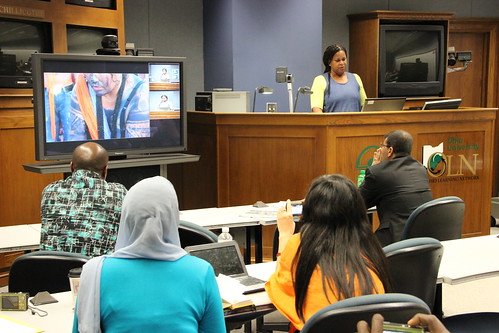
On Thursday, July 12, the fourth International Mass Media summer course was held in Copeland Hall at the Ohio University campus. During each class, two SUSI scholars give a lecture about their own country’s media systems, journalism practices and political cultures. All of the lectures are streamed live through Ohio University distance learning and are available online to 35 students who are taking a summer class instructed by Dr. Brook Beshah.

The SUSI summer institute — in which scholars from all over the world come to the E.W. Scripps School of Journalism at OU to study journalism and media — is funded by an annual renewable grant from the U.S. Department of State’s Study of the U.S. Branch in the Office of Academic Exchange Programs.

Dr. Murad Abdullah
Yemen


To kick off his presentation, Dr. Murad Abdullah, the scholar from Yemen, began with an overview of the Yemeni political structure.

Abdullah explained that about 16 months ago, just one man — who claimed the government was a republic — essentially ruled Yemen. During that time, Abdullah explained that news was predictable — there was no criticism of basic government policy, except for complaints about lower-level government employees.

However, in 2011, the Yemeni Revolution ultimately brought a new leader into power. In Yemen today, Abdullah explained that there are five main types of media: government-controlled, party-affiliated, international, independent and social.

The government-controlled media includes two TV channels and several radio channels, as well as some print outlets. Today, the press is used primarily as a tool of political mobilization of the public.

There are several different party-affiliated media, which are run and sponsored by political parties. Abdullah explained that those media typically target the ruling regime with heavy criticism. They publish issues directly concerning their members, and often neglect human rights issues. However, Abdullah said that party-affiliated media did play a positive role throughout the Yemeni Revolution.

Independent media in Yemen is complicated. Though there are many different TV and radio channels, Abdullah said they are often aired from elsewhere, such as London or Egypt. That is changing as the constitution, reviewed by the new government, now allows more freedom.


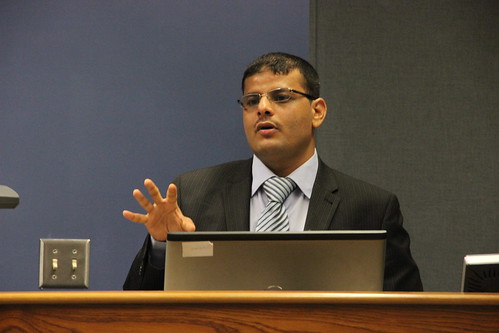
SUSI scholar Dr. Murad Abdullah presents a lecture that is streamed live through OU distance learning, and is available online.

Abdullah explained that there are also independent newspapers, but though professional journalists run them, parties are sometimes behind them. Such papers often tackle only certain issues and help certain parties.

Finally, there are truly independent media, which Abdullah said are preferred by the public. However, he explained that because many journalists do not know much about business management, such media often close down. Additionally, there is not always a lot of fact checking, which can lead to coverage of false information.

During the Yemeni Revolution, Abdullah said that social media were active and vibrant. Though social media did not cause the revolution, he said they did help it continue. Regardless, Abdullah pointed out that users of social media are still a minority in Yemen, and that social media can also have credibility issues.

Ultimately, Abdullah is not optimistic about the future of independent media, but is optimistic about that of governmental media. He said he believes that the latter have truly divorced from the past regime and no longer want to be the tool of a ruler. He also explained that Yemen’s new president seems genuinely willing to bring about change.

Although he prepared for his presentation one day prior to it, Abdullah said he had gathered the information for it while he was still in Yemen. For him, it was not difficult to present in front of his colleagues. However, he did mention some challenges.

“What is special about the event is that it is a new environment and a new audience,” he said. “I had the challenges of deciding how to make the information focused and concentrated to the media in Yemen, and how to give information that the audience would understand easily, as they don’t have background about the country of Yemen.”

Prof. Rachael van der Kooye
Suriname


Scholar Rachael van der Kooye, from Suriname, began her presentation with an introduction of herself, as well as an overview of her country. She explained that Suriname has a very culturally diverse population and that, for the most part, the different groups live in peace with one another.

She said that, in the past, a violent and unfriendly media culture existed in Suriname. However, that culture mostly disappeared after a nearly five-year-long civil war ended in 1992.

Suriname is a republic in which presidents are elected to five-year terms. However, the current president, Desi Bouterse, is controversial and has been accused of killing political opponents.

As far as Suriname’s media is concerned, van der Kooye explained that several TV stations, radio channels, newspapers, magazines and Internet news sites exist, and are owned by a mixture of the government, private groups and political parties.

In Suriname, multiple governmental ministries are responsible for media regulation, which includes granting licenses, dealing with legal matters and property rights, and more.

Despite the regulation, van der Kooye said that journalism suffers from many different things. Media owners rarely pay attention to quality; unprofessional conduct and propaganda are frequent; there is a lack of ethical principles, journalistic training and investigative journalism, and journalists are usually overworked and underpaid.


SUSI scholars and staff listen as scholar Rachael van der Kooye presents a lecture that is streamed live through OU distance learning, and is available online.

Additionally, the history of human rights violations in Suriname caused many journalists to be murdered or imprisoned, or to flee the country, according to van der Kooye.

Because media have been discovered as a way to gain power, influence and money, there has been an explosion of media within the past five years.

Often, journalists are politically affiliated, which disrupts objectivity and independence, according to van der Kooye. Many journalists limit themselves by simply copying press releases and by asking few or no critical questions. That occurs because those who ask critical questions can receive threats.

Suriname’s current government cultivates an image of fear not only through threats, but also through intimidation and boycotting media, van der Kooye said. Journalists are also limited in that the government does not openly provide information to them.

Ultimately, although press freedom is a constitutional law in Suriname, the majority of media operate under a system of self-censorship.

At the end of her presentation, van der Kooye warned that journalists in her country and others should remember that politicians often do not like journalists themselves, but rather the influence that journalists have.

“I don’t want to be a politician to change things, I want to be a teacher,” she said, bringing about applause from the audience.