Showing posts with label Jordan. Show all posts

Wednesday, December 5, 2012

November Uprising: Jordanian’s call for reform

By: Gina Mussio
Produced and edited by: Molly Nocheck

The Arab Spring has largely steered clear of Jordan, a US ally and relatively stable country. After recent protests, however, all that has changed.

Thousands crowded the streets across the country protesting the sharp increase in gas and fuel prices announced by Prime Minister Abdullah Ensour.

“People were there shouting and cursing the government and demanding they rescind the decision,” said Ahmad Tawalbeh, a chemical engineering major at the Jordan University of Science and Technology. “I went with my friend to protest because like a lot of Jordanian citizens I don't agree with the decision and I see it’s unfair for us.”

Jordan’s neighbors in the Middle East have seen their fair share of uprisings and demonstrations as well, starting in late 2010 with the Tunisia Revolution, and reaching its height spring of last year when thousands of Egyptians protested and called for the resignation of former Egyptian President Hosni Mubarak. Since then, rulers have been forced from power in Libya and Yemen and civil uprisings have erupted in Bahrain and Syria.

Jordan too has seen its fair share of protests, over 2,000 in the past two years, but nearly all have been peaceful, with cooperation between both the citizens and the police. Now, however, demonstrations have turned violent. Protesters have been sprayed with water and tear gas, police hit with rocks and two people have been reported killed.

After hearing about the protests, Naseer Alomari, a Jordanian-American principal in Westchester County and online advocate for Middle Eastern democracy, called his family in Jordan to make sure everything was okay. A large demonstration was taking place in Irbid, the city closest to his hometown, and he hoped his family could keep him updated.

His 24-year-old niece, Rawan, explained the situation to him via Skype – the tenseness, the discontent among people throughout Jordan and the conversations happening among friends and neighbors. Alomari’s brother was also in the room, simultaneously calling friends to learn what was going on in the streets below.

It was then that he received a phone call from another relative, telling him that his and Alomari’s cousin had been shot in the chest. Qais Al Omari, 27, was the first killed during the protests on Wednesday, Nov. 14 in downtown Irbid.

Qais' Coffin. Credit:  Naseer Alomar
“It’s still mind boggling that this would happen,” Alomari said. “He didn’t get to the hospital – Qais did not even make it to the hospital. He passed away.”

The village was traditionally supportive of the government, after this, however, the support of the people eroded. Demonstrators burned down the municipality building, as well as several vehicles belonging to the municipality.

“It was amazing that the first person to fall was in that small town where the king has a lot of support – or used to have,” Alomari said.

There is no doubt that Jordanians are angry. Unemployment in the cash-strapped nation is at 12 percent, with the highest rate, 27.2 percent, among young people between 20-24 years. In fact, similar to Egypt and Tunisia, its predecessors in protest, the youth are largely responsible for organizing protests and spurring conversation online and on the ground.

“My cousin, he has been looking for a job ever since I’ve known him. He’s 27 years old and he’s never held a decent job. When he died yesterday he didn’t have a job,” Alomari said. “People are afraid that they are not going to be able to support their families.”

The protests continued for days, with citizens chanting anti-regime slogans, calling the king a gambler in reference to his accused corruption, and supporting the downfall of the regime.

“I think most Jordanians have lost optimism,” said Zaid Samkari, a 24-year-old medical student and democracy activist in Jordan. “People are really frustrated and they are really angry. We are not seeing any serious measures taking place. The only thing we’re seeing is the government asking us to pay the price.”

Samkari, a member of the youth Herak movement, did not participate in the most recent protests because he doesn’t support their call for the downfall of the regime, but his discontent is palpable. The people’s demands are legitimate, he said, they want to elect a government, a parliament that represents Jordanians, to get through the economic crises and end government corruption. He acknowledged that this will not come easily.

“I’m really scared that things might develop like it has in many other Arab countries,” Samkari said. “Honestly speaking, most Jordanians don’t want that. We want the regime to be wise enough to make true reform without any bloodshed.”

The U.S.-backed Jordanian government has often issued government subsidies to placate the people, this time though, the cash ran out. The state attempted to institute austerity measures, such as the fuel price increase, to reduce a growing budget deficit and decrease public spending.

The protests have continued despite the violence, roadblocks set up by the police and hundreds jailed. Tawalbeh went to protest again after Friday prayer, Nov 16, taking video and continuing to support other citizens and friends on the streets.

Though none have said they believe the protests can be labeled a “revolution” yet, all acknowledge that Jordan is in uncharted waters and that the people are not going to give up their requests for reform.

“We are looking for a better future; We are looking for corrupts to be jailed; We want a democratic government that are elected by the people not appointed; We want a better future for the next generations,” Samkari said.

Thursday, October 25, 2012

As Winter Looms, Prepartions Begin for Syrians

By: Gina Mussio
Produced & edited by: Molly Nocheck

As Syrian refugees continue to pour in to Jordan, both governments and non-governmental organizations attention is turned toward the oncoming winter, and the preparations necessary to help thousands survive the change of season.

Hot summers, cold winters and minimal rainfalls characterize the climate in northern Jordan, with the coldest part of the year falling between mid-November and mid-March.

For those Syrians living in Za’atari Refugee camp in the northern city of Mafraq, battling the elements is already well known, as the camp is located in the middle of the desert.

“You stay there five minutes and you are full of dust. It gets everywhere, in your nose, in your ears, everywhere,” said Marta Triggiano, project coordinator for Un Ponte Per, a partner organization of the Jordanian Women’s Union. “It’s super hot in summer, and it will be super cold in winter and this is the biggest problem.”

Jordan, a strategic American ally in the region, was also one of the first Arab countries to call for Syria’s President Bashar Al-Assad’s resignation. However, with more and more refugees pouring in to the country, the strains on the country are beginning to show.

“The problem is the location, the problem is the Syrians are angry,” said Triggiano. “The people are already psychologically unstable and this situation stresses them.”

In fact, protests and clashes in the Za’atari camp prompted the United Nations High Commissioner for Refugees (UNHCR) to evacuate partner NGOs, such as the Jordan Health Aid Society (JHAS), whose team was evacuated to the entrance of the camp.

Tear gas affected three of the JHAS staff, but none were ever attacked or hurt by Syrian refugees, said Yaroup Ajlouni, president of JHAS.

“The more difficult situation is that winter is coming,” Ajlouni said, “This is a very difficult climate in the desert – cold mainly. “I think the (current) diseases will be more prevalent.”

Ajlouni expects that upper respiratory flu and gastroenteritis, sickness common among the refugees now, will rise exponentially come winter. He also cited flu vaccinations and a stronger focus on malnutrition as upcoming pushes to prepare for the winter.

Despite the difficult security situation and harsh conditions in the camp, the number of refugees living in camps is predicted to reach 150,000 people by the end of 2012, according to a recent report from UNHCR, a factor to consider when ordering supplies for winter.

Courtesy of Data Analysis Group for UNHCR.  Academic Fair Use
The winter season starts early December but UNHCR has already begun preparing. The NRC Rapid Response Team (RRT) issued a winterization report recommending the distribution of winter clothing and blankets, the addition of a fire resistant porch to the tents in the camp and a supply of family heating and fuel.

In addition, to avoid the possibility of further disputes among the Syrian refugees, UNHCR considers an early information campaign explaining what to expect this winter of “utmost importance.”

One current problem that might be alleviated by the change of season is water.

The variation between summer and winter is considerable. With the drop in temperatures often comes a drop in water consumption, leading to a minimal use of water, explained Mottaz Obaidat, representative of Yarmouk Water Company.

In fact, the average rainfall in Mafraq during the winter season is about 1.8 inches, one of the lowest in Jordan. As such, there is not a considerable risk of flooding in the camp and simple drainage ditches are all the RRT suggests are necessary.

Outside of the camp, an estimated 50,000 Syrians came to Jordan looking for a safe place to live. The majority of Syrians who came to Jordan before Za’atari was established came to stay with relatives or friends and live in urban areas.

The basic needs of these ‘urban refugees’ is money to cover the cost of living, food and other various demands of life, said Ahmed Albzayah, representative of the All Jordan Youth Commission.

After months of displacement, the Syrian refugees rely almost totally on charity aid for their survival. Those refugees who were able to find jobs – most commonly in construction, maintenance, sales or agriculture – cannot obtain a work permit and so are often exploited and underpaid.

For them, the winter could potentially mean a decrease in work, among other concerns.
“The situation of the urban refugees is much more difficult in some ways than the camp people because they are really on their own they don’t have much support at all,” said Kevin Fitzcharles, CARE country director of Jordan.

The support they do have primarily comes from organizations such as CARE who often offer basic care and support, however, this is only if the NGOs can find the refugees and vice versa.

“The big thing on everybody’s mind is how these people are going to cope in the winter,” Fitzcharles said.

Friday, July 13, 2012

International Mass Media: July 9

By Lindsay Boyle

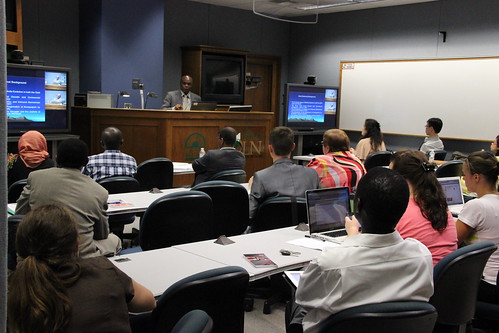
On Monday, July 9, the first International Mass Media summer course was held in Copeland Hall at the Ohio University campus. During each class, two SUSI scholars give a lecture about their own country’s media systems, journalism practices and political cultures. All of the lectures are streamed live through Ohio University distance learning and are available online to 35 students who are taking a summer class instructed by Dr. Brook Beshah.

The SUSI summer institute — in which scholars from all over the world come to the E.W. Scripps School of Journalism at OU to study journalism and media — is funded by an annual renewable grant from the U.S. Department of State’s Study of the U.S. Branch in the Office of Academic Exchange Programs.

Dr. Wilberforce Dzisah
Ghana


Dr. Wilberforce Dzisah began his presentation with a brief history of media in Ghana. He emphasized the struggles of newspapers and other media outlets through the many dictatorships and totalitarian regimes that existed in Ghana between 1957 — when it gained independence — and 1992.

In Ghana today, however, Dzisah explained that media often lean liberal or even socialist. He said that it is not unusual for media stories — especially those of private media — to criticize governmental actions. Ghana’s constitution, unlike the constitutions of some other African countries, allows freedom of the press and prohibits censorship.

A regulatory body called the National Communications Authority is responsible for granting licenses, authorizing operations and establishing and monitoring the quality of media services in Ghana.


SUSI scholars and staff listen as Dr. Wilberforce Dzisah presents a lecture that is streamed live through OU distance learning, and is available online.

According to Dzisah, some media outlets in Ghana are state-owned, while others have private ownership. He explained that, until 2000, those that were state-owned were the biggest threat to journalistic freedom, because an existing criminal libel law allowed politicians to frequently raise lawsuits against journalists.

In 2000, however, new leadership repealed that law. Dzisah said that the responsibility of media in Ghana has now mostly shifted toward ensuring democratic accountability and responsibility. Dzisah explained that Ghana’s political system is called a parliamentary democracy.

In Ghana, there are about 100 newspapers in circulation, and radio is still a very prominent medium. Though the Internet is not yet a primary method for obtaining news in Ghana, Dzisah said that the amount of people in Ghana who are joining the online world is increasing.

Dr. Aysha Abughazzi
Jordan


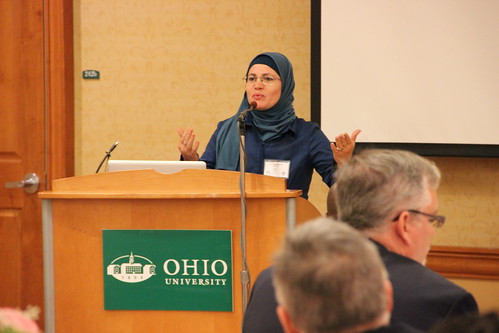
In scholar Dr. Aysha Abughazzi’s overview of Jordan, she explained that it became independent in 1946 and is currently under a constitutional monarchy.

Abughazzi went on to explain the different types of media in Jordan, which include news agencies, broadcast stations, public television and several kinds of printed publications. She said that media in Jordan can be either publicly or privately owned.

Jordanians, however, are less likely to rely on TV and radio than on printed publications, according to Abughazzi. That is because the government sometimes monitors TV and radio groups, such as the Jordan Radio and Television Corporation, quite closely.

Jordan’s first newspaper launched in 1936 and was printed in Palestine. Abughazzi said that, today, daily newspapers are the most trusted by Jordanians, followed by weekly papers, then online publications. Because a censorship of sorts — self-censorship by journalists — exists in Jordan, Abughazzi explained that people there are likely to read both state and private papers in order to obtain news.


Dr. Aysha Abughazzi gives a vote of thanks speech at the SUSI Welcome Dinner.

In 1997, one of the strictest publication laws in Jordan's history allowed the government to jail journalists if it did not approve of what they wrote. However, that law was outlawed within a few years of its endorsement. Regardless, many journalists still practice self-censorship concerning topics sensitive to Jordanian ethics or morals, or to the king, for fear of governmental threats of fines, detention or otherwise.

Despite such infringements on the freedom of the press, Jordan’s high literacy rate and high level of technological connectivity allow its citizens to have several sources of information. Many events are covered, and social media often play a role in what those events are.

So far, Abughazzi said she has enjoyed everyone's International Mass Media class presentations, because she has been learning about things she may not have otherwise learned.

“I thought that their presentations were enlightening,” she said of fellow SUSI scholars. “The fact is that sometimes you have certain stereotypes, you’re an outsider, you don’t know how things go on, but now you have somebody to disillusion those ideas.”