Showing posts with label News Coverage. Show all posts

Saturday, January 31, 2009

Comparing Local and International Coverage of Obama Inauguration

A Nation Reborn... Australian Coverage

Edited by Sally A. Cruikshank
Author: Ellen Schnier

Photo courtesy of WAToday
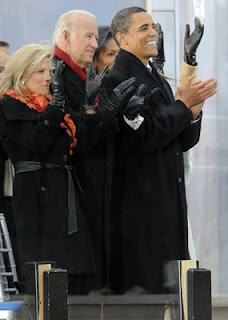
Aretha Franklin sang 'Our Country 'Tis of Thee' just before President Barack Obama was sworn in and delivered his inaugural speech. Michael D. Shear and Anne E. Kornblut of the Washington Post included this in their article, 'A Historic Inauguration Draws Throngs to the Mall.' Geoff Elliot, Washington Correspondent for The Australian, in 'A Nation Reborn Under President Bush,' left out such details as this and that Mr. Obama used the same Bible Abraham Lincoln used for his first inauguration.


While, of course, Americans are more interested in the details of an event happening in their own country, the Australian journalist spoke more about U.S. military involvement in Iraq and Afghanistan and what General Petraeus was doing during the inauguration.This is only to say that there was an overwhelming and palpable feeling of hope and a sense of history taking place that was felt by Americans on Tuesday and seeped into the Washington Post article. Shear and Kornblut, in introducing the tone on the National Mall in Washington, said the event 'took place among a building air of anticipation' for an inauguration with 'record-breaking attendance.'

President Obama 'looked out at a sea of admirers' while giving his speech, 'chanting his name and straining for a glimpse of the new president.' Elliott, on the other hand, began his article mentioning that one of the new president's first acts would be to stop legal proceedings at Guantanamo Bay. Caught up in the grandness of the day, the American journalists began by saying Mr. Obama has the task of 'reviving a country in crisis.' The words 'hope' and 'change' are used throughout the article.Geoff Elliott said of the president's address, 'The speech was a fairly dour effort for a renowned orator' and reported its 'subdued tone.' While Shear and Kornblut agreed about the 'somber tone,' they called his speech notable for its 'soaring rhetoric.'
Beyond such differences (that can be attributed mainly to the fog of euphoria that seemed to join Americans for a day), much of the commentary overlaps. Both mentioned near the beginning of their articles the economic hardships the country faces and quoted Mr. Obama, 'We must pick ourselves up, dust ourselves off and begin again the work of remaking America.'Both articles also mentioned the president's discussion of foreign affairs with both ally nations and enemies. 'America is a friend to each nation and every man, woman and child who seeks a future of peace and dignity, and that we are ready to lead once more.'
The Australian, offering an international perspective to his comment, added, 'He sent a message to the rest of the world, and Islamic nations, after eight years in which US ties with some of its top allies have frayed, especially after the war in Iraq.' (This certainly speaks to a renewed interest both the new president and other foreign leaders have in moving forward.) Mr. Obama continued, 'To the Muslim world, we seek a new way forward' and announced to terrorists, 'We say to you now that our spirit is stronger and cannot be broken; you cannot outlast us, and we will defeat you.' A message of strength to our enemies in war, both articles included his vow.Aside from quoting similar parts of Mr. Obama's address, both articles mentioned that on Wall Street, stocks took a tumble throughout the day, signaling even greater economic demise.

Very little was mentioned about President Obama's race in The Australian and in fact never mentions the fact that he is the first African-American president. Elliott simply mentions his 'improbable tilt for the presidency' and said he 'touched only briefly on the triumph he shares with African-Americans.' While theWashington Post would agree that Mr. Obama 'made only glancing references to the racial barrier that had fallen with his historic ascent,' Shear and Kornblut did not downplay its significance. 'His voice echoing across the Mall, where Rev. Martin Luther King, Jr. addressed the 1963 march on Washington, Obama saluted the progress the nation has made in healing racial division.' They mentioned his reference to slavery, how ancestors 'endured the lash of the whip and plowed the hard earth' and hailed 'our patchwork history.' It is evident that even if the new president did not bring his race to the forefront of his speech, the rest of the nation did.
Lastly, it is interesting to note that George W. Bush, upon being relieved of his duties and boarding a plane to Texas, received 'plenty of jeers from a crowd eager to see a new chapter in the U.S. story (from The Australian). 'Some of the crowd booed at the sight of Bush,' the Washington Post relayed, "who left office as one of the least popular presidents in U.S. history." Some things are too obvious to go unnoticed..."

Comparing Local and International Coverage of President Obama's Inauguration

Power of People... German Coverage

Edited by Sally A. Cruikshank
Author: Stine Eckert

Capturing the moment, saving it for the next generation - this seemed to be the purpose of German newspapers on January, 21st.. But it was not Obama, foreign correspondent Matthias Rüb (Frankfurter Allgemeine Zeitung) was focusing on - it was the American people. He observed and described a moment, where people stood together, sharing a moment everyone was waiting for. The correspondent experienced a united America, where citizens, whether they were Black, Hispanic, Asian or Caucasian, looked up to and believed in the words of one man. Matthias Rüb witnessed a day, where the American people re-gained their pride, and he shared this day with the German people. Also the New York Times appreciated the sea of flags and red, white and blue between the Lincoln Memorial and the Capitol. 'Beyond the politics of the occasion, the sight of a black man climbing the highest peak electrified people across racial, generational and partisan lines,' the paper wrote. And this new hope is needed, to solve all the current and upcoming problems. Two wars, an economic crisis, terrorism, lost jobs and health care are only a few challenges the newspaper lists.

Photo courtesy of CreativeSoulPhoto
"Capturing the moment, saving it for the next generation - this seemed to be the purpose of German newspapers on January, 21st.. But it was not Obama, foreign correspondent Matthias Rüb (Frankfurter Allgemeine Zeitung) was focusing on - it was the American people. He observed and described a moment, where people stood together, sharing a moment everyone was waiting for. The correspondent experienced a united America, where citizens, whether they were Black, Hispanic, Asian or Caucasian, looked up to and believed in the words of one man. Matthias Rüb witnessed a day, where the American people re-gained their pride, and he shared this day with the German people. Also the New York Times appreciated the sea of flags and red, white and blue between the Lincoln Memorial and the Capitol. 'Beyond the politics of the occasion, the sight of a black man climbing the highest peak electrified people across racial, generational and partisan lines,' the paper wrote. And this new hope is needed, to solve all the current and upcoming problems. Two wars, an economic crisis, terrorism, lost jobs and health care are only a few challenges the newspaper lists.

In contrast to that, the Frankfurter Allgemeine Zeitung focuses on the overall goals of Obama's politics: hope over fear, and unity over conflicts. Detailed challenges, or overall goals - The newspapers from the two continents seem to agree. There are problems to face in the next couple of months and years. But a President that has and values the support of the people is a step in the right direction.On January, 21st, German and U.S. newspapers had the same opinion. It was a glorious day, that was a result from the power of people." --Carolin Biebrach"On both sides of the Atlantic, journalists tried to get an overall feel for Obama’s tone during his inaugural speech; German and US journalists covered the event rather homogeneously.German foreign correspondent Gregor Peter Schmitz in Washington who was reporting for one of the major political publications in German, weekly Spiegel magazine, dubbed Obama the 'new national chief psychologist' for his motivational spirit; CNN gave Obama a thumbs up for 'the right speech for the times.' Whereas the Spiegel article was titled 'Obama proclaims his American dream,' the analysis of his inaugural speech by Nancy Gibbs of Time magazine was more specific and somber: 'Humility, Gratitude, Sacrifice.' She concluded her story taking the perspective of the audience who looked up at 'a man in the very far distance accept[ing] the full weight of their hopes.'

Hope over fear was just one topic that German and U.S. journalists addressed. Both also emphasized Obama’s willingness to face what ails the United States openly, his call for duty and sacrifice. Another German foreign correspondent Oskar Piegsa of weekly newspaper Zeit, another major political publication in Germany, gave examples of people in tears due to the historical meaning of the moment, pointing out Obama’s background. A theme that came up with every U.S. media I read. Piesga also likened the event to public viewing for a major soccer game with everyone on the same page, booing Bush and obsessing about Obama, a big game easy enough to play for everyone. Interestingly, the Spiegel article reported about Obama’s emphasis on a new and more appreciated position for science and his mentioning of wind and solar energy whereas environmental issues where absent in the U.S. coverage I followed on NPR, CNN, and Time.

The mirroring of topics was reflected in a number of same quotes: In their assessment of Obama’s inaugural speech, Spiegel as well as CNN referenced John F. Kennedy in 1961: 'Ask not what your country can do for you. Ask what you can do for your country.' Both publications quoted the America-as-a-friend line, his acknowledgment of a nation not only at war, and in an economic crisis but also the 'nagging fear that America's decline is inevitable and that the next generation must lower its sights.' In this transatlantic homogeneous mixture of hope and fear only one sentence struck me more than the rest, provided by Nancy Gibbs of Time Magazine: "You could almost pity the pundits as they groped for extravagant new ways to say what didn't need to be said in the first place.

Comparing Inauguration Coverage: IRELAND and CHINA

Overcome with Emotions...
Irish Coverage

Edited by Sally A. Cruikshank
Author: Aerin Curtis

Photo courtesy: CreativeSoulPhoto
"The main differences I have found between the in-state coverage and the foreign coverage of the inauguration, and the events surrounding it, are in tone and focus. The international papers and web sites focus on the emotional aspect of the event – the on-site Irish Times reporter, Kathy Sheridan, referenced individual people crying (happily) five separate times in an article that ran less than two pages. Whereas, similar domestic articles by the New York Times reporter Carl Hulse offered a serious tone and few descriptions of the crowd other than 'festive' or 'cheering,' while remaining focused on both the time line and the specific events.

The articles written by foreign papers often discussed the effect that the change in leadership would have on their particular country, thus localizing the event, before examining the emotional depth of response in their own country and the U.S. However, they almost uniformly raised the issue of racism and the progress that Obama’s election marked.

In comparison, Hulse’s coverage was much more sober. It began with a comment and quotation on the economy before bringing in an emotional tone. Then it quickly returned to the somber themes of racism, President Lincoln, and America’s problems which are 'serious' and 'many.'
Hulse’s article also quoted mostly from Obama’s speech and political celebrities like Colin Powell. Conversely, though Sheridan’s article, and other foreign coverage, also quoted the speech, it gathered reactions from the crowd rather than other politicians.

Overall, I think the difference between the national and foreign coverage of Obama’s election comes down to perception. The media from other countries are hopeful about what this new president means since many of them did not like our last one. However, the domestic media have suddenly remembered their job is to criticize and critique the President and his policy - a job they did not always perform adequately under Bush. Now that Obama has taken office they are damping down their enthusiasm until he proves himself."

Analyzing History... Chinese Coverage

Author: Yilei Cheng

"By reading the U.S. media coverage on Obama's inauguration, I can feel the proud and enthusiasm of American through out the country. Leading media in each state and major city sent their reporters to Washington D.C. to cover the grand, historical event. Their reporters did a good job in finding interesting characters from hometown regions and telling their personal experiential stories of the excitement in the "once in a lifetime moment". Their reports appeal to their readers emotionally with personal stories. At the same time, the stories also reflect the local relevance that their readers concern, such as rights for black people, financial policy, oversea wars, etc...

Compared to the emotional appealing reports by the U.S. media, Chinese media coverage on Obama's inauguration are more rational and analytical. The correspondents appointed by Chinese media play not only the reporter's role, but also the expert of international business and politics. Their reports emphasized more on the facts of the event, and the economic and diplomatic parts of Obama's speech. A few individual experience stories took a supporting part of all the coverage on the Inauguration, definitely not the spotlight part.
Chinese readers care more about how this new U.S. president will influence their lives. Chinese media highlighted the relevant statements in Obama's speech and also provided critical analysis on the possible future situation. The mainstream ideas consider the new U.S. president Obama as "a pragmatist on economic policy" and "a center on diplomatic policy". They stated strong arguments to discuss if Obama can deliver his promises and fulfill the hope from American people.

For example, Yang Qingchuan, the D.C. correspondent of Reference News, a Chinese newspaper with the biggest daily circulation (3 millions) in China, published a feature-length article providing analysis on Obama's speech: Whether or not Obama's inauguration speech could become a classic one?"

Comparing International Coverage of Obama's Inauguration

A Close Relationship... Canadian Coverage

Edited by Sally A. Cruikshank
Author: Cristina Mutchler

The presidential inauguration of Barack Obama had different meanings for different people, regions and countries. Inauguration day have been interpreted in many ways by journalists and people worldwide, and analyzing two countries’ coverage helps portray what is important or interesting to those countries and may reveal something about their relationship with the U.S.

Because Canada is one of our close neighbors, I chose to look at an article from the Vancouver Sun written by correspondent Sheldon Alberts, 'New Era of Hope Begins in America as Obama sworn in as 44th President.' The New York Times is so renowned and had an extensive collection of inauguration coverage to choose from that I decided to read an article written by reporter Carl Huse, 'Obama is Sworn in as the 44th President."


Photo courtesy of CreativeSoulPhoto

I was somewhat surprised to find many similarities with the two articles. Both focused on the historic aspect of this inauguration, the importance of this inauguration for the American people, and economy as one of Barack Obama’s main focuses for the future. It is evident that the economic panic, which polls indicate was the most important issue for 63% of voters, still plays a significant role for both countries' coverage (Foreign Affairs and the 2008 Election, Robert P. Saldin, p. 12). Quoting the inaugural address was also obviously an integral part of coverage for both countires. I found that the two articles used a few of the same quotes from the inaugural address; for example, 'Starting today, we must pick ourselves up, dust ourselves off, and begin again the work of remaking America.' The quotes from the inaugural speech used in both of the articles were significant and profound, and the selection that each reporter chose added emphasis to their focal points in the story.


The New York Times piece used and emphasized the 'change' that Obama’s presidency represented, something that was also an integral part of his presidential campaign message. Change was not, however, a huge topic in the Vancouver Sun article. The New York Times also highlighted the cheering crowds of American people that were present at this address; the Canadian article did not focus so much on this aspect. Bill Clinton was also a significant point of the article, as the New York Times quoted former President Bill Clinton’s remarks about the speech. This was not evident in the Canadian article.

Not so surprisingly, race was brought up as a point in both of the articles. What was so interesting was that the Vancouver Sun mentioned race within the first few sentences, but did not elaborate on that racial reference for the rest of the article. The New York Times reporter chose not to mention race until after the first two paragraphs, but referenced race a few more times, commenting on the prevalence of African Americans in the inaugural crowd and the symbolism of the proximity to the Martin Luther King, Jr. holiday.

What set the Vancouver Sun article apart from several of the other local reports that I read was its mention of America’s relationship with Canada, for obvious reasons. Included was a quote from Obama’s speech that gave a message for those beyond America’s borders. Most interesting were the quotes from Canadian Prime Minster Stephen Harper and Gov. Gen. Michaelle Jean, who offered their best regards to the new U.S. president. The government officials were 'thrilled' that Obama will soon be in Canada for his first official visit, and referred to the U.S.’s relationship with Canada. 'The United States remains Canada’s most important ally, closest friend and largest trading partner and I look forward to working with President Obama and his administration as we build on this special relationship,' said Prime Minster Harper.

Also unique to the Vancouver Sun article was a focus on the personal milestones that Obama has marked throughout his political career. The reporter chose to recap Obama’s political journey from an Illinois state senator to a Democratic presidential nominee and finally, as the 44th president of the United States. Interesting to me is that this historical outlook on Obama’s career was absent in the New York Times article, as well as in other domestic reports that I have read.
Because Canada is such a close neighbor, perhaps Americans often times do not necessarily consider this alliance as a 'foreign' relationship. But nonetheless, foreign affairs still played a huge role in the 2008 election, and coverage of the inauguration may show us just how important that role was. Many of the points in the Canadian article were similar to those in the coverage by a U.S. reporter.

However, the additional four or so paragraphs regarding our relationship with Canada made it evident that this is an important factor most likely of interest to Canadian readers. Foreign affairs and our relationship with other countries played a large role in the U.S. election, as well. The racial barrier was not mentioned more than once in the Vancouver Sun article; perhaps this isn’t as important an issue for Canadians because of the eclectic mix of diversity there. But the historical significance of this inauguration, the meaning for American people, and the hopefulness to overcome the economic crisis remained the prominent issues in both articles, revealing that perhaps country borders are not indicative of the true importance of this inauguration to people of different nationalities and backgrounds. "